
درجات التيتانيوم لأواني الطهي: الدليل الهندسي النهائي TA1 مقابل TA2 (ASTM B265)
Executive Summary: Material Selection Drives Yield Rate
In OEM cookware programs, specifying generic “titanium” obscures critical differences in mechanical behavior. The choice between Grade 1 (TA1) و Grade 2 (TA2) directly impacts manufacturing yield, tooling lifespan, and total unit cost.
While Grade 2 offers a lower raw material cost, Grade 1 is the superior specification for deep-drawn vessels (mugs, pots) due to its high elongation and low spring-back. This guide analyzes both alloys under the ASTM B265 standard to assist engineering teams in optimizing the Bill of Materials (BOM).
For product designers, titanium is often treated as a monolith. However, commercially pure (CP) titanium grades vary significantly in their interstitial chemistry. This variation dictates whether a production run results in premium cookware or a 20% scrap rate due to stress cracking.
1. Chemical Composition Under ASTM B265
Titanium grades are classified not by their titanium content, but by their impurities—specifically Oxygen (O) و Iron (Fe). These are not “contaminants” but alloying elements that control strength.

The “Interstitial Strengthening” Effect
Oxygen acts as an interstitial strengthener in the titanium crystal lattice.
The Rule of Thumb: Higher Oxygen = Higher Strength = Lower Ductility.
| Element (Max %) | Grade 1 (TA1) | Grade 2 (TA2) | Engineering Impact |
|---|---|---|---|
| Nitrogen (N) | 0.03 | 0.03 | Hardening agent; kept low to prevent brittleness. |
| Carbon (C) | 0.08 | 0.08 | Kept low to ensure weldability. |
| Iron (Fe) | 0.20 | 0.30 | Higher Iron increases strength but slightly reduces corrosion resistance. |
| Oxygen (O) | 0.18 | 0.25 | The Critical Differentiator. Grade 2 has ~40% more oxygen, making it significantly harder. |
| Titanium (Ti) | Balance | Balance | Base matrix. |
2. Mechanical Properties & Manufacturing Outcomes
Chemical differences translate directly into mechanical performance on the factory floor. The following data represents typical annealed properties required for successful forming.
| ملكية | Grade 1 (TA1) | Grade 2 (TA2) | Manufacturing Implication |
|---|---|---|---|
| Yield Strength (0.2% Offset) | 170 MPa (Min) | 275 MPa (Min) | Grade 1 requires less force to deform, reducing press tonnage requirements. |
| قوة الشد | 240 MPa (Min) | 345 MPa (Min) | Grade 2 is structurally stronger but harder to work. |
| Elongation (%) | ≥ 24% | ≥ 20% | Critical for Deep Drawing. Grade 1’s higher elongation allows for deeper cups without tearing. |
| القابلية للتشكيل | ممتاز | Good / Moderate | Grade 2 is prone to “Orange Peel” surface defects in deep draws. |
Deep Drawing Analysis: Why TA1 Wins
For products like أكواب التيتانيوم أو زجاجات, the metal must be stretched significantly.
Spring-back Control: Titanium has a low modulus of elasticity (Young’s Modulus), leading to significant “spring-back” after stamping. Grade 1 (Softer) has less spring-back than Grade 2, ensuring tighter dimensional tolerances and easier assembly with lids.

3. The “Aerospace” Myth: Why Grade 5 (Ti-6Al-4V) Fails in Cookware
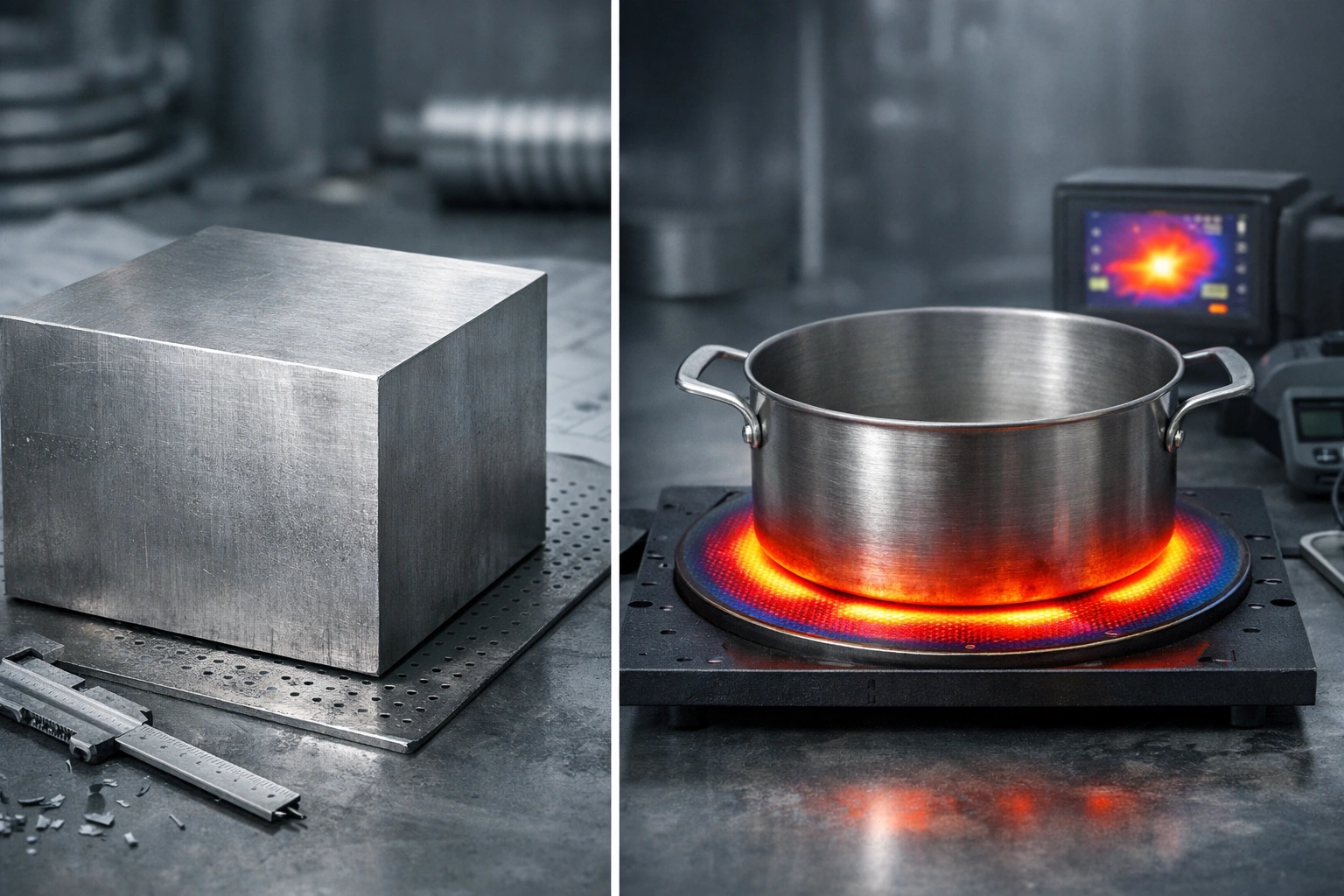
Marketing teams often request “Aerospace Grade 5” due to its name recognition. For cookware engineering, Grade 5 is objectively inferior to CP Grades.
-
1. Thermal Inefficiency
Grade 5 has a thermal conductivity of ~6.7 W/m·K, compared to ~16 W/m·K for Grade 1. This creates severe “hot spots,” causing food to burn immediately. -
2. Manufacturing Cost
Grade 5 cannot be cold-stamped effectively. It requires hot-forming or CNC machining from solid blocks, increasing unit costs by 300%–500%. -
3. Safety Margins
Grade 5 contains 6% Aluminum and 4% Vanadium. While stable, it lacks the absolute purity of Grade 1 for sensitive food-contact applications.
4. مصفوفة اختيار الدرجة حسب فئة المنتج
استخدم مصفوفة القرار هذه لمواءمة خريطة طريق منتجك مع مواصفات المواد الصحيحة.

| فئة المنتج | الدرجة الموصى بها | الأساس المنطقي | وصلة |
|---|---|---|---|
| أكواب مزدوجة الجدار | Grade 1 (TA1) | نسب التشكيل القصوى المطلوبة؛ سوف يتشقق الصف الثاني أثناء التوسع. | عرض الأكواب |
| أواني خفيفة (عميقة) | Grade 1 (TA1) | يسمح بمقياس جدار أرق (0.35 مم) لتوفير الوزن دون تمزق. | عرض الأواني |
| مقالي (سطحية) | Grade 2 (TA2) | يشكل عمق السحب الضحل مخاطرة منخفضة؛ يوفر الصف الثاني مقاومة أفضل للانبعاج. | عرض المقالي |
| أدوات المائدة والأدوات | Grade 2 (TA2) | يتطلب صلابة لمنع الانحناء تحت الحمل. | عرض أدوات المائدة |
5. تحليل التكلفة: المواد الخام مقابل التكلفة الإجمالية للملكية (TCO)
غالبًا ما يشير محللو التكلفة إلى الدرجة الأولى على أنها "باهظة الثمن" لأن سعر المواد الخام عادةً ما يكون كذلك أعلى بنسبة 5-10% من الدرجة الثانية. ومع ذلك، يعد هذا اقتصادًا زائفًا للأجزاء المسحوبة بعمق.
- ارتفاع معدل الخردة: توقع معدل رفض يتراوح بين 15-20% بسبب التصدع الإجهادي مقابل معدل الرفض. <2% for Grade 1.
- ارتداء الأدوات: تزيد الدرجة الثانية الأصعب من تآكل القالب وتسببه في التآكل، مما يتطلب تلميعًا وصيانة متكررة.
- دورات الصلب: قد تتطلب الدرجة الثانية خطوة إضافية للتليين بالفراغ لمنع التشقق، ومضاعفة تكاليف الطاقة.
الاستنتاج: بالنسبة للأشكال المعقدة، ينتج عن الدرجة الأولى تكلفة وحدة نهائية أقل على الرغم من ارتفاع سعر المادة.
6. بروتوكولات التحقق
Visual inspection cannot distinguish between titanium grades. To ensure your OEM partner is using the specified material, implement these checks:
- Review the MTC (Mill Test Certificate): Verify the “Heat Number” matches your production batch. Check the Oxygen content (≤0.18% for Gr1).
- Hardness Testing (Vickers): A quick non-destructive test. Grade 1 typically tests below 140-150 HV, while Grade 2 tests higher (160-200 HV).
- XRF Analysis: Handheld X-ray fluorescence can instantly detect the presence of Aluminum/Vanadium (indicating Grade 5) or confirm pure CP titanium profiles.
Conclusion: Specification is Strategy
In the competitive outdoor gear market, material selection is not just a technical detail—it is a strategic decision that defines your product’s durability and your project’s profitability.
For premium cookware requiring deep forming and lightweight performance, ASTM B265 Grade 1 (TA1) is the undisputed standard. For structural components and flatware, Grade 2 (TA2) provides the necessary rigidity.
Ready to optimize your BOM?
Contact our engineering team to review your drawings and recommend the ideal grade for your next mold.