
Titanium vs Stainless Steel: How Material Choice Impacts Your Supply Chain, Lead Times, and Total Cost
Why the real risk in “titanium vs stainless” isn’t just material properties—but whether your supply chain can deliver on your launch plan, MOQs, and margins.
On this page
Plan a realistic titanium rollout
Share your target launch window, volumes, and target channels. We’ll tell you honestly whether titanium fits—or if stainless is the safer first step for your brand.
Talk to our supply chain team →Typical project range: 500–5,000 units per SKU, OEM & private label for outdoor brands.

Three weeks before your spring product launch, your supplier sends the email every brand dreads: “Material sourcing delays. Production pushed to Q3.” Your retail partners are locked in, your marketing spend is committed, and your competitor just launched a lighter alternative.
This scenario plays out dozens of times each year in the outdoor gear industry, and it usually starts with the same root cause—misaligned material selection and supply chain planning. The titanium versus stainless steel decision isn’t just about weight specs and corrosion ratings. It’s about lead time windows, minimum order volumes, supplier concentration risk, and whether your production schedule can survive upstream volatility.
I’ve spent a decade at 7titanium.com managing OEM relationships for outdoor brands, and I’ve watched smart teams get burned by both materials—not because they chose the wrong one on paper, but because they didn’t match material properties to supply chain realities. A 45% weight reduction means nothing if you miss your launch window. A 3× cost premium can pay off if it unlocks a performance tier your competitor can’t match. The question isn’t “which material is better?” It’s “which material lets you execute your strategy?”
This article breaks down the titanium-stainless steel decision from a supply chain and total cost perspective. You’ll see actual lead time data, MOQ implications, cost structures, and decision frameworks—not just material datasheets. Whether you’re launching your first titanium product line or reconsidering an existing SKU, you’ll finish with a clearer view of when each material makes sense and how to de-risk whichever path you choose.
Material Properties: What the Data Actually Shows
Before we talk lead times and supplier networks, let’s establish the performance baseline. The properties that matter for outdoor gear aren’t academic—they directly affect your product positioning, warranty costs, and whether your customers notice the difference.
Weight and Density: The 45% Advantage
Titanium’s density sits at approximately 4.5 g/cm³, compared to stainless steel’s 8.0 g/cm³. That 45% weight reduction translates differently depending on your product category. For a 600 ml camping pot, you’re looking at roughly 95 grams for titanium versus 175 grams for stainless steel—a difference backpackers feel immediately. For tent stakes, that gap compounds across a set of eight or ten units.
But weight advantage has context. If you’re designing a 3-liter base camp cookset where stability matters more than pack weight, stainless steel’s heft becomes an asset, not a liability. The same applies to vehicle-based outdoor gear where transport weight is irrelevant.
Corrosion Resistance: When It Actually Matters
Titanium forms a passive oxide layer that resists saltwater, acidic foods, and most corrosive outdoor environments without additional surface treatment. Grade 2 titanium (the commercial pure grade most outdoor brands use) handles marine exposure, sweat salts, and acidic trail foods without pitting or staining.
Stainless steel’s corrosion story depends entirely on the grade. 304 stainless works fine for inland camping where chloride exposure is minimal. 316 stainless (the marine grade) handles saltwater and coastal environments reasonably well, though prolonged exposure to concentrated chlorides can still cause pitting over years of use. For brands targeting coastal markets, sailing, or sea kayaking, that performance gap matters. For mountain and desert use cases, 304 stainless holds up without issue.
The practical test: Can your warranty budget absorb corrosion claims from coastal users? If you’re positioning a premium product line and serving customers in Florida, California, or the Pacific Northwest where saltwater exposure is routine, titanium eliminates a failure mode. If your primary market is landlocked trail users, 304 stainless delivers adequate corrosion resistance at a fraction of the cost.
Strength-to-Weight Ratio: The Hidden Complexity
Titanium’s strength-to-weight ratio gets cited often, but the numbers need context. Grade 2 titanium (commercial pure) offers tensile strength around 345 MPa at 4.5 g/cm³. Grade 5 (Ti-6Al-4V, the aerospace alloy) jumps to approximately 900 MPa but costs significantly more and requires more complex processing. 304 stainless delivers roughly 505 MPa at 8.0 g/cm³, while 316 stainless sits around 515 MPa.
For thin-walled cookware where stiffness matters more than raw strength, titanium’s lower modulus of elasticity (about 110 GPa versus stainless steel’s 200 GPa) means titanium walls feel less rigid at the same thickness. Brands often compensate by using thicker titanium gauge or adding structural ribs, which eats into the weight advantage.
For structural components like tent poles, bike frames, or load-bearing hardware, Grade 5 titanium’s strength-to-weight advantage justifies the premium. For cookware, stakes, or utensils where wall thickness and forming complexity dominate, the picture gets muddier.
Temperature Performance: Real-World Limits
Both materials handle typical outdoor temperature ranges (-40 °C to 200 °C) without issues. Titanium maintains strength at higher temperatures, but unless you’re designing exhaust components or industrial equipment, you won’t approach those limits with camping cookware or outdoor accessories.
One practical difference: Titanium’s lower thermal conductivity (about 21.9 W/m·K versus stainless 304’s 16.2 W/m·K, both significantly lower than aluminum’s 205 W/m·K) means titanium cookware develops hot spots over camp stoves. Some users prefer this for boiling efficiency; others find it frustrating for sautéing. Stainless steel cookware exhibits similar behavior, so from a thermal standpoint, both materials sit in the same ballpark for outdoor cooking applications.
Material Grades: What Outdoor Brands Actually Use
Most titanium outdoor gear uses Grade 2 (commercial pure) for its balance of corrosion resistance, formability, and cost. Grade 5 appears in high-performance structural applications where the cost and machining complexity are justified. Grades 1, 3, and 4 see limited use in outdoor products.
For stainless steel, 304 dominates inland and general-purpose applications. 316 appears in marine-focused products. 430 (a ferritic grade) occasionally shows up in budget lines where corrosion resistance can be compromised, but most reputable outdoor brands avoid it because the rust risk damages brand reputation.
Understanding these grade differences matters when you’re qualifying suppliers. If a supplier quotes Grade 1 titanium for cookware or offers 430 stainless for a coastal product line, those are red flags indicating either inexperience or cost-cutting that will hurt you downstream.
Figure 1: Material Properties Comparison Matrix. Titanium offers significant weight and corrosion advantages but requires longer lead times and higher investment. Data reflects typical values for Grade 2 titanium and 304/316 stainless steel in outdoor gear applications.
Supply Chain Reality: Lead Times, MOQ, and Concentration Risk
Material properties get you shortlisted. Supply chain execution gets your product to market. Here’s where the titanium-stainless steel decision becomes a strategic trade-off rather than a simple performance comparison.
Lead Time Breakdown: Where the Delays Hide
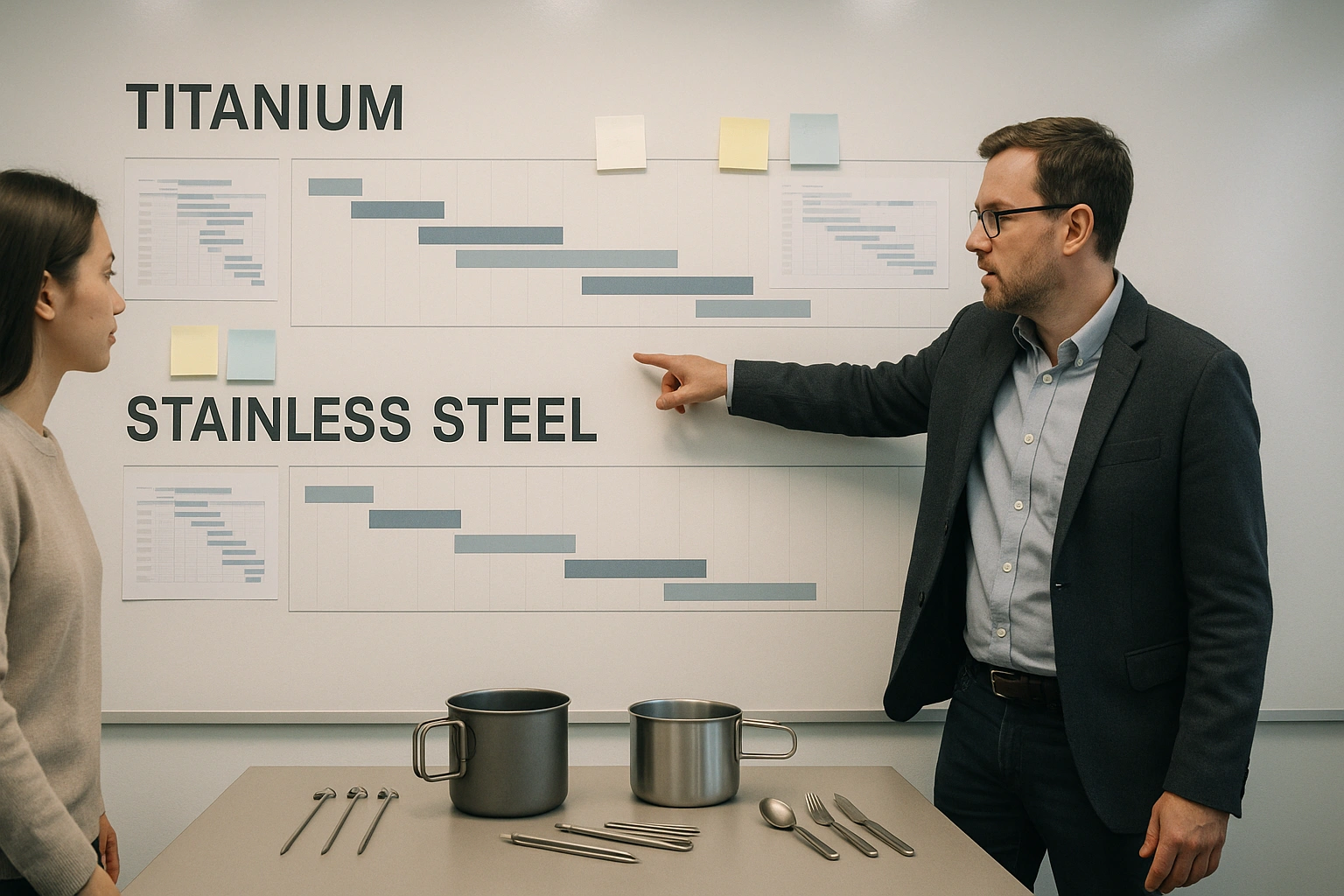
Titanium’s lead time challenge starts upstream. U.S. titanium sponge capacity remains severely constrained, with domestic production around 500 tonnes per year and most supply coming from imports—primarily Japan (67%), Saudi Arabia (23%), and Kazakhstan (7%). When aerospace demand tightens or geopolitical friction disrupts these sources, outdoor brands feel it 8–12 weeks later.
For a typical titanium OEM project, expect this timeline:
- Raw material procurement: 6–10 weeks for sponge or scrap sourcing, longer if you’re competing with aerospace orders
- Mill processing: 4–6 weeks to convert sponge to sheet, plate, or tube stock
- Manufacturing: 3–5 weeks for forming, welding, and finishing
- QC and logistics: 2–3 weeks
Total: 15–24 weeks from PO to delivered goods, assuming no upstream disruptions. If your supplier doesn’t maintain safety stock of common titanium gauges, add another 4–8 weeks.
Stainless steel operates on a fundamentally different rhythm. Global production hit 62.6 million tonnes in 2024, distributed across China, Europe, the U.S., and other regions. That scale and geographic diversity translate to:
- Raw material procurement: 1–2 weeks for common grades (304, 316) in standard forms
- Manufacturing: 2–4 weeks depending on complexity
- QC and logistics: 2–3 weeks
Total: 5–9 weeks for most outdoor gear applications, with shorter windows possible if your supplier stocks material.
The lead time gap compounds when you factor in replanning cycles. If you need to adjust order volumes or specifications mid-production, stainless steel suppliers can usually accommodate changes with 2–3 weeks notice. Titanium projects lock in earlier because the upstream material pipeline is longer and less flexible.
Minimum Order Quantities: The Hidden Cost Barrier
Titanium MOQs reflect the economics of a specialty material with concentrated production. For custom titanium components:
- Sheet stock: Minimum 50–100 kg per gauge/width combination
- Formed parts: 500–1,000 units per SKU to justify tooling and setup
- Machined components: 200–500 units depending on complexity
Those minimums create cash flow pressure for emerging brands. A 1,000-unit MOQ on a $35 wholesale titanium pot ties up $35,000 before you’ve validated market demand. For brands testing new product categories or regional markets, that’s a painful threshold.
Stainless steel MOQs run lower across the board:
- Sheet stock: Minimum 20–50 kg, often available from distributor inventory in smaller quantities
- Formed parts: 200–500 units per SKU
- Machined components: 100–300 units
The volume flexibility matters most during product development and market testing phases. You can pilot a stainless steel cookset with 200 units, gather customer feedback, iterate the design, and scale production—all within a 6-month window. The same cycle with titanium forces you to commit heavier upfront or accept unit economics that don’t work until you hit scale.
Supplier Concentration Risk: One Country, Three Suppliers
Titanium’s upstream concentration creates strategic exposure. Global titanium sponge production is dominated by China (~220,000 tonnes), Japan (~55,000 tonnes), Russia (~20,000 tonnes), and Saudi Arabia (~15,000 tonnes). That’s four countries controlling 97% of supply, with China alone accounting for nearly 70%.
For U.S. brands, this matters in two ways. First, import reliance exceeds 95% for titanium sponge, making your production schedule vulnerable to trade policy shifts, tariffs, or export restrictions. Second, aerospace demand takes priority—when Boeing or Airbus ramp up orders, outdoor gear suppliers wait in line.
I’ve seen this play out firsthand. In late 2023, a West Coast outdoor brand committed to a spring 2024 titanium cookware launch. Their supplier’s sponge allocation got diverted to an aerospace contract in February. By the time replacement material arrived, the brand missed their retail window and had to clearance the inventory in Q4 at 40% below planned margins.
Stainless steel’s supply base is fundamentally more diversified. Production spans dozens of countries with deep domestic capacity in the U.S., Europe, and Asia. You can qualify multiple suppliers in different regions, and if one source tightens, alternatives exist without massive lead time penalties. That redundancy carries real value when you’re planning 12–18 months out.

Inventory Strategy: How Much Safety Stock Do You Really Need?
Titanium’s longer and less predictable lead times force you into one of two positions: carry more safety stock (tying up working capital) or accept stockout risk during demand surges.
For a $2 million annual titanium product line, maintaining 12–16 weeks of safety stock to buffer upstream volatility means holding roughly $460K–$615K in inventory. That’s capital you can’t deploy into marketing, new product development, or channel expansion.
Stainless steel’s shorter lead times let you run leaner. 6–8 weeks of safety stock covers most disruption scenarios, cutting your inventory carrying cost by 40–50% compared to titanium for the same revenue base.
The strategic question isn’t whether titanium’s supply chain is “worse” than stainless steel’s. It’s whether your business model and capital structure can absorb the working capital load and lead time variability that come with titanium. High-margin, established product lines can. Early-stage market tests often can’t.
Total Cost of Ownership: Beyond the Sticker Price
Raw material cost gets all the attention, but it’s only one piece of your total cost structure. Tooling, processing, defect rates, and lifecycle costs shift the economic picture in ways that aren’t obvious from a simple material price comparison.
Raw Material Cost: The 3–4× Starting Point
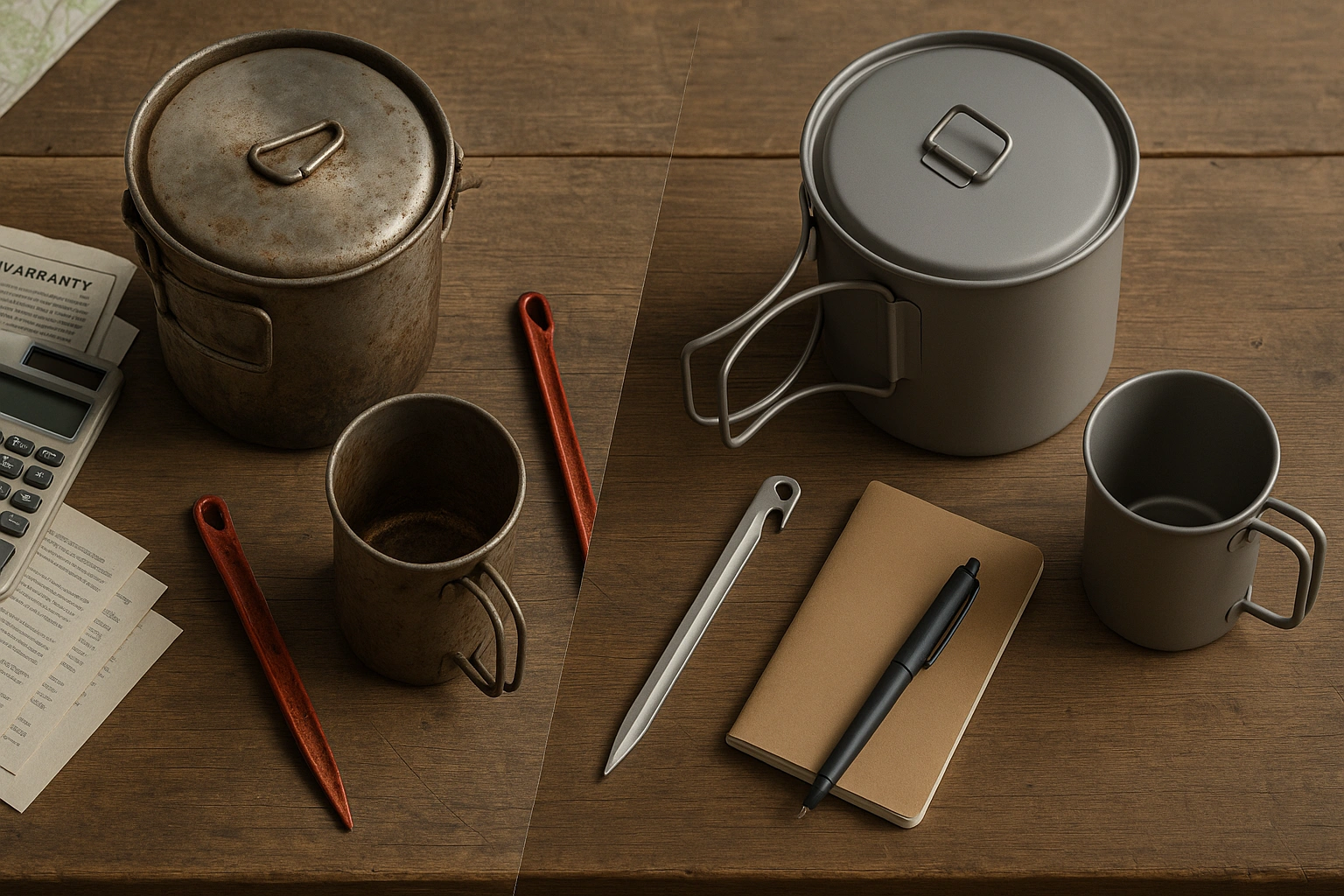
U.S. titanium sponge imports averaged approximately $13 per kilogram in 2024. By the time that sponge becomes Grade 2 sheet or tube stock suitable for outdoor gear manufacturing, you’re looking at $30–45 per kilogram depending on gauge, form, and order volume.
Stainless steel 304 cold-rolled coil trades globally around $2.50–3.00 per kilogram. 316 (marine grade) runs about $4.00–4.30. So the raw material multiplier sits at roughly 10–15× for titanium versus 304 stainless, and 7–10× versus 316 stainless.
That gap narrows slightly when you account for yield and weight. Titanium’s 45% density advantage means you need less material by volume for the same part geometry. A cookpot that requires 120 grams of stainless steel might use only 68 grams of titanium, cutting the effective material cost gap to 6–9× rather than 10–15×.
But even at 6×, you’re starting with a significant cost disadvantage that has to be justified somewhere else in your value proposition—either through performance differentiation, customer willingness to pay, or lifecycle cost savings.
Processing and Tooling: Where Titanium Gets Expensive
Titanium’s reputation for difficult machining is well-earned. Tool wear rates run 3–5× higher than stainless steel because titanium’s low thermal conductivity concentrates heat at the cutting edge. That means more frequent tool changes, slower cutting speeds, and higher labor hours per part.
For formed parts (deep-drawn cookware, stamped tent stakes), titanium’s springback and work-hardening behavior require more forming stages and tighter process control than stainless steel. Tooling costs for a titanium cookware project typically run 15–25% higher than the equivalent stainless steel tool set, and tool life is shorter.
Welding adds another layer of complexity. Titanium requires inert gas shielding (argon) on both the weld face and the backside to prevent oxidation and embrittlement. Stainless steel welds can often use simpler shielding or even air in less critical applications. That translates to slower welding speeds, more complex fixturing, and higher scrap rates during production ramp-up for titanium.
All of this processing complexity shows up in your per-unit manufacturing cost. For a moderately complex titanium part (e.g., a cookpot with welded handles and a formed lid), expect manufacturing cost to run 40–60% higher than the stainless steel equivalent, even before you factor in the material cost premium.
Defect Rates and Scrap: The Hidden Margin Killer
Titanium’s sensitivity to contamination and process variation means higher scrap rates, especially during new product introduction. A stainless steel cookware project might stabilize at 2–3% scrap once production is dialed in. Titanium projects often run 5–8% scrap through the first few production runs, and even mature titanium lines hold at 3–5% scrap due to the material’s less forgiving nature.
At $35–45 per kilogram, that scrap rate carries real cost. For a 1,000-unit production run of 100-gram parts, the difference between 3% and 6% scrap is roughly 300 grams of titanium—$10–13 per batch in direct material waste, multiplied across dozens of batches per year.
More painful than the material waste is the risk of late-stage defects. A weld crack discovered after surface finishing on a titanium part means scrapping not just the material but also the labor and processing cost invested up to that point. Stainless steel’s wider process window reduces that risk.
Lifecycle Cost: Where Titanium Claws Back Ground
Titanium’s corrosion resistance and durability extend product life in harsh environments, reducing warranty claims and replacement cycles.
For a coastal sailing brand, the difference between a 5-year service life for 316 stainless hardware and a 15-year service life for titanium changes the total cost of ownership calculation. If your customer values durability and you’re positioning products at the premium end, titanium’s lifecycle advantage justifies the upfront cost premium.
Similarly, weight savings compound over time for ultralight backpacking gear. A backpacker carrying 3 kg less weight over 500 trail miles per year values that reduction far more than the absolute cost difference between a $45 titanium pot and a $22 stainless steel pot. The willingness-to-pay gap widens as you move upmarket.
But lifecycle cost only matters if your customer base values durability over initial price and if your brand positioning supports a premium. For budget-conscious recreational campers or brands competing primarily on price, lifecycle cost arguments don’t move the needle—they buy on sticker price and replace when something breaks.
Volume Economics: When Scale Shifts the Math
At low volumes (under 2,000 units annually per SKU), titanium’s higher tooling and setup costs get amortized over fewer units, making per-unit economics painful. At higher volumes (5,000–10,000+ units), those fixed costs spread out and raw material becomes the dominant cost driver again.
Stainless steel maintains better unit economics at low volumes because tooling is cheaper, setup is faster, and scrap rates are lower out of the gate. This is why you see established outdoor brands launching new product categories in stainless steel first, validating demand, and then introducing a premium titanium variant once volume justifies the investment.
The break-even volume depends on your specific part geometry and target margin, but as a rule of thumb: if you’re not confident you’ll move 3,000+ units annually for at least three years, the titanium economics get hard to defend unless you’re charging a significant premium and targeting a niche willing to pay for it.
When Titanium Justifies the Premium
Titanium isn’t the right choice for every outdoor product, but when the conditions align, it creates differentiation that’s hard for competitors to match. Here are the scenarios where the material premium pays off.
Weight-Critical Applications Where Grams Matter
Ultralight backpacking, bikepacking, and alpine climbing represent markets where customers obsess over weight. A 30-gram tent stake that replaces a 55-gram stainless steel alternative gets noticed. When you’re selling to someone who cuts the handle off their toothbrush to save 8 grams, titanium’s 45% weight advantage isn’t a nice-to-have—it’s the entire value proposition.
These customers will pay 2–3× for titanium without hesitation because the performance benefit is tangible and measurable. Your marketing doesn’t need to convince them; you just need to deliver the product and prove the weight claims.
Marine and Coastal Environments
If your brand serves sailors, sea kayakers, coastal guides, or fishing charter operators, titanium eliminates corrosion as a failure mode. 316 stainless holds up reasonably well in saltwater, but “reasonably well” still means pitting and degradation over 3–5 years of heavy exposure.
Titanium hardware, cookware, and tools in marine environments last 10–15+ years without corrosion. For commercial operators who depend on gear reliability and can’t afford mid-season equipment failures, that durability justifies the upfront cost. For recreational coastal users building a long-term gear collection, titanium becomes a buy-it-for-life investment.
The warranty cost avoidance alone can justify titanium for marine-focused brands. If you’re replacing 8–12% of stainless steel coastal products under warranty each year due to corrosion, switching to titanium for those SKUs cuts your warranty liability and improves customer satisfaction.
Premium Brand Positioning
Some outdoor brands compete on performance and prestige rather than price. If your customer base includes early adopters, gear collectors, and enthusiasts who want the best available option, titanium signals premium quality in a way that stainless steel cannot.
This isn’t about functional superiority alone—it’s about brand perception. A $150 titanium cookset tells a different story than a $55 stainless steel cookset, even if both perform adequately for most users. If your brand positioning supports premium pricing and your customers are willing to pay for exclusivity and performance, titanium reinforces that positioning.
For brands like Snow Peak, TOAKS, or other premium outdoor companies, titanium isn’t just a material choice—it’s a brand identity anchor that attracts a specific customer segment and supports higher margins across the product line.
Low-Volume, High-Margin Product Lines
If you’re producing limited-edition runs, regional specialty products, or custom projects for guides and outfitters, titanium’s economics work differently. At 500 units per year, stainless steel’s volume advantages disappear, and titanium’s performance benefits become the deciding factor.
For custom knife makers, specialty tool manufacturers, or brands serving niche adventure segments (ultralight paragliding gear, expedition-grade equipment), the customer expects titanium and the volume is too low for mass-production economics to matter. You’re pricing based on value and exclusivity, not cost-plus margins, which means titanium’s material premium gets absorbed into a product price that already sits at the high end of the market.
When Stainless Steel Is the Smarter Choice
Stainless steel doesn’t get the same marketing glamour as titanium, but for many outdoor brands, it’s the more strategic material choice. Here’s when stainless steel wins on both performance and business fundamentals.
High-Volume Product Lines Where Cost Scales
If you’re targeting mass-market outdoor retailers, selling through Amazon, or building a product line aimed at recreational campers and casual outdoor users, stainless steel’s cost advantage compounds quickly. At 10,000+ units per year, the $15–20 per unit material cost difference between titanium and stainless steel adds up to $150K–$200K in annual gross margin—capital you can reinvest into marketing, channel expansion, or new product development.
For brands competing in the $30–$60 retail price range where customers are price-sensitive, titanium pricing simply doesn’t work. You’d need to charge $80–$120 to maintain equivalent margins, which pushes you out of the consideration set for mainstream buyers. Stainless steel keeps you competitive while delivering adequate performance for the vast majority of outdoor use cases.
Base Camp and Car Camping Gear
When weight isn’t a primary concern—base camp cookware, car camping setups, RV accessories, or picnic gear—stainless steel’s heft becomes an advantage rather than a liability. Heavier cookware sits more stably on camp stoves, resists tipping, and feels more substantial to customers accustomed to home kitchen equipment.
For this market segment, customers often perceive lightweight gear as flimsy or lower quality. A titanium pot that saves 80 grams provides no functional benefit when it’s transported in a vehicle and used at a fixed campsite. Stainless steel delivers better value perception at a price point that makes sense for occasional-use camping gear.
Product Testing and Market Validation
When you’re launching a new product category or entering a new market segment, stainless steel’s lower MOQs and faster lead times let you test demand without overcommitting capital. You can produce 300–500 units, run a regional pilot or online soft launch, gather customer feedback, and iterate the design—all within a 4–6 month cycle.
Trying the same approach with titanium means committing to 1,000+ units with 20–24 week lead times and 2–3× the capital outlay. If the product doesn’t resonate or you need to adjust specifications, you’re stuck with excess inventory or expensive retooling.
Smart outdoor brands use stainless steel as their validation material. Once a product proves itself at scale (3,000+ units sold, clear customer demand, positive unit economics), they introduce a premium titanium variant to capture the high-end segment and expand margin opportunities. This de-risks product development while still preserving the option to move upmarket later.
Inland and Temperate Climate Markets
If your primary customer base camps in forests, mountains, and desert environments where saltwater exposure is nonexistent, 304 stainless steel’s corrosion resistance is more than adequate. Titanium’s superior corrosion performance provides no marginal benefit in these conditions, making the cost premium unjustifiable.
For brands focused on regional markets—Colorado mountain guides, Pacific Northwest trail outfitters, Southwest desert hikers—304 stainless delivers 10–15 years of service life without corrosion failures. Your customers get reliable gear, you maintain healthy margins, and you’re not spending 6–10× on material cost for performance they’ll never use.
Budget-Conscious Customer Segments
Not every outdoor enthusiast wants or needs premium gear. Families introducing kids to camping, college students building their first backpacking kit, casual weekend campers—all of these segments prioritize value over performance optimization.
For these customers, a $35 stainless steel cookset that works reliably beats a $95 titanium cookset they can’t afford. By offering stainless steel products at accessible price points, you expand your addressable market and build brand loyalty with customers who may upgrade to premium titanium products later as their involvement in outdoor activities deepens.
De-Risking Your Material Decision
Whether you choose titanium or stainless steel, supply chain risk doesn’t disappear—it just takes different forms. Here’s how to mitigate the biggest risks inherent to each material.
For Titanium: Build Lead Time Buffers and Dual-Source Where Possible
Titanium’s upstream concentration means single-supplier relationships carry heightened risk. Where volumes justify it, qualify at least two titanium suppliers in different regions. If your primary supplier runs into sponge allocation issues or capacity constraints, having a backup with established tooling and specifications prevents a complete production halt.
On lead times, pad your planning assumptions by 20–25% above quoted timelines. If your supplier commits to 18 weeks, plan for 22–23 weeks in your production schedule. That buffer absorbs most upstream delays without cascading into missed launch windows or stockouts.
Finally, negotiate safety stock agreements with your supplier. Some titanium OEMs will hold 4–8 weeks of raw material inventory for established customers in exchange for volume commitments or advance deposits. That upstream inventory buffer shortens your effective lead time and reduces exposure to sponge market volatility.
For Stainless Steel: Avoid Complacency on Supplier Quality
Stainless steel’s availability creates a different risk—complacency. With dozens of suppliers quoting competitive prices, it’s tempting to optimize purely on cost. But not all 304 stainless is equivalent. Material certifications, traceability, and consistent chemistry matter, especially for products going into marine environments or food contact applications.
Require mill test certificates and third-party material verification for stainless steel suppliers, particularly if you’re working with new partners in low-cost regions. Spending an extra $0.30–$0.50 per kilogram for certified material from a reputable mill prevents warranty disasters downstream when substandard stainless corrodes prematurely or fails mechanical testing.
Also, diversify suppliers across at least two countries or regions. Over-reliance on a single geography (even one as large and capable as China) exposes you to regional trade policy shifts, tariffs, or logistics disruptions that can idle production for weeks.
Test Before You Scale: Prototype with Both Materials
Even if you’re 80% certain which material is right for your product, prototype with both. Run field tests with 20–30 units of each material among your target customer segment. Collect feedback on weight perception, durability, value perception, and willingness to pay.
You might find that your assumptions about customer priorities were wrong. A product you thought needed titanium performs just fine in stainless steel because your customers value stability over weight savings. Or the reverse—a product you thought could use stainless steel underperforms in coastal testing because corrosion shows up faster than expected.
Field testing costs 5–10% of your first production run but can prevent a six-figure mistake if it reveals misalignment between material choice and customer needs.
Lock In Pricing Early for Titanium, Stay Flexible for Stainless
Titanium pricing can swing 15–25% year-over-year based on sponge availability and aerospace demand cycles. If you’re committing to a multi-year titanium product line, negotiate fixed pricing or price caps with your supplier for 12–18 month terms. That protects your margin planning from upstream commodity volatility.
Stainless steel pricing is more stable, but the trade-off is less reason to lock in long-term contracts. Stay flexible, qualify multiple suppliers, and renegotiate pricing every 6–12 months to capture favorable market conditions.
Making the Call: A Framework for Your Next Project

The titanium versus stainless steel decision doesn’t have a universal right answer. It has your answer, based on your brand positioning, customer segment, volume expectations, and supply chain capabilities. Here’s a decision framework to clarify which material aligns with your business reality.
Ask yourself these five questions:
- Is weight reduction a primary customer need?
If your target customer obsesses over pack weight (ultralight backpackers, bikepackers, alpinists), titanium’s 45% weight advantage justifies the premium. If your customer transports gear by vehicle or values stability over lightness, stainless steel wins.
- What’s your expected production volume over the next 2–3 years?
Below 2,000 units annually, titanium’s economics are tough unless you’re pricing for exclusivity. Between 2,000–5,000 units, both materials can work depending on your margin targets. Above 5,000 units with tight cost control, stainless steel usually makes more sense unless you’re firmly positioned as a premium brand.
- What percentage of your customers face marine or extreme corrosion exposure?
If 40%+ of your customer base operates in coastal, saltwater, or high-chloride environments, titanium’s corrosion advantage pays for itself in reduced warranty costs and customer satisfaction. If most customers use gear inland or in temperate conditions, 304 stainless is sufficient.
- Can your working capital support 15–24 week lead times and higher inventory levels?
Titanium’s upstream supply chain demands more capital, longer planning windows, and larger safety stock. If your cash position or financing structure can’t absorb 12–16 weeks of inventory, stainless steel’s faster turns and lower capital requirements reduce financial stress.
- Does your brand positioning support a 2–3× price premium?
Titanium only works if customers will pay for it. If your brand competes in the premium segment (think $100–$200+ retail price points), titanium reinforces your positioning. If you’re targeting value-conscious recreational users at $30–$60 retail, titanium pricing pushes you out of the market.
Run through those five questions with your team. If you answered “yes” to at least three, titanium likely makes strategic sense. If you answered “yes” to fewer than three, stainless steel is probably the smarter path.
Figure 4: Material Selection Decision Framework. Use this flow to evaluate whether titanium or stainless steel aligns with your brand positioning, target market, and supply chain capabilities.
Quick FAQ
Ready to choose between titanium and stainless for your next project? Execution depends on finding a manufacturing partner who understands your market, respects your lead time constraints, and has the supply chain depth to deliver consistently.
At 7titanium.com, we’ve built our entire operation around helping outdoor brands execute titanium projects without the typical supply chain headaches. We maintain safety stock of common titanium gauges, work directly with multiple sponge sources, and specialize in the 500–5,000 unit volume range where most outdoor brands operate.
Whether you’re exploring titanium for the first time or frustrated with your current supplier’s lead times, let’s talk through your project. We’ll review your specs, discuss realistic timelines and MOQs, and help you determine whether titanium fits your business model—even if that answer is “not yet.”
Because the right material decision isn’t about what’s “best” in theory. It’s about what works for your customers, your timelines, and your margins.