
Марки титана для кухонной посуды: полное инженерное руководство TA1 и TA2 (ASTM B265)
Executive Summary: Material Selection Drives Yield Rate
In OEM cookware programs, specifying generic “titanium” obscures critical differences in mechanical behavior. The choice between Grade 1 (TA1) и Grade 2 (TA2) directly impacts manufacturing yield, tooling lifespan, and total unit cost.
While Grade 2 offers a lower raw material cost, Grade 1 is the superior specification for deep-drawn vessels (mugs, pots) due to its high elongation and low spring-back. This guide analyzes both alloys under the ASTM B265 standard to assist engineering teams in optimizing the Bill of Materials (BOM).
For product designers, titanium is often treated as a monolith. However, commercially pure (CP) titanium grades vary significantly in their interstitial chemistry. This variation dictates whether a production run results in premium cookware or a 20% scrap rate due to stress cracking.
1. Chemical Composition Under ASTM B265
Titanium grades are classified not by their titanium content, but by their impurities—specifically Oxygen (O) и Железо (Fe). These are not “contaminants” but alloying elements that control strength.

The “Interstitial Strengthening” Effect
Oxygen acts as an interstitial strengthener in the titanium crystal lattice.
The Rule of Thumb: Higher Oxygen = Higher Strength = Lower Ductility.
| Element (Max %) | Grade 1 (TA1) | Grade 2 (TA2) | Engineering Impact |
|---|---|---|---|
| Nitrogen (N) | 0.03 | 0.03 | Hardening agent; kept low to prevent brittleness. |
| Carbon (C) | 0.08 | 0.08 | Kept low to ensure weldability. |
| Железо (Fe) | 0.20 | 0.30 | Higher Iron increases strength but slightly reduces corrosion resistance. |
| Oxygen (O) | 0.18 | 0.25 | The Critical Differentiator. Grade 2 has ~40% more oxygen, making it significantly harder. |
| Titanium (Ti) | Balance | Balance | Base matrix. |
2. Mechanical Properties & Manufacturing Outcomes
Chemical differences translate directly into mechanical performance on the factory floor. The following data represents typical annealed properties required for successful forming.
| Свойство | Grade 1 (TA1) | Grade 2 (TA2) | Manufacturing Implication |
|---|---|---|---|
| Yield Strength (0.2% Offset) | 170 MPa (Min) | 275 MPa (Min) | Grade 1 requires less force to deform, reducing press tonnage requirements. |
| Предел прочности | 240 MPa (Min) | 345 MPa (Min) | Grade 2 is structurally stronger but harder to work. |
| Elongation (%) | ≥ 24% | ≥ 20% | Critical for Deep Drawing. Grade 1’s higher elongation allows for deeper cups without tearing. |
| Формируемость | Отличный | Good / Moderate | Grade 2 is prone to “Orange Peel” surface defects in deep draws. |
Deep Drawing Analysis: Why TA1 Wins
For products like Титановые кружки или Бутылки, the metal must be stretched significantly.
Spring-back Control: Титан имеет низкий модуль упругости (модуль Юнга), что приводит к значительному «пружинению» после штамповки. Класс 1 (более мягкий) имеет меньшую упругость, чем класс 2, что обеспечивает более жесткие допуски на размеры и более легкую сборку с крышками.

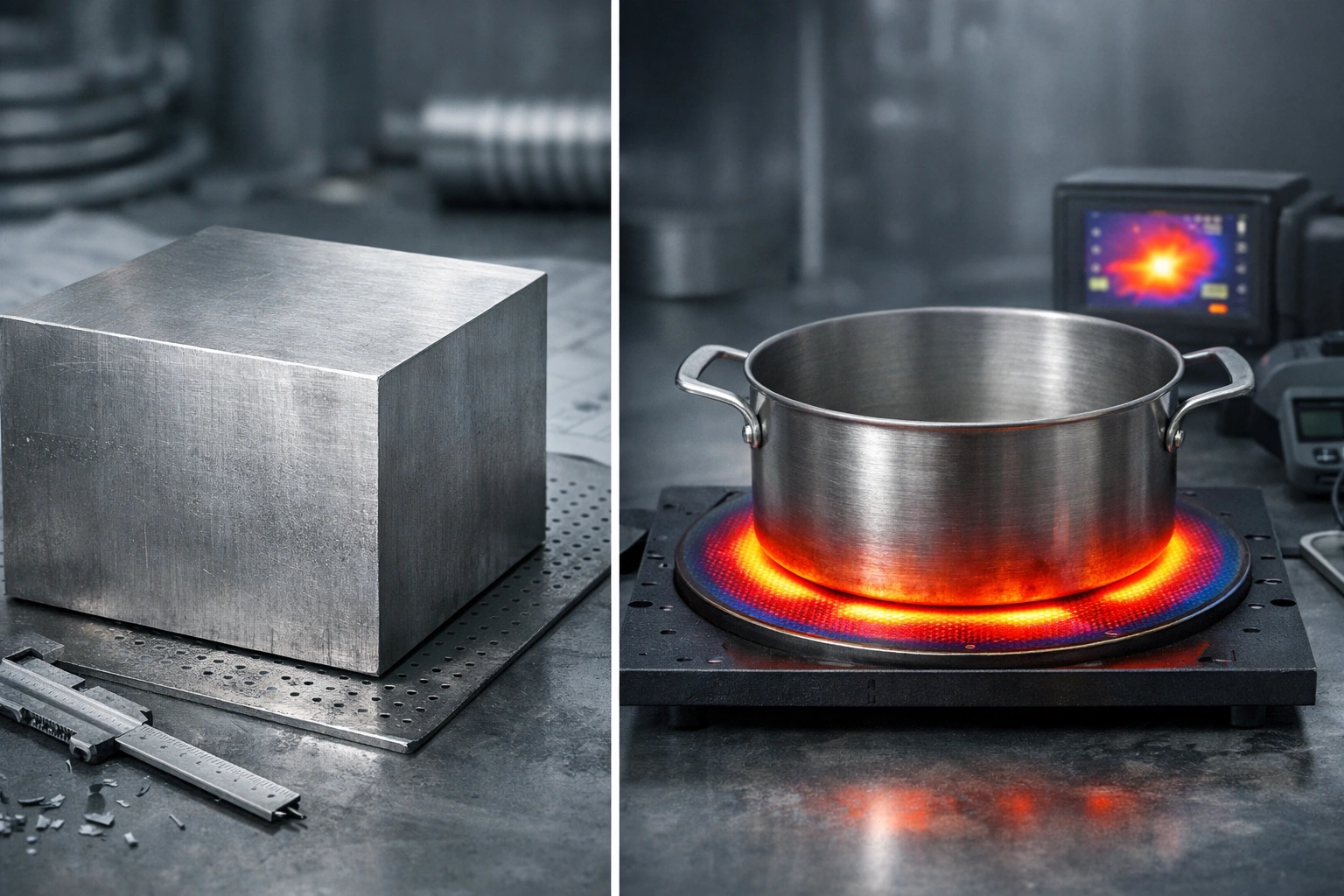
3. «Аэрокосмический» миф: почему 5-й класс (Ti-6Al-4V) не подходит для посуды
Маркетинговые команды часто называют «Аэрокосмический класс 5» из-за узнаваемости его названия. По технологии изготовления посуды 5-й класс объективно уступает CP-классам.
-
1. Thermal Inefficiency
Grade 5 has a thermal conductivity of ~6.7 W/m·K, compared to ~16 W/m·K for Grade 1. This creates severe “hot spots,” causing food to burn immediately. -
2. Manufacturing Cost
Grade 5 cannot be cold-stamped effectively. It requires hot-forming or CNC machining from solid blocks, increasing unit costs by 300%–500%. -
3. Safety Margins
Grade 5 contains 6% Aluminum and 4% Vanadium. While stable, it lacks the absolute purity of Grade 1 for sensitive food-contact applications.
4. Grade Selection Matrix by Product Category
Use this decision matrix to align your product roadmap with the correct material specification.

| Product Category | Recommended Grade | Rationale | Link |
|---|---|---|---|
| Double-Wall Mugs | Grade 1 (TA1) | Extreme forming ratios required; Grade 2 will crack during expansion. | View Mugs |
| Ultralight Pots (Deep) | Grade 1 (TA1) | Allows for thinner wall gauge (0.35mm) to save weight without tearing. | View Pots |
| Frying Pans (Shallow) | Grade 2 (TA2) | Shallow draw depth poses low risk; Grade 2 offers better dent resistance. | View Pans |
| Cutlery & Tools | Grade 2 (TA2) | Requires stiffness to prevent bending under load. | View Cutlery |
5. Cost Analysis: Raw Material vs. Total Cost of Ownership (TCO)
Cost Analysts often flag Grade 1 as “too expensive” because the raw material price is typically 5-10% higher than Grade 2. However, this is a false economy for deep-drawn parts.
- Higher Scrap Rate: Expect 15-20% rejection rate due to stress cracking vs. <2% for Grade 1.
- Tooling Wear: Harder Grade 2 increases die wear and galling, requiring frequent polishing and maintenance.
- Annealing Cycles: Grade 2 may require an additional vacuum annealing step to prevent cracking, doubling energy costs.
Conclusion: For complex shapes, Grade 1 yields a lower final unit cost despite the higher material price tag.
6. Verification Protocols
Visual inspection cannot distinguish between titanium grades. To ensure your OEM partner is using the specified material, implement these checks:
- Review the MTC (Mill Test Certificate): Verify the “Heat Number” matches your production batch. Check the Oxygen content (≤0.18% for Gr1).
- Hardness Testing (Vickers): A quick non-destructive test. Grade 1 typically tests below 140-150 HV, while Grade 2 tests higher (160-200 HV).
- XRF Analysis: Handheld X-ray fluorescence can instantly detect the presence of Aluminum/Vanadium (indicating Grade 5) or confirm pure CP titanium profiles.
Conclusion: Specification is Strategy
In the competitive outdoor gear market, material selection is not just a technical detail—it is a strategic decision that defines your product’s durability and your project’s profitability.
For premium cookware requiring deep forming and lightweight performance, ASTM B265 Grade 1 (TA1) is the undisputed standard. For structural components and flatware, Grade 2 (TA2) provides the necessary rigidity.
Ready to optimize your BOM?
Contact our engineering team to review your drawings and recommend the ideal grade for your next mold.