
Titanium vs Stainless Steel: How Material Choice Impacts Your Supply Chain, Lead Times, and Total Cost
Why the real risk in “titanium vs stainless” isn’t just material properties—but whether your supply chain can deliver on your launch plan, MOQs, and margins.
На этой странице
Plan a realistic titanium rollout
Поделитесь своим целевым окном запуска, объемами и целевыми каналами. Мы честно скажем вам, подходит ли титан или нержавеющая сталь — более безопасный первый шаг для вашего бренда.
Поговорите с нашей командой по цепочке поставок →Типичный диапазон проекта: 500–5 000 единиц на SKU, OEM и собственную торговую марку для брендов, занимающихся уличной продукцией.

Three weeks before your spring product launch, your supplier sends the email every brand dreads: “Material sourcing delays. Production pushed to Q3.” Your retail partners are locked in, your marketing spend is committed, and your competitor just launched a lighter alternative.
This scenario plays out dozens of times each year in the outdoor gear industry, and it usually starts with the same root cause—misaligned material selection and supply chain planning. The titanium versus stainless steel decision isn’t just about weight specs and corrosion ratings. It’s about lead time windows, minimum order volumes, supplier concentration risk, and whether your production schedule can survive upstream volatility.
Я провел десять лет на 7titanium.com, управляя отношениями с OEM-производителями для брендов активного отдыха, и видел, как умные команды обжигались обоими материалами — не потому, что они выбрали неправильный на бумаге, а потому, что они не соответствовали свойствам материала реалиям цепочки поставок. Снижение веса на 45% ничего не значит, если вы пропустите окно запуска. Троекратная надбавка к стоимости может окупиться, если она откроет уровень производительности, с которым ваш конкурент не может сравниться. Вопрос не в том, «какой материал лучше?» Вопрос «какой материал позволит вам реализовать вашу стратегию?»
В этой статье рассматривается решение о выборе титана и нержавеющей стали с точки зрения цепочки поставок и общих затрат. Вы увидите фактические данные о сроках выполнения заказа, последствиях минимального заказа, структуру затрат и структуру принятия решений, а не только таблицы данных о материалах. Независимо от того, запускаете ли вы свою первую линейку титановых продуктов или пересматриваете существующую артикулу, вы получите более четкое представление о том, когда каждый материал имеет смысл и как снизить риски, какой бы путь вы ни выбрали.
Свойства материала: что на самом деле показывают данные
Before we talk lead times and supplier networks, let’s establish the performance baseline. The properties that matter for outdoor gear aren’t academic—they directly affect your product positioning, warranty costs, and whether your customers notice the difference.
Weight and Density: The 45% Advantage
Titanium’s density sits at approximately 4.5 g/cm³, compared to stainless steel’s 8.0 g/cm³. That 45% weight reduction translates differently depending on your product category. For a 600 ml camping pot, you’re looking at roughly 95 grams for titanium versus 175 grams for stainless steel—a difference backpackers feel immediately. For tent stakes, that gap compounds across a set of eight or ten units.
But weight advantage has context. If you’re designing a 3-liter base camp cookset where stability matters more than pack weight, stainless steel’s heft becomes an asset, not a liability. The same applies to vehicle-based outdoor gear where transport weight is irrelevant.
Corrosion Resistance: When It Actually Matters
Titanium forms a passive oxide layer that resists saltwater, acidic foods, and most corrosive outdoor environments without additional surface treatment. Grade 2 titanium (the commercial pure grade most outdoor brands use) handles marine exposure, sweat salts, and acidic trail foods without pitting or staining.
История коррозии нержавеющей стали полностью зависит от марки. Нержавеющая сталь 304 отлично подходит для кемпинга внутри страны, где воздействие хлоридов минимально. Нержавеющая сталь 316 (морской класс) достаточно хорошо справляется с морской водой и прибрежной средой, хотя длительное воздействие концентрированных хлоридов все равно может вызвать образование язв в течение многих лет использования. Для брендов, ориентированных на прибрежные рынки, парусный спорт или морской каякинг, этот разрыв в производительности имеет значение. Нержавеющая сталь 304 подходит для использования в горах и пустыне без проблем.
The practical test: Can your warranty budget absorb corrosion claims from coastal users? If you’re positioning a premium product line and serving customers in Florida, California, or the Pacific Northwest where saltwater exposure is routine, titanium eliminates a failure mode. If your primary market is landlocked trail users, 304 stainless delivers adequate corrosion resistance at a fraction of the cost.
Strength-to-Weight Ratio: The Hidden Complexity
Titanium’s strength-to-weight ratio gets cited often, but the numbers need context. Grade 2 titanium (commercial pure) offers tensile strength around 345 MPa at 4.5 g/cm³. Grade 5 (Ti-6Al-4V, the aerospace alloy) jumps to approximately 900 MPa but costs significantly more and requires more complex processing. 304 stainless delivers roughly 505 MPa at 8.0 g/cm³, while 316 stainless sits around 515 MPa.
For thin-walled cookware where stiffness matters more than raw strength, titanium’s lower modulus of elasticity (about 110 GPa versus stainless steel’s 200 GPa) means titanium walls feel less rigid at the same thickness. Brands often compensate by using thicker titanium gauge or adding structural ribs, which eats into the weight advantage.
For structural components like tent poles, bike frames, or load-bearing hardware, Grade 5 titanium’s strength-to-weight advantage justifies the premium. For cookware, stakes, or utensils where wall thickness and forming complexity dominate, the picture gets muddier.
Temperature Performance: Real-World Limits
Both materials handle typical outdoor temperature ranges (-40 °C to 200 °C) without issues. Titanium maintains strength at higher temperatures, but unless you’re designing exhaust components or industrial equipment, you won’t approach those limits with camping cookware or outdoor accessories.
One practical difference: Titanium’s lower thermal conductivity (about 21.9 W/m·K versus stainless 304’s 16.2 W/m·K, both significantly lower than aluminum’s 205 W/m·K) means titanium cookware develops hot spots over camp stoves. Some users prefer this for boiling efficiency; others find it frustrating for sautéing. Stainless steel cookware exhibits similar behavior, so from a thermal standpoint, both materials sit in the same ballpark for outdoor cooking applications.
Material Grades: What Outdoor Brands Actually Use
Most titanium outdoor gear uses Grade 2 (commercial pure) for its balance of corrosion resistance, formability, and cost. Grade 5 appears in high-performance structural applications where the cost and machining complexity are justified. Grades 1, 3, and 4 see limited use in outdoor products.
For stainless steel, 304 dominates inland and general-purpose applications. 316 appears in marine-focused products. 430 (a ferritic grade) occasionally shows up in budget lines where corrosion resistance can be compromised, but most reputable outdoor brands avoid it because the rust risk damages brand reputation.
Understanding these grade differences matters when you’re qualifying suppliers. If a supplier quotes Grade 1 titanium for cookware or offers 430 stainless for a coastal product line, those are red flags indicating either inexperience or cost-cutting that will hurt you downstream.
Figure 1: Material Properties Comparison Matrix. Titanium offers significant weight and corrosion advantages but requires longer lead times and higher investment. Data reflects typical values for Grade 2 titanium and 304/316 stainless steel in outdoor gear applications.
Supply Chain Reality: Lead Times, MOQ, and Concentration Risk
Material properties get you shortlisted. Supply chain execution gets your product to market. Here’s where the titanium-stainless steel decision becomes a strategic trade-off rather than a simple performance comparison.
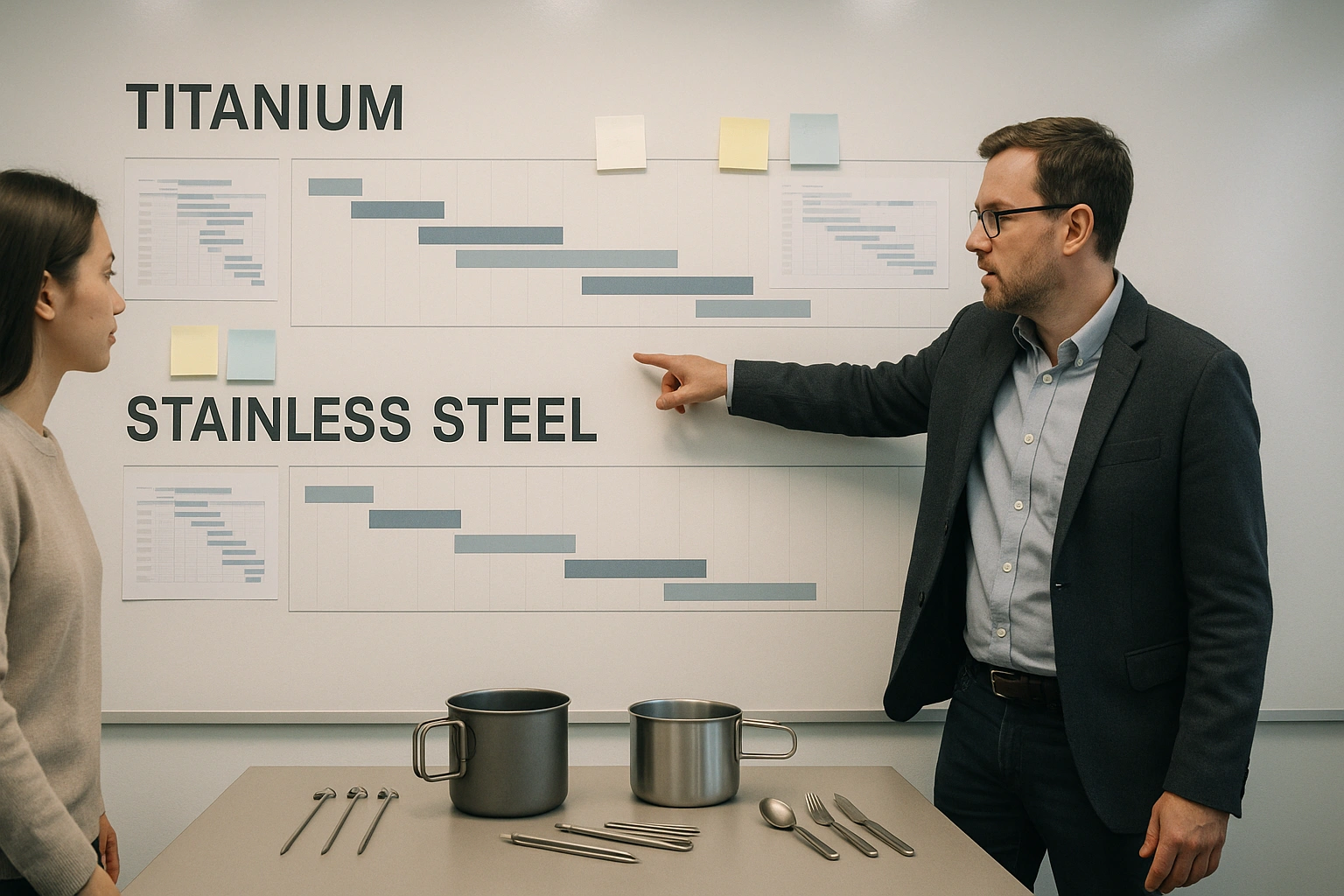
Lead Time Breakdown: Where the Delays Hide
Titanium’s lead time challenge starts upstream. U.S. titanium sponge capacity remains severely constrained, with domestic production around 500 tonnes per year and most supply coming from imports—primarily Japan (67%), Saudi Arabia (23%), and Kazakhstan (7%). When aerospace demand tightens or geopolitical friction disrupts these sources, outdoor brands feel it 8–12 weeks later.
For a typical titanium OEM project, expect this timeline:
- Raw material procurement: 6–10 weeks for sponge or scrap sourcing, longer if you’re competing with aerospace orders
- Mill processing: 4–6 weeks to convert sponge to sheet, plate, or tube stock
- Manufacturing: 3–5 weeks for forming, welding, and finishing
- QC and logistics: 2–3 weeks
Total: 15–24 weeks from PO to delivered goods, assuming no upstream disruptions. If your supplier doesn’t maintain safety stock of common titanium gauges, add another 4–8 weeks.
Stainless steel operates on a fundamentally different rhythm. Global production hit 62.6 million tonnes in 2024, distributed across China, Europe, the U.S., and other regions. That scale and geographic diversity translate to:
- Raw material procurement: 1–2 weeks for common grades (304, 316) in standard forms
- Manufacturing: 2–4 weeks depending on complexity
- QC and logistics: 2–3 weeks
Total: 5–9 weeks for most outdoor gear applications, with shorter windows possible if your supplier stocks material.
The lead time gap compounds when you factor in replanning cycles. If you need to adjust order volumes or specifications mid-production, stainless steel suppliers can usually accommodate changes with 2–3 weeks notice. Titanium projects lock in earlier because the upstream material pipeline is longer and less flexible.
Minimum Order Quantities: The Hidden Cost Barrier
Titanium MOQs reflect the economics of a specialty material with concentrated production. For custom titanium components:
- Sheet stock: Minimum 50–100 kg per gauge/width combination
- Formed parts: 500–1,000 units per SKU to justify tooling and setup
- Machined components: 200–500 units depending on complexity
Those minimums create cash flow pressure for emerging brands. A 1,000-unit MOQ on a $35 wholesale titanium pot ties up $35,000 before you’ve validated market demand. For brands testing new product categories or regional markets, that’s a painful threshold.
Stainless steel MOQs run lower across the board:
- Sheet stock: Minimum 20–50 kg, often available from distributor inventory in smaller quantities
- Formed parts: 200–500 units per SKU
- Machined components: 100–300 units
The volume flexibility matters most during product development and market testing phases. You can pilot a stainless steel cookset with 200 units, gather customer feedback, iterate the design, and scale production—all within a 6-month window. The same cycle with titanium forces you to commit heavier upfront or accept unit economics that don’t work until you hit scale.
Supplier Concentration Risk: One Country, Three Suppliers
Titanium’s upstream concentration creates strategic exposure. Global titanium sponge production is dominated by China (~220,000 tonnes), Japan (~55,000 tonnes), Russia (~20,000 tonnes), and Saudi Arabia (~15,000 tonnes). That’s four countries controlling 97% of supply, with China alone accounting for nearly 70%.
For U.S. brands, this matters in two ways. First, import reliance exceeds 95% for titanium sponge, making your production schedule vulnerable to trade policy shifts, tariffs, or export restrictions. Second, aerospace demand takes priority—when Boeing or Airbus ramp up orders, outdoor gear suppliers wait in line.
I’ve seen this play out firsthand. In late 2023, a West Coast outdoor brand committed to a spring 2024 titanium cookware launch. Their supplier’s sponge allocation got diverted to an aerospace contract in February. By the time replacement material arrived, the brand missed their retail window and had to clearance the inventory in Q4 at 40% below planned margins.
Stainless steel’s supply base is fundamentally more diversified. Production spans dozens of countries with deep domestic capacity in the U.S., Europe, and Asia. You can qualify multiple suppliers in different regions, and if one source tightens, alternatives exist without massive lead time penalties. That redundancy carries real value when you’re planning 12–18 months out.

Inventory Strategy: How Much Safety Stock Do You Really Need?
Titanium’s longer and less predictable lead times force you into one of two positions: carry more safety stock (tying up working capital) or accept stockout risk during demand surges.
For a $2 million annual titanium product line, maintaining 12–16 weeks of safety stock to buffer upstream volatility means holding roughly $460K–$615K in inventory. That’s capital you can’t deploy into marketing, new product development, or channel expansion.
Stainless steel’s shorter lead times let you run leaner. 6–8 weeks of safety stock covers most disruption scenarios, cutting your inventory carrying cost by 40–50% compared to titanium for the same revenue base.
The strategic question isn’t whether titanium’s supply chain is “worse” than stainless steel’s. It’s whether your business model and capital structure can absorb the working capital load and lead time variability that come with titanium. High-margin, established product lines can. Early-stage market tests often can’t.
Total Cost of Ownership: Beyond the Sticker Price
Raw material cost gets all the attention, but it’s only one piece of your total cost structure. Tooling, processing, defect rates, and lifecycle costs shift the economic picture in ways that aren’t obvious from a simple material price comparison.
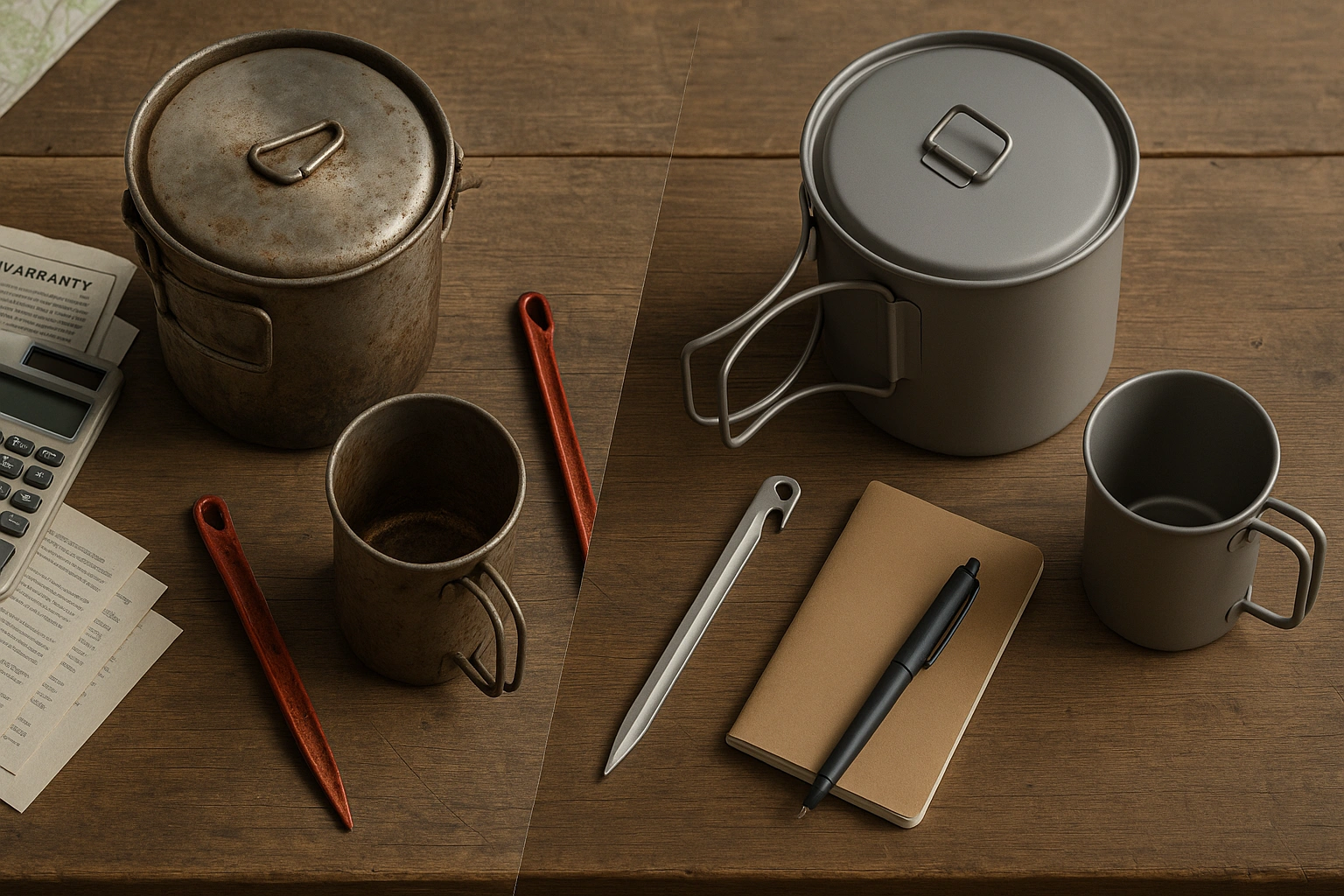
Raw Material Cost: The 3–4× Starting Point
U.S. titanium sponge imports averaged approximately $13 per kilogram in 2024. By the time that sponge becomes Grade 2 sheet or tube stock suitable for outdoor gear manufacturing, you’re looking at $30–45 per kilogram depending on gauge, form, and order volume.
Stainless steel 304 cold-rolled coil trades globally around $2.50–3.00 per kilogram. 316 (marine grade) runs about $4.00–4.30. So the raw material multiplier sits at roughly 10–15× for titanium versus 304 stainless, and 7–10× versus 316 stainless.
That gap narrows slightly when you account for yield and weight. Titanium’s 45% density advantage means you need less material by volume for the same part geometry. A cookpot that requires 120 grams of stainless steel might use only 68 grams of titanium, cutting the effective material cost gap to 6–9× rather than 10–15×.
But even at 6×, you’re starting with a significant cost disadvantage that has to be justified somewhere else in your value proposition—either through performance differentiation, customer willingness to pay, or lifecycle cost savings.
Processing and Tooling: Where Titanium Gets Expensive
Titanium’s reputation for difficult machining is well-earned. Tool wear rates run 3–5× higher than stainless steel because titanium’s low thermal conductivity concentrates heat at the cutting edge. That means more frequent tool changes, slower cutting speeds, and higher labor hours per part.
For formed parts (deep-drawn cookware, stamped tent stakes), titanium’s springback and work-hardening behavior require more forming stages and tighter process control than stainless steel. Tooling costs for a titanium cookware project typically run 15–25% higher than the equivalent stainless steel tool set, and tool life is shorter.
Welding adds another layer of complexity. Titanium requires inert gas shielding (argon) on both the weld face and the backside to prevent oxidation and embrittlement. Stainless steel welds can often use simpler shielding or even air in less critical applications. That translates to slower welding speeds, more complex fixturing, and higher scrap rates during production ramp-up for titanium.
All of this processing complexity shows up in your per-unit manufacturing cost. For a moderately complex titanium part (e.g., a cookpot with welded handles and a formed lid), expect manufacturing cost to run 40–60% higher than the stainless steel equivalent, even before you factor in the material cost premium.
Defect Rates and Scrap: The Hidden Margin Killer
Titanium’s sensitivity to contamination and process variation means higher scrap rates, especially during new product introduction. A stainless steel cookware project might stabilize at 2–3% scrap once production is dialed in. Titanium projects often run 5–8% scrap through the first few production runs, and even mature titanium lines hold at 3–5% scrap due to the material’s less forgiving nature.
At $35–45 per kilogram, that scrap rate carries real cost. For a 1,000-unit production run of 100-gram parts, the difference between 3% and 6% scrap is roughly 300 grams of titanium—$10–13 per batch in direct material waste, multiplied across dozens of batches per year.
More painful than the material waste is the risk of late-stage defects. A weld crack discovered after surface finishing on a titanium part means scrapping not just the material but also the labor and processing cost invested up to that point. Stainless steel’s wider process window reduces that risk.
Lifecycle Cost: Where Titanium Claws Back Ground
Titanium’s corrosion resistance and durability extend product life in harsh environments, reducing warranty claims and replacement cycles.
For a coastal sailing brand, the difference between a 5-year service life for 316 stainless hardware and a 15-year service life for titanium changes the total cost of ownership calculation. If your customer values durability and you’re positioning products at the premium end, titanium’s lifecycle advantage justifies the upfront cost premium.
Similarly, weight savings compound over time for ultralight backpacking gear. A backpacker carrying 3 kg less weight over 500 trail miles per year values that reduction far more than the absolute cost difference between a $45 titanium pot and a $22 stainless steel pot. The willingness-to-pay gap widens as you move upmarket.
But lifecycle cost only matters if your customer base values durability over initial price and if your brand positioning supports a premium. For budget-conscious recreational campers or brands competing primarily on price, lifecycle cost arguments don’t move the needle—they buy on sticker price and replace when something breaks.
Volume Economics: When Scale Shifts the Math
At low volumes (under 2,000 units annually per SKU), titanium’s higher tooling and setup costs get amortized over fewer units, making per-unit economics painful. At higher volumes (5,000–10,000+ units), those fixed costs spread out and raw material becomes the dominant cost driver again.
Stainless steel maintains better unit economics at low volumes because tooling is cheaper, setup is faster, and scrap rates are lower out of the gate. This is why you see established outdoor brands launching new product categories in stainless steel first, validating demand, and then introducing a premium titanium variant once volume justifies the investment.
The break-even volume depends on your specific part geometry and target margin, but as a rule of thumb: if you’re not confident you’ll move 3,000+ units annually for at least three years, the titanium economics get hard to defend unless you’re charging a significant premium and targeting a niche willing to pay for it.
When Titanium Justifies the Premium
Titanium isn’t the right choice for every outdoor product, but when the conditions align, it creates differentiation that’s hard for competitors to match. Here are the scenarios where the material premium pays off.
Weight-Critical Applications Where Grams Matter
Ultralight backpacking, bikepacking, and alpine climbing represent markets where customers obsess over weight. A 30-gram tent stake that replaces a 55-gram stainless steel alternative gets noticed. When you’re selling to someone who cuts the handle off their toothbrush to save 8 grams, titanium’s 45% weight advantage isn’t a nice-to-have—it’s the entire value proposition.
These customers will pay 2–3× for titanium without hesitation because the performance benefit is tangible and measurable. Your marketing doesn’t need to convince them; you just need to deliver the product and prove the weight claims.
Marine and Coastal Environments
If your brand serves sailors, sea kayakers, coastal guides, or fishing charter operators, titanium eliminates corrosion as a failure mode. 316 stainless holds up reasonably well in saltwater, but “reasonably well” still means pitting and degradation over 3–5 years of heavy exposure.
Titanium hardware, cookware, and tools in marine environments last 10–15+ years without corrosion. For commercial operators who depend on gear reliability and can’t afford mid-season equipment failures, that durability justifies the upfront cost. For recreational coastal users building a long-term gear collection, titanium becomes a buy-it-for-life investment.
The warranty cost avoidance alone can justify titanium for marine-focused brands. If you’re replacing 8–12% of stainless steel coastal products under warranty each year due to corrosion, switching to titanium for those SKUs cuts your warranty liability and improves customer satisfaction.
Premium Brand Positioning
Some outdoor brands compete on performance and prestige rather than price. If your customer base includes early adopters, gear collectors, and enthusiasts who want the best available option, titanium signals premium quality in a way that stainless steel cannot.
This isn’t about functional superiority alone—it’s about brand perception. A $150 titanium cookset tells a different story than a $55 stainless steel cookset, even if both perform adequately for most users. If your brand positioning supports premium pricing and your customers are willing to pay for exclusivity and performance, titanium reinforces that positioning.
For brands like Snow Peak, TOAKS, or other premium outdoor companies, titanium isn’t just a material choice—it’s a brand identity anchor that attracts a specific customer segment and supports higher margins across the product line.
Low-Volume, High-Margin Product Lines
If you’re producing limited-edition runs, regional specialty products, or custom projects for guides and outfitters, titanium’s economics work differently. At 500 units per year, stainless steel’s volume advantages disappear, and titanium’s performance benefits become the deciding factor.
For custom knife makers, specialty tool manufacturers, or brands serving niche adventure segments (ultralight paragliding gear, expedition-grade equipment), the customer expects titanium and the volume is too low for mass-production economics to matter. You’re pricing based on value and exclusivity, not cost-plus margins, which means titanium’s material premium gets absorbed into a product price that already sits at the high end of the market.
When Stainless Steel Is the Smarter Choice
Stainless steel doesn’t get the same marketing glamour as titanium, but for many outdoor brands, it’s the more strategic material choice. Here’s when stainless steel wins on both performance and business fundamentals.
High-Volume Product Lines Where Cost Scales
If you’re targeting mass-market outdoor retailers, selling through Amazon, or building a product line aimed at recreational campers and casual outdoor users, stainless steel’s cost advantage compounds quickly. At 10,000+ units per year, the $15–20 per unit material cost difference between titanium and stainless steel adds up to $150K–$200K in annual gross margin—capital you can reinvest into marketing, channel expansion, or new product development.
For brands competing in the $30–$60 retail price range where customers are price-sensitive, titanium pricing simply doesn’t work. You’d need to charge $80–$120 to maintain equivalent margins, which pushes you out of the consideration set for mainstream buyers. Stainless steel keeps you competitive while delivering adequate performance for the vast majority of outdoor use cases.
Base Camp and Car Camping Gear
When weight isn’t a primary concern—base camp cookware, car camping setups, RV accessories, or picnic gear—stainless steel’s heft becomes an advantage rather than a liability. Heavier cookware sits more stably on camp stoves, resists tipping, and feels more substantial to customers accustomed to home kitchen equipment.
В этом сегменте рынка покупатели часто воспринимают легкое оборудование как хрупкое или низкокачественное. Титановый горшок, который экономит 80 граммов, не дает никакой функциональной пользы при транспортировке в автомобиле и использовании в стационарном кемпинге. Нержавеющая сталь обеспечивает лучшее восприятие ценности по цене, которая имеет смысл для походного снаряжения, которое используется нерегулярно.
Тестирование продукта и проверка рынка
Когда вы запускаете новую категорию продуктов или выходите на новый сегмент рынка, более низкие минимальный объем заказа нержавеющей стали и более короткие сроки выполнения заказов позволяют вам протестировать спрос без чрезмерных затрат капитала. Вы можете произвести 300–500 единиц, запустить региональный пилотный проект или программный запуск онлайн, собрать отзывы клиентов и повторить дизайн — и все это в течение 4–6-месячного цикла.
Trying the same approach with titanium means committing to 1,000+ units with 20–24 week lead times and 2–3× the capital outlay. If the product doesn’t resonate or you need to adjust specifications, you’re stuck with excess inventory or expensive retooling.
Smart outdoor brands use stainless steel as their validation material. Once a product proves itself at scale (3,000+ units sold, clear customer demand, positive unit economics), they introduce a premium titanium variant to capture the high-end segment and expand margin opportunities. This de-risks product development while still preserving the option to move upmarket later.
Inland and Temperate Climate Markets
Если ваша основная клиентская база проживает в лесах, горах и пустынях, где отсутствует воздействие соленой воды, коррозионная стойкость нержавеющей стали 304 более чем достаточна. Превосходные антикоррозийные свойства титана не приносят никакой незначительной выгоды в этих условиях, что делает неоправданную надбавку к затратам.
Для брендов, ориентированных на региональные рынки — горных гидов Колорадо, экипировщиков троп Тихоокеанского Северо-Запада, туристов по пустыне Юго-Запада — нержавеющая сталь 304 обеспечивает срок службы 10–15 лет без повреждений, связанных с коррозией. Ваши клиенты получают надежное оборудование, вы сохраняете стабильную прибыль и не тратите в 6–10 раз больше материальных затрат на производительность, которую они никогда не будут использовать.
Экономные сегменты клиентов
Не каждый любитель активного отдыха хочет или нуждается в снаряжении премиум-класса. Семьи, знакомящие детей с походами, студенты колледжей, собирающие свой первый походный комплект, случайные туристы выходного дня — все эти сегменты отдают приоритет ценности, а не оптимизации производительности.
Для этих клиентов варочная панель из нержавеющей стали за 35 долларов, которая работает надежно, превосходит титановую варочную панель за 95 долларов, которую они не могут себе позволить. Предлагая продукцию из нержавеющей стали по доступным ценам, вы расширяете свой целевой рынок и укрепляете лояльность к бренду среди клиентов, которые позже могут перейти на титановую продукцию премиум-класса по мере того, как их участие в мероприятиях на свежем воздухе становится глубже.
Снижение рисков вашего материального решения
Независимо от того, выбираете ли вы титан или нержавеющую сталь, риск в цепочке поставок не исчезает — он просто принимает другие формы. Вот как можно смягчить самые большие риски, присущие каждому материалу.
Для титана: создайте буферы времени выполнения и используйте двойной источник, где это возможно.
Концентрация добычи титана означает, что отношения с одним поставщиком несут повышенный риск. Если объемы оправдывают это, квалифицируйте как минимум двух поставщиков титана в разных регионах. Если у вашего основного поставщика возникают проблемы с распределением губки или ограничения производительности, наличие резервной копии с установленными инструментами и спецификациями предотвратит полную остановку производства.
Что касается сроков выполнения заказов, увеличьте свои предположения по планированию на 20–25 % по сравнению с указанными сроками. Если ваш поставщик обязуется уложиться в 18 недель, запланируйте в своем производственном графике 22–23 недели. Этот буфер поглощает большую часть задержек в восходящем направлении, не приводя к пропущенным окнам запуска или дефицитам.
Наконец, заключите договор о страховом запасе с вашим поставщиком. Некоторые OEM-производители титана будут хранить запасы сырья для постоянных клиентов на 4–8 недель в обмен на обязательства по объемам или авансовые депозиты. Этот резервный запас запасов сокращает эффективное время выполнения заказа и снижает подверженность волатильности рынка губок.
Для нержавеющей стали: избегайте самоуспокоенности в отношении качества поставщика
Доступность нержавеющей стали создает другой риск — самоуспокоенность. Поскольку десятки поставщиков предлагают конкурентоспособные цены, возникает соблазн оптимизировать исключительно затраты. Но не вся нержавеющая сталь 304 эквивалентна. Сертификация материалов, отслеживаемость и постоянный химический состав имеют значение, особенно для продуктов, предназначенных для использования в морской среде или для применения в контакте с пищевыми продуктами.
Требуйте сертификаты заводских испытаний и стороннюю проверку материалов для поставщиков нержавеющей стали, особенно если вы работаете с новыми партнерами в регионах с низкими затратами. Потратив дополнительные 0,30–0,50 доллара за килограмм на сертифицированный материал от известного завода, вы предотвратите гарантийные катастрофы в дальнейшем, когда некондиционная нержавеющая сталь преждевременно подвергается коррозии или не проходит механические испытания.
Кроме того, диверсифицируйте поставщиков как минимум в двух странах или регионах. Чрезмерная зависимость от одного региона (даже такого большого и мощного, как Китай) подвергает вас изменениям региональной торговой политики, тарифам или сбоям в логистике, которые могут привести к остановке производства на несколько недель.
Тестируйте перед масштабированием: прототип из обоих материалов
Даже если вы на 80 % уверены, какой материал подходит для вашего продукта, создавайте прототипы с обоими вариантами. Проведите полевые испытания с 20–30 единицами каждого материала среди вашего целевого сегмента клиентов. Соберите отзывы о восприятии веса, долговечности, восприятии ценности и готовности платить.
Вы можете обнаружить, что ваши предположения о приоритетах клиентов ошибочны. Продукт, который, как вы считали, нуждался в титане, отлично работает с нержавеющей сталью, потому что ваши клиенты ценят стабильность выше экономии веса. Или наоборот: продукт, который, как вы думали, мог бы использовать нержавеющую сталь, показал худшие результаты при прибрежных испытаниях, поскольку коррозия проявляется быстрее, чем ожидалось.
Полевые испытания стоят 5–10 % от вашей первой партии продукции, но могут предотвратить шестизначную ошибку, если выяснится несоответствие между выбором материала и потребностями клиента.
Зафиксируйте цены на титан заранее, оставайтесь гибкими на нержавеющую сталь
Цены на титан могут колебаться на 15–25% по сравнению с прошлым годом в зависимости от доступности губки и циклов спроса в аэрокосмической отрасли. Если вы планируете выпускать линейку титановой продукции на несколько лет, договоритесь с поставщиком о фиксированных ценах или ценовых ограничениях на срок 12–18 месяцев. Это защитит ваше планирование маржи от волатильности сырьевых товаров.
Цены на нержавеющую сталь более стабильны, но такой компромисс дает меньше причин заключать долгосрочные контракты. Сохраняйте гибкость, аттестуйте нескольких поставщиков и пересматривайте цены каждые 6–12 месяцев, чтобы воспользоваться благоприятными рыночными условиями.
Принятие решения: основа для вашего следующего проекта

Решение о выборе титана или нержавеющей стали не имеет универсального правильного ответа. У него есть ответ, основанный на позиционировании вашего бренда, сегменте клиентов, ожиданиях по объему и возможностях цепочки поставок. Вот схема принятия решений, позволяющая уточнить, какой материал соответствует реальности вашего бизнеса.
Задайте себе эти пять вопросов:
- Является ли снижение веса основной потребностью клиента?
Если ваш целевой клиент зациклен на весе рюкзака (сверхлегкие туристы, велосипедисты, альпинисты), преимущество титана в весе на 45% оправдывает премию. Если ваш клиент перевозит снаряжение на автомобиле или ценит стабильность выше легкости, нержавеющая сталь выигрывает.
- Каков ваш ожидаемый объем производства в ближайшие 2–3 года?
Если объем производства титана не превышает 2000 единиц в год, его экономика будет трудной, если только вы не рассчитываете на эксклюзивность. Оба материала могут работать от 2000 до 5000 единиц в зависимости от ваших целевых показателей прибыли. При объеме производства более 5000 единиц при жестком контроле затрат использование нержавеющей стали обычно имеет больше смысла, если только вы не твердо позиционируетесь как бренд премиум-класса.
- Какой процент ваших клиентов сталкивается с морской или экстремальной коррозией?
Если более 40% вашей клиентской базы работает в прибрежных, соленых водах или средах с высоким содержанием хлоридов, преимущества титана в отношении коррозии окупаются снижением гарантийных затрат и удовлетворенностью клиентов. Если большинство клиентов используют снаряжение на суше или в условиях умеренного климата, достаточно нержавеющей стали 304.
- Может ли ваш оборотный капитал обеспечить сроки выполнения заказов в течение 15–24 недель и более высокий уровень запасов?
Цепочка поставок титана требует большего капитала, более длительных периодов планирования и большего резервного запаса. Если ваша денежная позиция или финансовая структура не могут покрыть запасы на 12–16 недель, более быстрые обороты нержавеющей стали и более низкие требования к капиталу уменьшают финансовый стресс.
- Поддерживает ли позиционирование вашего бренда надбавку к цене в 2–3 раза?
Титан работает только в том случае, если клиенты готовы за него платить. Если ваш бренд конкурирует в премиальном сегменте (например, розничная цена от 100 до 200 долларов США), титан укрепит ваши позиции. Если вы ориентируетесь на рекреационных пользователей, которые ценят ценность продукта по цене от 30 до 60 долларов в розницу, цены на титан вытеснят вас с рынка.
Ответьте на эти пять вопросов вместе со своей командой. Если вы ответили «да» хотя бы на три вопроса, титан, вероятно, имеет стратегический смысл. Если вы ответили «да» менее чем на три вопроса, нержавеющая сталь, вероятно, будет более разумным вариантом.
Рисунок 4: Схема принятия решения о выборе материала. Используйте этот процесс, чтобы оценить, соответствует ли титан или нержавеющая сталь позиционированию вашего бренда, целевому рынку и возможностям цепочки поставок.
Quick FAQ
Готовы выбрать между титаном и нержавеющей сталью для своего следующего проекта? Выполнение зависит от поиска производственного партнера, который понимает ваш рынок, уважает ваши временные ограничения и имеет развитую цепочку поставок для последовательной доставки.
В 7titanium.com мы построили всю свою деятельность вокруг помощи брендам наружной рекламы в реализации титановых проектов без типичных головных болей в цепочке поставок. Мы поддерживаем резервный запас обычных титановых манометров, работаем напрямую с несколькими источниками губки и специализируемся на диапазоне объемов 500–5000 единиц, где работает большинство брендов, занимающихся уличной продукцией.
Независимо от того, изучаете ли вы титан впервые или разочарованы сроками выполнения заказов у вашего текущего поставщика, давайте обсудим ваш проект. Мы рассмотрим ваши спецификации, обсудим реалистичные сроки и минимальный объем заказа, а также поможем вам определить, соответствует ли титан вашей бизнес-модели, даже если ответ «пока нет».
Потому что правильное материальное решение не связано с тем, что «лучше» в теории. Речь идет о том, что работает для ваших клиентов, ваших сроков и вашей прибыли.