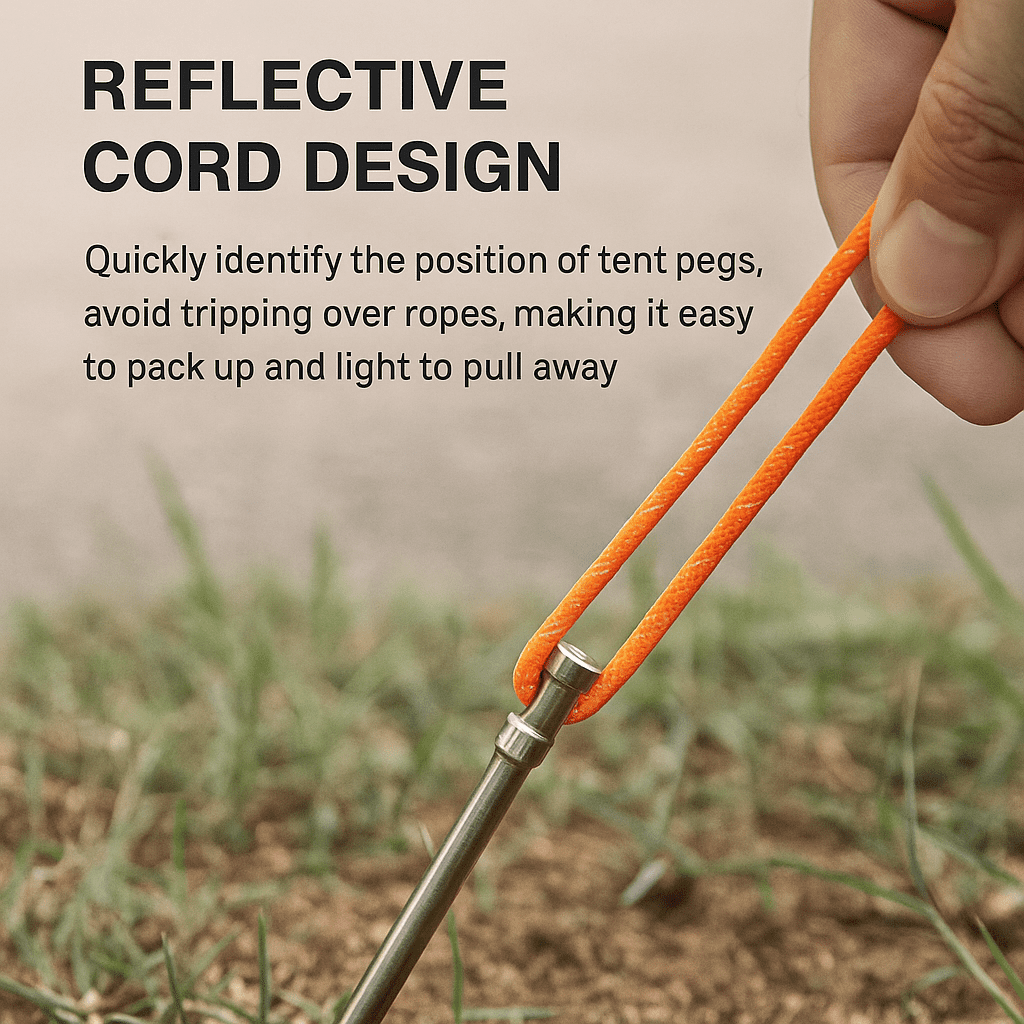
Титановые колышки для палаток (также называемые титановыми колышками для палаток) — это сверхлегкие, устойчивые к коррозии крепления, используемые для крепления палаток, навесов и укрытий к земле. Большинство титановых колышков для палаток изготавливаются из технически чистого титана (CP) класса 2 или титана Ti-6Al-4V (класса 5), что обеспечивает примерно 43% экономии веса по сравнению со стальными колышками и превосходную удерживающую прочность по сравнению с алюминиевыми эквивалентами той же массы.
For outdoor brands evaluating titanium tent peg OEM partnerships, the core decision factors are: material grade and weight (Grade 2 CP at 3-4 mm diameter typically weighs 6-8 grams per 165 mm stake), minimum order quantity (typically 50-100 pieces for standard designs), lead time (7-15 days for small batches), and per-unit cost (wholesale pricing ranges from $2.86-$3.62 USD for simple shepherd’s hook designs at moderate volumes). This guide covers specifications, manufacturing processes, supplier evaluation criteria, and common sourcing pitfalls.

What Are Titanium Tent Pegs?
Титановые колышки для палаток — это легкие наземные анкеры, изготовленные из титановых сплавов, предназначенные для крепления палаток для кемпинга, сверхлегких укрытий и уличных навесов. Они выполняют ту же функцию, что и традиционные стальные или алюминиевые колья, но используют уникальные свойства титана: высокое соотношение прочности к весу, коррозионную стойкость и долговечность.
Основные типы дизайна
Титановые колышки для палаток выпускаются в нескольких геометрических конфигурациях, каждая из которых оптимизирована для различных почвенных условий и вариантов использования:
1. Пастуший крючок (проволочные колья)
Изготовлен из титановой проволоки или стержня с крючком наверху для легкого снятия. Типичные размеры: длина 165 мм × диаметр 3–3,5 мм, вес примерно 6–8 граммов на кол. Это наиболее распространенная конструкция для сверхлегких походов.
2. V-Shaped Stakes
Изготавливается из титанового листа или формованной проволоки с V-образным поперечным сечением. V-образная форма увеличивает площадь поверхности, обеспечивая лучшую удерживающую способность на мягких почвах, сохраняя при этом малый вес. Типичные размеры: длина 160-200 мм, вес 13-15 грамм на кол.
3. Y-образные ставки
Похож на V-образные стойки, но с трехсторонним поперечным сечением для повышенной жесткости на кручение. Лучше подходит для каменистых или плотных почв. Обычно вес составляет 15–20 грамм для длины 180–200 мм.
4. Колья для гвоздей (прямые штифты)
Простой цилиндрический титановый стержень с заостренным кончиком и плоской или фигурной головкой. Распространен в минималистских системах укрытий. Размеры варьируются от 150-300 мм длины, 3-6 мм диаметра.

Сравнение веса по материалам
При одинаковой геометрии кольев (длина 165 мм, сопоставимое поперечное сечение) плотность материала приводит к следующей приблизительной разнице в весе:
- Алюминий: ~4-5 грамм (самый легкий, но более низкая прочность требует большего поперечного сечения)
- Титан: ~6-8 грамм (оптимальное соотношение силы и веса)
- Сталь: ~12–14 грамм (самый тяжелый, но самая высокая абсолютная прочность)
На практике титановые колья обеспечивают более высокую прочность на грамм по сравнению с алюминием, позволяя создавать более тонкие профили, которые приближаются к весу алюминия, сохраняя при этом удерживающую способность, как у стали.
Характеристики титанового колышка для палатки
При оценке или выборе титановых колышков для OEM-производства эти технические параметры определяют характеристики продукта и производственные требования.
Марки материалов и свойства
Титан 2-го класса (технически чистый)
- Плотность: ~4,5 г/см³
- Предел прочности: ~345 МПа
- Applications: Wire-form shepherd’s hooks and stakes where formability is prioritized
- Advantages: Superior bend tolerance, easier to form into complex shapes, lower material cost than Grade 5
- Trade-offs: Lower strength than Grade 5; may require slightly larger cross-sections for equivalent holding power
Grade 5 Titanium (Ti-6Al-4V)
- Density: ~4.42 g/cm³
- Tensile Strength: ~900-1,000 MPa
- Applications: High-performance stakes requiring maximum strength-to-weight ratio
- Advantages: Nearly 3x the tensile strength of Grade 2; allows thinner profiles and lighter final weights
- Trade-offs: More difficult to form; higher material cost; requires specific forging/annealing temperatures
Standard Dimensions and Tolerances
Shepherd’s Hook Stakes (Most Common OEM Specification)
- Length: 165 mm (±2 mm tolerance typical)
- Wire Diameter: 3.0-3.5 mm (±0.1 mm tolerance)
- Weight: 6-8 grams per stake (Grade 2)
- Hook Radius: Minimum 4.5-6× wire thickness to prevent cracking during forming
- Tip Geometry: Tapered or ground point for soil penetration
V-Shaped Stakes
- Length: 160-200 mm
- Profile Width: 8-12 mm (flattened V-cross section)
- Weight: 13-15 grams per stake
- Material Thickness: 1.0-1.5 mm titanium sheet or formed wire
Material Supply Standards
Titanium wire and rod used for tent peg manufacturing should conform to:
- ASTM B863: Titanium and titanium alloy wire
- AWS A5.16: Specification for titanium and titanium-alloy welding electrodes and rods (wire reference)
- ISO 5912:2020: Camping tents — Requirements and test methods (system-level standard for tent components)
Performance Specifications
Коррозионная стойкость
Титановые колышки для палаток естественным образом образуют пассивный оксидный слой, обеспечивающий превосходную коррозионную стойкость в соленой воде, кислых почвах и средах с высокой влажностью. Что касается соответствия палаточной системы, стандарт ISO 5912 ссылается на стандарт ISO 9227 по испытаниям металлических компонентов в солевом тумане.
Удерживающая сила
Примечание. ISO 5912:2020 явно исключил воспроизводимые испытания на стабильность из-за отсутствия стандартизированных методов. Прочность на выдергивание значительно варьируется в зависимости от:
- Тип почвы (песчаная, глинистая, суглинистая, каменистая)
- Влажность почвы
- Глубина вставки
- Угол введения (перпендикулярно или под углом)
- OEM-поставщики стоек с площадью поперечного сечения должны разработать внутренние протоколы испытаний, которые воспроизводят целевые условия почвы и документировать данные о силе выдергивания для целей сравнения.
Требования к весу
For brands marketing “minimum usable weight” (a term defined in ISO 5912), tent pegs must be included in the system weight if they are necessary to pitch the tent. This affects how stake weight is communicated in product specifications.

OEM Manufacturing Considerations
Understanding the titanium tent peg production process helps brands set realistic expectations for lead times, costs, and quality standards.
Manufacturing Processes
Wire-Form Stakes (Shepherd’s Hook, Straight Pin)
- Material Procurement: Source Grade 2 or Grade 5 titanium wire conforming to ASTM B863. Wire is available in straight lengths or coils; diameters from 0.1-6 mm (cold-drawn) and up to 15 mm (hot-rolled rod).
- Straightening: If wire arrives in coiled form, straighten before cutting.
- Cut-to-Length: Precision cutting to specified stake length (±2 mm tolerance).
- Tip Forming: Grind or taper one end to create a soil-penetrating point.
- Hook/Head Forming: For shepherd’s hooks, bend wire using forming jigs. Minimum bend radius must be 4.5-6× wire thickness to prevent cracking. Grade 5 requires more careful control than Grade 2.
- Отделка поверхности: Optional treatments include pickling (chemical cleaning), sandblasting, or anodizing for color.
- Quality Control: Dimensional checks, weight verification, visual inspection for cracks or forming defects.
Stamped/Formed V-Stakes and Y-Stakes
- Material Procurement: Titanium sheet (1.0-1.5 mm thickness) or larger-diameter wire for forming.
- Stamping/Forming: Dies press flat sheet into V or Y cross-sections. Tooling cost for new geometries ranges from $500-$2,000 USD depending on complexity.
- Cut-to-Length: Shear or cut formed profile to specified length.
- Tip and Head Forming: Flatten or form head for driving surface; sharpen tip.
- Surface Treatment and QC: Same as wire-form stakes.
Minimum Order Quantities (MOQ)
Typical titanium tent peg MOQs vary by design complexity and customization level:
Standard Designs (Existing Tooling)
- Simple shepherd’s hook stakes: 50-100 pieces
- V-stakes and Y-stakes: 100-200 pieces
Custom Designs (New Tooling Required)
- Bespoke geometries requiring new dies: 500-1,000 pieces to amortize tooling cost
Customization MOQs
- Logo engraving/marking: Minimum 100 pieces
- Custom color finishes: Minimum 100-200 pieces
- Custom packaging: Minimum 1,000 pieces
For comparison, aluminum tent stake MOQs typically run 20-30% lower due to simpler forming and wider material availability.
Сроки выполнения
Production timelines from purchase order to shipment:
Small Batches (1-100 pieces)
- Standard designs with existing tooling: 7-10 days
- Custom designs or finishes: 10-15 days
Medium Batches (101-500 pieces)
- Standard designs: 10-15 days
- Custom designs: 15-20 days
Large Batches (500+ pieces)
- Standard designs: 15-20 days
- Custom designs requiring new tooling: 20-30 days (includes tooling fabrication time)
Add 3-7 days for international shipping and customs clearance.
Cost Structure
Material Costs
Titanium raw material is the largest cost driver. Titanium forging and forming prices range from tens to hundreds of dollars per kilogram, varying by:
- Марка (CP Grade 2 по сравнению со сплавом Grade 5)
- Форм-фактор (проволока, стержень, лист)
- Количество покупки
- Текущий рыночный спрос
Оптовая цена за единицу продукции (справочная)
Для кольев с титановым пастушьим крючком диаметром 300 мм:
- 100–499 штук: ~3,62 доллара США за ставку.
- 500+ штук: ~ 2,86 доллара США за ставку.
Более короткие ставки (165 мм) обычно варьируются от 2,00 до 3,00 долларов США при умеренных объемах (200-500 штук).
Стоимость оснастки
- Колья проволочной формы с использованием стандартных гибочных приспособлений: минимальный дополнительный инструмент (~ 0–200 долларов США).
- Новые штампы для V-образных кольев или нестандартных профилей: единовременная стоимость от 500 до 2000 долларов США.
- Установка гравировки логотипа: 50–150 долларов США.
Отделка и брендинг
- Анодирование/окрашивание: добавляет 0,30–0,80 доллара за ставку.
- Лазерная гравировка логотипа: добавляет 0,15–0,40 доллара за ставку.
- Индивидуальная упаковка за единицу: добавляет 0,20–0,60 доллара США за ставку при количестве более 1000 штук.
Quality Control Checkpoints
Ensure OEM suppliers implement these QC steps:
Material Verification
- Request material test certificates (MTCs) conforming to EN 10204 3.1 for traceability
- Verify titanium grade (Grade 2 or Grade 5) matches purchase order specification
- Confirm chemistry and mechanical properties align with ASTM B863 requirements
Dimensional Inspection
- Length tolerance: ±2 mm
- Diameter tolerance: ±0.1 mm for wire stakes
- Weight verification: Measure sample stakes to confirm mass matches design specification (e.g., 6-8 grams for 165 mm × 3.5 mm Grade 2 stakes)
Forming Quality
- Inspect bend radii for cracks or surface defects
- Verify hook geometry and tip sharpness
- Check for straightness and consistent cross-section
Surface Condition
- Inspect for scratches, pits, or contamination
- Verify finish consistency if anodizing or coating is applied
Functional Testing
- Conduct pull-out testing in representative soil conditions (though no standardized method exists per ISO 5912)
- Document holding force at specified insertion depths and angles
Evaluating Titanium Tent Peg Suppliers
When vetting potential OEM partners for titanium tent peg manufacturing, use these criteria to separate qualified suppliers from unreliable sources.
Essential Certifications and Compliance
ISO 9001 Quality Management System
Verify that the supplier holds current ISO 9001 certification for their manufacturing facility. This ensures documented quality processes, traceability, and continuous improvement systems are in place.
Material Certifications
Request EN 10204 3.1 material test certificates (MTCs) for all titanium wire, rod, or sheet used in production. MTCs should document:
- Material grade (Grade 2 CP or Grade 5)
- Chemical composition
- Mechanical properties (tensile strength, yield strength, elongation)
- Heat/lot traceability
Regulatory Compliance (Market-Specific)
For European Union Markets:
- REACH compliance: Confirm supplier understanding of obligations under Regulation (EC) 1907/2006 for articles
- SVHC screening: Verify that coatings, packaging, and finishing materials are screened for Substances of Very High Concern
- Note: LFGB and FDA certifications apply to food-contact materials only, not camping hardware like tent pegs
For U.S. Markets:
- Confirm compliance with U.S. Customs and Border Protection requirements for titanium imports
- Verify country of origin documentation for tariff classification
Production Capability Assessment
Capacity and Lead Time Validation
Ask suppliers for:
- Current production capacity (pieces per day for your stake design)
- Lead time tables by quantity bracket
- Recent on-time delivery performance data
Request references from 2-3 current clients in similar volume ranges to verify promised timelines.
Tooling and Equipment
During factory audits or video calls, verify:
- Wire straightening and cutting equipment
- Forming jigs and presses appropriate for titanium
- CNC or precision grinding equipment for tip forming
- Surface treatment capabilities (pickling, sandblasting, anodizing)
- Laser or mechanical engraving equipment for logo marking
Quality Control Systems
Confirm that suppliers have:
- Incoming material inspection procedures
- In-process dimensional checks (calipers, micrometers, weight scales)
- Final inspection protocols with documented acceptance criteria
- Documented corrective action procedures for defects
Cost and MOQ Transparency
Request Detailed Quote Breakdowns
A professional supplier quote should itemize:
- Per-unit material cost
- Per-unit manufacturing cost
- Tooling costs (one-time or amortized)
- Finishing/branding costs (logo, color, packaging)
- Shipping and logistics costs
- Payment terms and deposit requirements
MOQ Negotiation Strategy
For initial orders:
- Request lower MOQs for prototype/sampling runs (50-100 pieces)
- Negotiate volume discounts with tiered pricing (e.g., 100-499 pcs, 500-999 pcs, 1000+ pcs)
- Clarify separate MOQs for branding elements (logo minimum 100 pcs, packaging minimum 1,000 pcs)

Sampling and Pre-Production Validation
Request Pre-Production Samples
Before committing to full production runs:
- Order 10-20 sample stakes at quoted specifications
- Conduct weight verification (scales accurate to 0.1 gram)
- Perform dimensional checks with calipers
- Field-test samples in representative soil conditions
- Assess surface finish quality and consistency
- Verify logo/branding quality if applicable
Document Sample Approval
Create a written sample approval document specifying:
- Approved stake dimensions and tolerances
- Approved weight range
- Surface finish standards
- Logo placement and quality requirements
This document becomes the manufacturing standard for all subsequent orders.
Red Flags to Avoid
Warning Signs of Unreliable Suppliers:
- Unable to provide material test certificates (MTCs)
- No ISO 9001 or equivalent quality certification
- Vague or inconsistent lead time commitments
- Unwilling to provide client references
- Quotes significantly below market rates (suggests substandard materials or quality shortcuts)
- Poor English communication creating specification ambiguity
- Requests for full payment upfront without established relationship
- Cannot demonstrate titanium-specific forming experience
Common Sourcing Mistakes and How to Avoid Them
Even experienced procurement teams make these errors when sourcing titanium tent pegs. Learn from others’ mistakes to avoid costly delays and quality issues.
Mistake #1: Requesting LFGB/FDA Certification for Non-Food-Contact Products
The Error: Many brands automatically request LFGB (German) or FDA (U.S.) food-contact certifications for all titanium products, including tent pegs.
Why It’s Wrong: LFGB and FDA regulations apply specifically to materials intended for food contact. Tent pegs are camping hardware, not food-contact articles. Requesting irrelevant certifications wastes time and confuses suppliers about your actual requirements.
The Fix:
- For EU markets, focus on REACH compliance (Regulation EC 1907/2006) for articles and SVHC screening
- Request material traceability via EN 10204 3.1 certificates
- For tent systems, reference ISO 5912:2020 camping tent standards
- Reserve LFGB/FDA requests for actual food-contact products (cookware, utensils, drinkware)
Mistake #2: Ignoring Separate MOQs for Branding Elements
The Error: Ordering 200 titanium tent pegs with custom logo and packaging, then discovering the logo MOQ is 100 pieces but packaging MOQ is 1,000 pieces.
Why It’s Wrong: This creates three bad outcomes:
- Delayed production while waiting for additional orders to meet packaging MOQ
- Forced acceptance of generic packaging that doesn’t match brand standards
- Unexpected cost increases to meet higher MOQs than originally budgeted
The Fix:
- Request itemized MOQs for each customization element upfront:
- Base product MOQ (typically 50-100 pcs for standard titanium stakes)
- Logo engraving/marking MOQ (typically 100 pcs)
- Custom color finish MOQ (typically 100-200 pcs)
- Custom packaging MOQ (typically 1,000 pcs)
- Phase your branding strategy: start with generic packaging for initial orders, add custom packaging once volumes justify the MOQ
- Negotiate combo MOQs: some suppliers will reduce packaging MOQ if you commit to recurring orders
Mistake #3: Assuming Lead Times Are Consistent Across Order Sizes
The Error: Receiving a 7-day lead time quote for a 50-piece sample order, then expecting the same 7-day turnaround for a 1,000-piece production order.
Why It’s Wrong: Lead times scale with order volume. Small batch quotes (1-100 pcs) reflect fast-turn capacity for samples or rush orders. Larger volumes require material procurement, extended production runs, and longer QC cycles.
Typical Reality:
- 1-100 pieces: 7-10 days
- 101-500 pieces: 10-15 days
- 500-1,000 pieces: 15-20 days
- Custom tooling adds 7-15 days
- International shipping adds 3-7 days
The Fix:
- Request lead-time tables broken down by quantity brackets
- Add 20-25% buffer to quoted lead times for production planning
- Align PO quantities with lead times that fit your launch schedule
- For seasonal products, place orders 45-60 days before required delivery date
Mistake #4: Failing to Specify Titanium Grade on Purchase Orders
The Error: Ordering “titanium tent pegs” without specifying Grade 2 (CP) or Grade 5 (Ti-6Al-4V), then receiving stakes that don’t meet strength requirements or weigh more than expected.
Why It’s Wrong: Titanium grades have dramatically different properties:
- Grade 2: ~345 MPa tensile strength, easier to form, lower cost
- Grade 5: ~900-1,000 MPa tensile strength, higher cost, requires specific forming processes
Suppliers may default to Grade 2 to minimize costs, or use inconsistent grades across production runs, creating product variability.
The Fix:
- Explicitly specify titanium grade on all POs: “Grade 2 CP titanium per ASTM B863” or “Grade 5 Ti-6Al-4V per ASTM B863”
- Request material test certificates (EN 10204 3.1) with each shipment to verify grade
- Document grade selection in your product specification sheet
- Match grade to application: Grade 2 for cost-sensitive wire hooks; Grade 5 for high-performance stakes requiring thinner profiles
Mistake #5: Not Budgeting for Tooling Costs on Custom Geometries
The Error: Designing a unique V-stake or Y-stake profile, submitting it for quotation, and receiving a quote with $1,500 USD in tooling costs that weren’t anticipated in the product budget.
Why It’s Wrong: Custom geometries require dedicated stamping dies, forming jigs, or bending fixtures. Tooling costs are one-time investments that significantly impact first-order economics but amortize over repeat production runs.
Typical Tooling Costs:
- Standard wire-form bending (existing jigs): $0-$200
- Custom V-stake stamping dies: $500-$1,500 USD
- Complex multi-feature stakes: $1,500-$3,000 USD
The Fix:
- Ask suppliers: “Will this design require new tooling? If yes, what’s the cost and who owns the tooling?”
- Negotiate tooling ownership: clarify whether you own the dies (allowing supplier changes) or supplier retains ownership
- Amortize tooling cost across multiple orders when modeling product economics
- For initial market tests, consider standard geometries (shepherd’s hooks) that require minimal custom tooling
Mistake #6: Over-Relying on Single-Source Suppliers
The Error: Establishing an exclusive relationship with one titanium tent peg supplier without backup options, then facing production halts when that supplier experiences capacity constraints or material shortages.
Why It’s Wrong: Titanium’s supply chain concentration (China produces ~70% of global titanium sponge) creates upstream volatility. Single-source strategies expose brands to:
- Material allocation issues during aerospace demand spikes
- Factory capacity constraints during peak seasons
- Quality problems with no immediate alternative
- Reduced negotiating leverage on pricing
The Fix:
- Qualify at least two suppliers for your stake specifications
- Split orders 70/30 or 80/20 between primary and secondary suppliers to maintain relationships
- Document specifications and tooling requirements in a way that’s transferable between suppliers
- Conduct annual supplier reviews comparing quality, delivery performance, and pricing
- For critical product lines, maintain 8-12 weeks of safety stock to buffer supply disruptions
Mistake #7: Skipping Field Testing Before Large Production Runs
The Error: Approving samples based on dimensional checks and weight alone, then discovering holding strength issues or bent stakes after 500-1,000 units are delivered and field-tested by customers.
Why It’s Wrong: Dimensional accuracy doesn’t guarantee field performance. Titanium’s springback, forming stresses, and tip geometry all affect real-world holding strength. Discovering performance issues after large production runs creates:
- Warranty costs and customer dissatisfaction
- Unsellable inventory
- Expensive rework or scrapping
The Fix:
- Order 20-30 pre-production samples
- Conduct field testing in representative soil conditions:
- Sandy soil (beach, desert)
- Clay soil (firm, dense)
- Rocky/hard-packed soil (alpine, gravel)
- Test insertion ease, holding strength, and removal difficulty
- Assess any bending, cracking, or deformation after repeated use
- Document approval criteria before scaling to full production
- Require suppliers to replicate field test conditions and share pull-out force data

Часто задаваемые вопросы
What is the typical weight difference between titanium and aluminum tent pegs?
For identical stake geometry, titanium weighs approximately 1.66× more than aluminum by mass. However, titanium’s superior strength allows thinner cross-sections, narrowing the real-world weight gap. A typical 165 mm shepherd’s hook stake weighs 6-8 grams in titanium versus 4-5 grams in aluminum, but the titanium stake delivers significantly better holding strength and durability.
Which titanium grade is better for tent pegs: Grade 2 or Grade 5?
Grade 2 (commercially pure) offers easier formability, lower cost, and adequate strength for most ultralight applications. Grade 5 (Ti-6Al-4V) provides nearly 3× the tensile strength, allowing thinner profiles and lighter final weights, but costs more and requires specialized forming. For cost-sensitive wire hooks targeting recreational users, Grade 2 is sufficient. For high-performance stakes targeting ultralight backpackers willing to pay premium prices, Grade 5 justifies the cost.
What MOQ should I expect for titanium tent peg OEM orders?
Typical MOQs are:
- Standard designs (shepherd’s hooks, existing tooling): 50-100 pieces
- Custom V-stakes or Y-stakes: 100-200 pieces
- Bespoke geometries requiring new dies: 500-1,000 pieces
- Logo engraving: 100 pieces minimum
- Индивидуальная упаковка: минимум 1000 штук.
Эти минимальный заказ примерно на 20-30% выше, чем у алюминия, из-за особых требований к обработке титана.
Сколько времени занимает производство титановых колышков для палаток?
Сроки выполнения зависят от размера заказа:
- 1-100 штук (стандартные конструкции): 7-10 дней
- 101-500 pieces: 10-15 days
- 500+ штук: 15-20 дней
- Custom tooling adds 7-15 days
- International shipping adds 3-7 days
При выпуске сезонных продуктов размещайте заказы за 45–60 дней до необходимой доставки, чтобы учесть время производства, проверки качества и логистику.
Стоят ли титановые колышки для палаток более высокой стоимости по сравнению с алюминиевыми?
For ultralight backpackers and premium outdoor brands, yes. Titanium tent pegs offer superior strength-to-weight ratio, corrosion resistance (critical in coastal/marine environments), and long-term durability that justifies wholesale costs of $2.86-$3.62 USD per stake versus $0.80-$1.50 for aluminum. The value proposition depends on target customer willingness to pay for performance and durability versus initial cost.
Do I need LFGB or FDA certification for titanium tent pegs?
No. LFGB and FDA certifications apply only to food-contact materials (cookware, utensils, drinkware). Tent pegs are camping hardware, not food-contact articles. For compliance, focus on:
- EN 10204 3.1 material test certificates for traceability
- ISO 9001 certification for supplier quality management
- REACH compliance (EU markets) for articles and SVHC screening
- ISO 5912:2020 for tent system component standards
Can titanium tent pegs be anodized or colored?
Yes. Titanium accepts anodizing and surface treatments for color customization. Typical MOQ for custom colors is 100-200 pieces, with $0.30-$0.80 USD added cost per stake. Popular colors include gold, blue, purple, and black. Anodizing also improves corrosion resistance and surface hardness.
What certifications should I request from titanium tent peg suppliers?
Essential certifications:
- ISO 9001: Quality management system certification
- EN 10204 3.1: Material test certificates (MTCs) documenting titanium grade, chemistry, and mechanical properties
- REACH compliance documentation (for EU markets)
Request these documents before placing production orders to ensure supplier credibility and material traceability.
How do I calculate the total landed cost for titanium tent peg OEM orders?
Total cost breakdown:
- Per-unit material + manufacturing cost: $2.00-$3.62 USD depending on volume and design
- Tooling (if applicable): $0-$2,000 USD one-time cost
- Logo engraving: $0.15-$0.40 per stake
- Color finish: $0.30-$0.80 per stake
- Custom packaging: $0.20-$0.60 per stake (at 1,000+ quantity)
- Shipping: Varies by destination; budget $0.20-$0.50 per stake for international freight
- Customs/duties: Check HS code classification for titanium hardware; typical U.S. duty rates 2-4%
For 500 titanium shepherd’s hooks with logo, budget approximately $3.50-$4.50 USD total landed cost per stake.
What’s the difference between V-stakes and shepherd’s hook stakes?
Shepherd’s hook stakes are formed from round titanium wire (3-3.5 mm diameter) with a hook at the top for easy removal. They weigh 6-8 grams and work well in firm soils. V-stakes have a V-shaped cross-section that increases surface area for better holding in soft soils like sand or loose dirt. They weigh 13-15 grams due to larger profile. Choose shepherd’s hooks for weight-critical applications and firm ground; choose V-stakes for soft soil conditions where holding power matters more than minimal weight.
Working with 7Titanium
At 7Titanium, we specialize in titanium outdoor gear OEM manufacturing with a focus on supply chain transparency and quality execution. Our titanium tent peg capabilities include:
Экспертиза материалов
- Direct sourcing of Grade 2 CP and Grade 5 Ti-6Al-4V titanium wire and sheet conforming to ASTM B863
- EN 10204 3.1 material test certificates provided with every shipment
- Safety stock of common wire diameters (3 mm, 3.5 mm, 4 mm) to shorten lead times
Design and Manufacturing Capabilities
- Standard shepherd’s hook stakes (165 mm, 3-3.5 mm diameter, 6-8 grams)
- V-shaped stakes (160-200 mm, customizable profiles)
- Custom geometries with in-house tooling design and fabrication
- Laser engraving for logo marking (0.1 mm precision)
- Anodizing and color treatments (gold, blue, purple, black, custom colors)
MOQ Flexibility
- Standard designs: 50-piece minimum for sampling and market testing
- Custom designs: 200-500 pieces depending on tooling requirements
- Transparent tiered pricing with volume discounts clearly documented
Lead Time Performance
- 7-10 days for standard stake orders (50-100 pieces)
- 10-15 days for medium batches (101-500 pieces) with custom branding
- 15-20 days for custom geometries with new tooling
- Real-time production updates via email and WhatsApp
Quality Assurance
- ISO 9001:2015 certified manufacturing facility
- 100% dimensional inspection (length ±2 mm, diameter ±0.1 mm, weight verification)
- Forming quality checks for crack detection and bend radius compliance
- Pre-shipment sampling available for customer approval
Why Outdoor Brands Choose 7Titanium
- Supply Chain Transparency: We maintain direct relationships with titanium sponge suppliers and provide full material traceability from raw material to finished product.
- Realistic Expectations: We provide honest lead time and MOQ guidance based on actual production capacity, not optimistic promises that create downstream delays.
- Technical Support: Our engineering team helps optimize stake designs for manufacturability, cost, and performance before tooling investment.
- Compliance Documentation: We provide all necessary certifications (ISO 9001, EN 10204 3.1 MTCs, REACH compliance) without brands needing to chase documentation.
Ready to Discuss Your Titanium Tent Peg Project?
Whether you’re launching your first titanium product line or seeking a more reliable OEM partner, we’ll review your specifications, discuss realistic timelines and MOQs, and help determine the best material grade and geometry for your target market.
Контакт 7Титан
- Веб-сайт: 7titanium.com
- Электронная почта: [email protected]
- WhatsApp: +86 135 2410 5790
- Product Catalog: 7titanium.com/products/titanium-tools-edc/tent-pegs
Let’s build reliable titanium tent pegs that match your brand’s performance standards and customer expectations.