
Titanium OEM · Lead Time Strategy
By Max JiangNovember 16, 2025Reading time: ~12–15 minutes
Production delays in titanium OEM manufacturing carry a steep price. A single late delivery can ripple through aircraft assembly schedules, postpone medical device launches, or trigger contractual penalties that erase already thin margins. This guide explains why delays happen and how OEMs can systematically prevent them across the entire titanium value chain.

Late titanium deliveries ripple through aerospace, medical and industrial OEM schedules — but most delays are preventable with the right systems.
Sommario
- 1. Understanding Root Causes of Production Delays
- 2. Mastering Supply Chain and Material Management
- 3. Building Proactive Quality Systems
- 4. Navigating Regulatory and Compliance Requirements
- 5. Implementation Framework: From Strategy to Action
- Conclusion: Prevention as Competitive Advantage
Production delays in titanium OEM manufacturing carry a steep price. A single late delivery can ripple through aircraft assembly schedules, postpone medical device launches, or trigger contractual penalties that erase already thin margins. The numbers tell the story: forged titanium components can take 6 to 18 months from raw material order to finished part, with raw titanium itself requiring roughly nine months to procure. When delays push those timelines even longer (sometimes by 12 months or more), the cascading effects touch every stakeholder in the supply chain.
Yet most delays are not inevitable. They stem from identifiable root causes: stretched supply chains with limited visibility, quality failures that demand rework, equipment breakdowns, audit stoppages, and capacity bottlenecks across multi-tier suppliers. For production managers and procurement teams navigating aerospace, medical device, automotive, and industrial OEM sectors, the question is no longer whether titanium production is inherently unpredictable. It’s whether your organization has put systematic prevention measures in place.
This article lays out the mechanics of titanium production delays and the proven strategies to prevent them, from supply chain design and quality system architecture to regulatory navigation and capacity planning.
Understanding Root Causes of Production Delays
Titanium manufacturing uses multiple routes: milling and machining, forging, investment casting, and additive manufacturing. Each brings distinct technical and schedule risks.
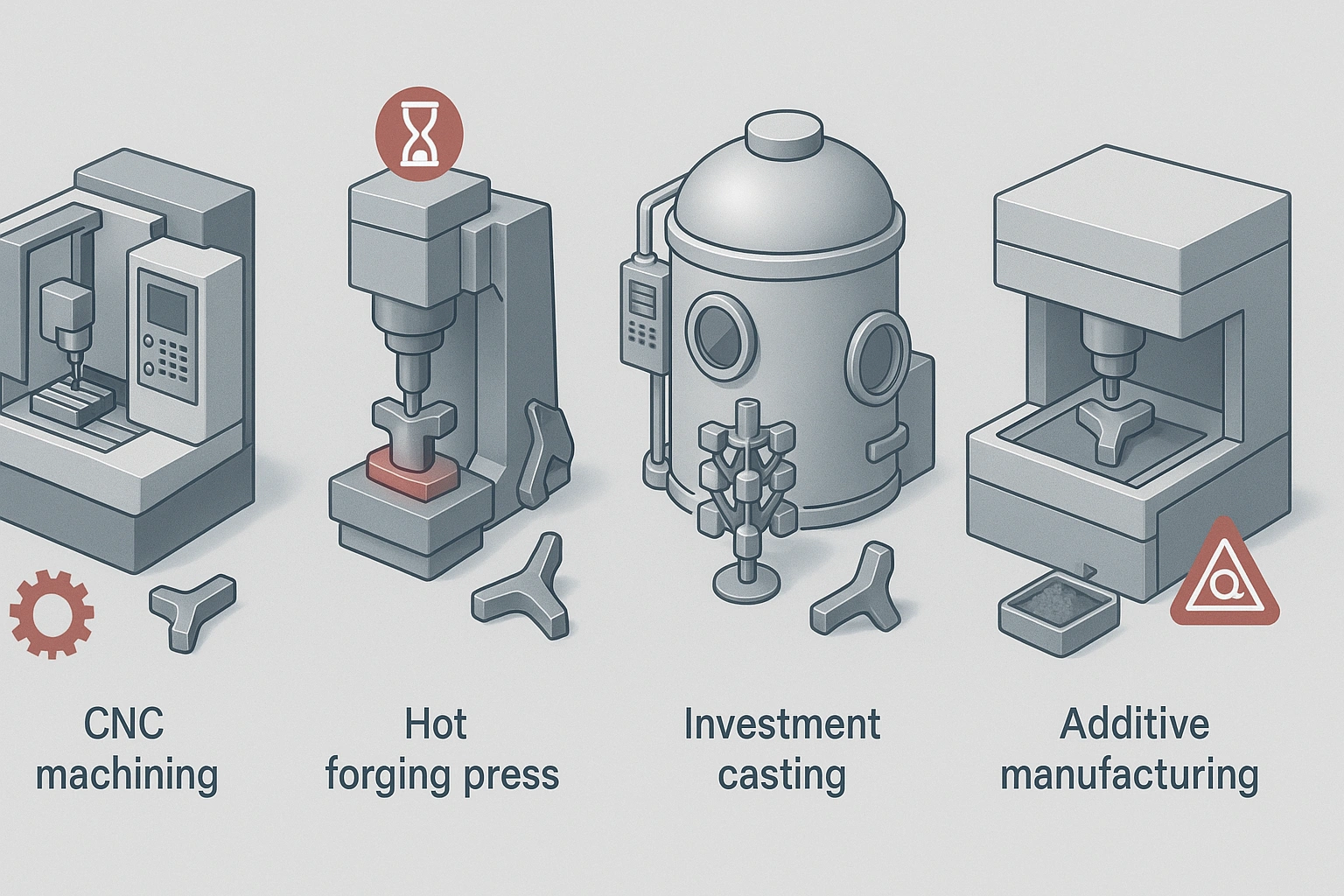
Machining, forging, casting and additive manufacturing each introduce unique delay risks that must be managed at the process level.
Machining and milling
Machining and milling: Low thermal conductivity forces roughly 80% of cutting heat into the tool rather than the chip, accelerating tool wear and raising the risk of tool failure mid-operation. Ti-6Al-4V remains the workhorse alloy, but higher-strength beta alloys (Ti-10V-2Fe-3Al, Ti-5Al-5V-5Mo-3Cr) have even lower machinability and demand reduced speeds. Practical countermeasures (positive rake geometry, climb milling, high-pressure through-tool coolant) help tool life, but the physics still make machining a frequent source of equipment stress, unplanned tool changes, and schedule variability.
Forgiatura
Forging: Forging uses compressive forces to shape parts, optimizing strength-to-weight ratios and microstructural consistency. Typical sequences repeat pressing, cleaning, grinding, and thermal treatment steps several times per part. Because forging suppliers often serve multiple OEMs and face long qualification cycles, capacity constraints and order backlogs can stretch cycle times significantly.
Investment casting
Investment casting: Titanium casting requires vacuum melting and specialized ceramic systems due to the metal’s reactivity. Common defects include centerline shrinkage porosity, mitigated by hot isostatic pressing (HIP), and subsequent weld repairs performed in inert atmospheres. Titanium also reacts with ceramic molds to form an oxygen-enriched “alpha case” layer that must be removed by chemical milling. Each remediation step (HIP, weld repair, alpha-case removal) adds cycle time and introduces rework risk.
Additive manufacturing (AM)
Additive manufacturing (AM): Powder-bed fusion processes (laser PBF and electron beam melting) are increasingly qualified for titanium components under standards such as ASTM F2924 and F3001, which define feedstock requirements, microstructure, mechanical properties, thermal processing, HIP, inspection, and certification. Recent ISO/ASTM 52928:2024 codifies powder life-cycle management, covering properties, test methods, and quality assurance for both virgin and reused powder. While AM can shorten lead times for complex geometries, it introduces powder quality loops, post-process HIP schedules, and qualification documentation that must be managed carefully to avoid delays.
Supply chain and material constraints
Supply chain and material constraints: Raw titanium lead times currently run about nine months, and end-to-end manufacturing cycles for cast or forged parts span 6 to 18+ months. OEMs often lack deep visibility beyond their direct suppliers, causing order timing mismatches and schedule slips when demand signals fail to propagate through the chain.
Quality control failures
Quality control failures: Casting porosity requiring HIP and weld repair, alpha-case removal via chemical milling, and machining tool failures due to heat can all trigger rework and push schedules. When quality escapes are caught late (during final inspection or customer receipt inspection), the cycle resets.
Equipment and process constraints
Equipment and process constraints: Heat-treat furnaces, vacuum melt equipment, and high-pressure coolant delivery systems are critical bottlenecks. Many of these special processes fall under Nadcap accreditation, an industry-managed, second-party audit program accepted by multiple OEMs. Lack of accreditation or audit nonconformances can halt shipments until corrective actions close.
Labor and engineering capacity gaps
Labor and engineering capacity gaps: Post-pandemic workforce losses slowed new-part qualification and production troubleshooting across OEMs, Tier 1 suppliers, foundries, and forges. Onboarding periods of 3 to 6 months and multi-year experience curves mean that capacity cannot be added overnight, even when capital is available.
Regulatory compliance bottlenecks
Regulatory compliance bottlenecks: Defense programs face DFARS specialty-metals clauses that restrict acquisition to titanium melted or produced in the U.S. or qualifying countries, with narrow exceptions. For medical device OEMs, the FDA’s Quality Management System Regulation (QMSR) now incorporates ISO 13485:2016 by reference, with full enforcement starting February 2, 2026. System updates, training, and inspection changes can temporarily affect throughput as organizations transition.
Figura 1: Root causes of production delays in OEM titanium manufacturing, categorized by domain. Understanding these interconnected factors enables targeted prevention strategies.
Mastering Supply Chain and Material Management
The titanium supply chain in 2024–2025 has been reshaped by rising non-Russian, aerospace-approved sponge output, rapid capacity additions in China’s industrial-grade market, and OEM production-rate adjustments that tempered raw-material intake. Aerospace-approved sponge production increased to 89,000 tonnes across Japan, Kazakhstan, and Saudi Arabia, as lower Japanese output was offset by higher utilization in Kazakhstan (UKTMP) and ramp-up in Saudi Arabia (AMIC Toho Titanium Metal). Meanwhile, China held sponge output roughly steady at around 220,000 tonnes but continued to expand capacity aggressively (estimated at 260,000 tonnes per year by end-2024 and possibly up to 320,000 tonnes per year), producing an oversupplied domestic market. However, Chinese sponge is not yet qualified for critical aerospace applications, leaving tightness in aerospace-approved material and prompting some Western ingot melters and U.S. consumers to test Chinese sponge as a supplement.
Contract prices for Western commercial-purity grade 2 titanium ingot were assessed at $11.50–12.50 per kilogram, versus domestic Chinese TA2-grade ingot at roughly $7.14–7.41 per kilogram. These spreads incentivize exploration of lower-cost sources where qualification allows.

Titanium sponge, ingot, forging and OEM routes form a long global supply chain. Visibility and realistic lead times are critical to avoiding delays.
Strengthen demand signaling and inventory strategies: Provide reliable, low-volatility, long-term demand signals to indirect suppliers. Many Tier 2 and Tier 3 suppliers lack visibility into OEM build rates and make capacity decisions based on outdated or incomplete information. Consider directed buys for critical alloys and holding buffer inventory for low-volume parts to reduce schedule surprises.
Assume more contractual risk and secure capacity: Offer longer-term contracts (10+ years), volume guarantees, and premiums for aftermarket parts. Boom-bust cycles and program shocks have eroded supplier trust and limited capacity expansions. Where strategic, co-invest in or develop in-house casting or forging capacity to reduce dependence on constrained external suppliers.
Deploy experienced engineering support into supplier sites: Rehire or assign OEM engineers to help stabilize processes and accelerate qualification and troubleshooting at foundries and forges. Deep process knowledge held by OEM engineers can shorten learning curves and prevent quality escapes that would otherwise trigger rework loops.
Use route alternatives and design for manufacturability: Where feasible, pivot select parts from casting or forging to additive manufacturing or advanced machining. Revisit performance specifications and alloy choices to improve manufacturability and enable multi-source availability. Parts designed with tight, legacy tolerances may lock in a single supplier and a single process route, magnifying delay risk.
Plan purchase orders against realistic lead times: Align procurement calendars with the actual 6–18+ month end-to-end cycles for cast and forged parts, plus the roughly nine-month raw titanium procurement window. Front-load orders for long-lead items and build schedule buffers that reflect the physics and economics of the supply base, not aspirational timelines.
Figure 2: Typical end-to-end production timeline for cast and forged titanium components. Red markers indicate common delay points where proactive management yields the highest schedule protection.
Building Proactive Quality Systems
Quality failures are among the most expensive delay drivers because they surface late and force rework through multiple process steps. A casting defect discovered during final inspection can send the part back through HIP, weld repair, chemical milling, and re-inspection, adding weeks or months to the schedule. Proactive quality systems catch problems early and prevent defects from propagating.
Embed Advanced Product Quality Planning (APQP) and Production Part Approval Process (PPAP) practices per AS9145: Plan quality early, with phase reviews from concept through production. Use PPAP to confirm demonstrated capability at required rates before ramping volume. This approach reduces late-stage surprises and ensures that process capability is proven, not assumed.
Maintain Nadcap accreditation and internal audits on special processes: Heat treating, non-destructive testing (NDT), welding, chemical processing, and additive manufacturing accreditations reduce audit-driven stoppages and raise process capability. Nadcap is an industry-managed, second-party audit program accepted by multiple OEMs across aerospace and defense. Many companies require accreditation, and missing or failed audits can halt shipments until corrective actions close. Treat Nadcap not as a compliance burden but as a process-improvement lever.
Use real-time process monitoring and Statistical Process Control (SPC): Instrument critical parameters (melt temperatures, cooling rates, tool wear indicators, powder moisture content) and use SPC to detect process drift before it produces scrap. Real-time monitoring allows operators to intervene early, reducing the frequency of end-of-line rejections.
Design First Article Inspection (FAI) and in-process inspection gates: Structure inspection points at logical process transitions (after forging but before heat treat, after rough machining but before finish operations) so that nonconformances are caught when corrective action is still feasible and less costly. Waiting until final inspection to discover a dimensional error or microstructural anomaly often means the part must restart from an earlier operation or be scrapped entirely.
Invest in supplier quality engineering and on-site presence: Deploy quality engineers to Tier 1 and Tier 2 suppliers to support process validation, root-cause analysis, and corrective action. Supplier-resident quality teams can identify emerging issues before they become systemic, reducing the volume of returned parts and schedule disruptions.
Figure 3: Strategic placement of inspection gates throughout the manufacturing process. Early detection at intermediate checkpoints prevents costly rework and schedule resets that occur when defects are discovered only at final inspection.
Navigating Regulatory and Compliance Requirements
Regulatory requirements impose hard gates on production schedules. Missing a compliance deadline or failing an audit can stop shipments, even when parts are physically ready.
Defense programs and DFARS specialty-metals clauses: DFARS 252.225-7008 and 252.225-7009 restrict specialty metals (explicitly including titanium and titanium alloys) to U.S. or qualifying-country melt and production, with limited exceptions for commercial off-the-shelf items and minimal-content thresholds. Make sure procurement contracts flow down these requirements to subcontractors and that material certifications trace melt origin. Qualification of new suppliers under DFARS can take months; plan supplier audits and documentation reviews well in advance of need.
Medical device QMSR and ISO 13485:2016 alignment: The FDA’s 2024 final rule incorporates ISO 13485:2016 by reference, with enforcement starting February 2, 2026. This transition requires system updates, training, and changes to inspection practices. For OEMs with medical device divisions, schedule internal audits and gap analyses now to identify and close nonconformances before enforcement begins. Regulatory readiness should be treated as a critical-path item, not an administrative afterthought.
Aerospace QMS (AS9100/IA9100) and supplier harmonization: AS9100 and its international variants harmonize aerospace quality management system requirements to reduce organization-unique add-ons and improve quality, schedule, and cost. Ensure that your supply base is certified and that internal processes align with the standard’s emphasis on risk management, configuration control, and on-time delivery. Supplier audits should verify not just certification status but active conformance to process controls.
Align PPAP, FAI, and Nadcap audit calendars with build schedules: Coordinate Production Part Approval Process (PPAP) submissions, First Article Inspections (FAI), and Nadcap audit windows with planned production ramps. Waiting until parts are ready to ship before scheduling audits or PPAP reviews creates unnecessary idle time. Build these milestones into the master schedule from the outset.
Implementation Framework: From Strategy to Action
Strategy without execution is planning theater. Turning delay-prevention principles into operational reality requires a structured implementation approach.
Conduct a delay root-cause analysis across the last 12 months: Categorize each delay by root cause (supply chain, quality, equipment, labor, regulatory) and quantify schedule impact. This baseline reveals where prevention efforts will yield the highest return and builds the business case for investment.
Map critical paths and identify bottleneck operations: Use value-stream mapping or critical-chain project management to visualize the end-to-end production flow. Identify the constraining operations (often heat treat, HIP, or specialized machining) and focus improvement resources there. Relieving a bottleneck elsewhere in the chain yields no throughput gain.
Establish joint planning cycles with Tier 1 and Tier 2 suppliers: Move from purchase-order-driven interactions to collaborative demand planning. Share rolling forecasts, engineering change pipelines, and aftermarket projections so that suppliers can adjust capacity and staffing proactively rather than reactively.
Create cross-functional delay-prevention teams: Form standing teams that include procurement, quality, engineering, and production control representatives. Task them with monitoring lead-time trends, supplier health, audit calendars, and early warning indicators. Empower these teams to escalate emerging risks before they become schedule slips.
Track and report leading indicators, not just lagging metrics: On-time delivery percentage is a lagging indicator that tells you delays have already happened. Leading indicators (supplier order acknowledgment time, tool-life trends, audit finding closure rates, raw-material inventory levels) give you time to intervene. Build dashboards that surface these signals and trigger action when thresholds are crossed.
Pilot improvements on constrained parts first: Select a handful of high-impact, high-delay parts as pilots for new supplier relationships, process routes, or quality protocols. Prove the concept on a manageable scale, document lessons learned, and then scale across the portfolio. Attempting to transform the entire supply base simultaneously dilutes resources and increases execution risk.
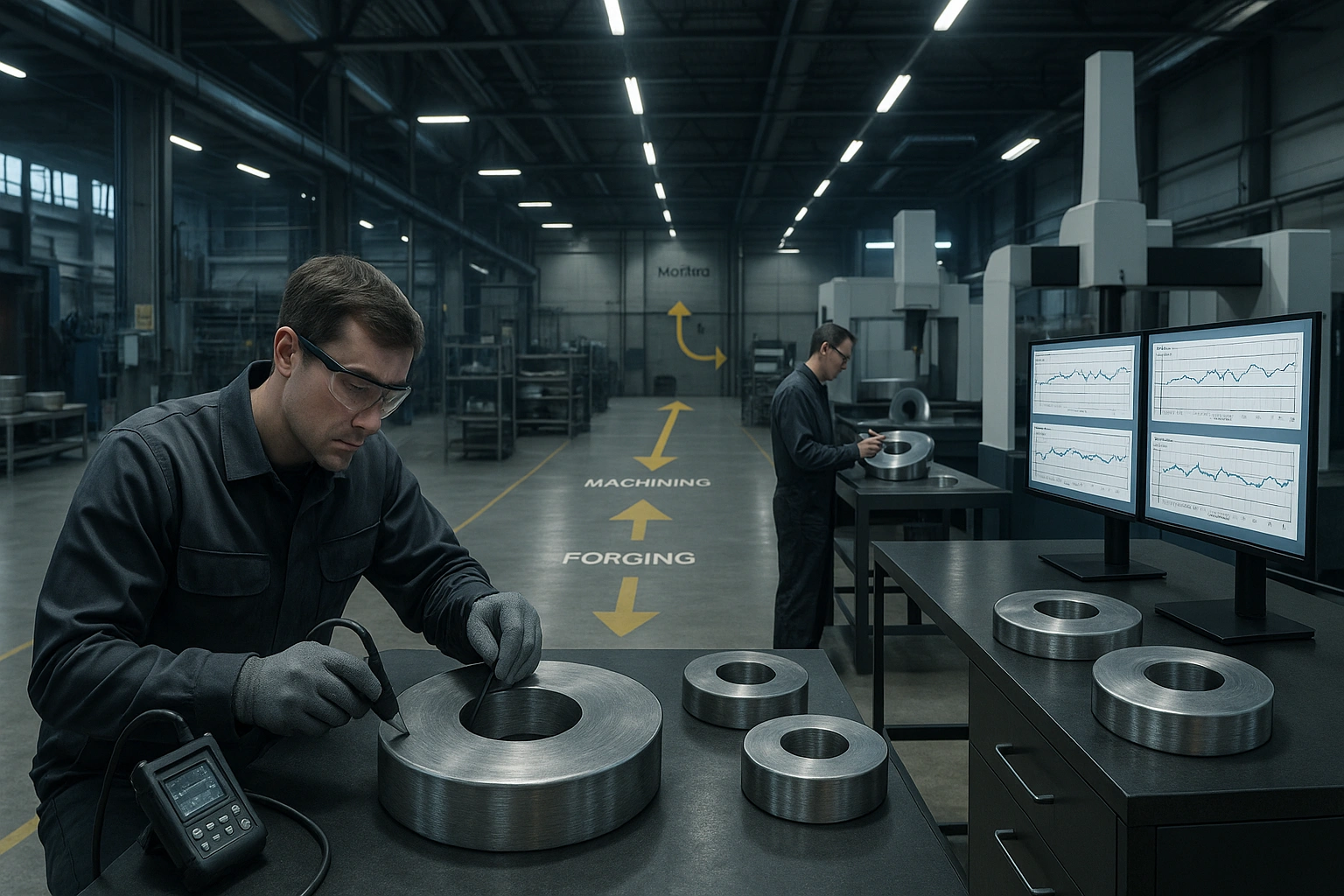
Cross-functional teams that track leading indicators and share forecasts with suppliers can prevent small issues from becoming schedule-slipping crises.
Conclusion: Prevention as Competitive Advantage
Production delays in titanium OEM manufacturing are expensive, disruptive, and largely preventable. The root causes are known: stretched supply chains, quality failures, equipment constraints, workforce gaps, and regulatory bottlenecks. The prevention strategies are proven: stronger demand signaling, long-term supplier partnerships, embedded engineering support, proactive quality systems, and regulatory readiness planning.
What separates high-performing OEMs from their struggling peers is not access to better information or more capable suppliers. It’s the discipline to put systematic prevention measures in place and the organizational commitment to treat schedule reliability as a strategic priority rather than an operational afterthought. In an industry where lead times are measured in months and delays cascade across programs, that discipline becomes a competitive advantage, one that compounds over time as supplier relationships strengthen, process capability improves, and institutional knowledge deepens.
The question is not whether your organization can afford to invest in delay prevention. It’s whether you can afford not to.
Frequently Asked Questions on Preventing Titanium OEM Production Delays
Below are concise answers to common questions about why titanium is difficult to produce, where delays originate, and how OEMs can systematically prevent schedule slippage in aerospace, medical, and high-performance industrial programs.
-
Q1 Why is titanium so expensive and difficult to produce?
Titanium is costly and challenging because of:- Extraction complexity: it must be refined from minerals like ilmenite and rutile.
- Kroll process: the dominant extraction route is energy-intensive and tightly controlled.
- High reactivity: at elevated temperatures titanium reacts with oxygen, nitrogen, and hydrogen, requiring vacuum or inert atmospheres.
- Specialized processing: downstream forging, casting, machining, and inspection need dedicated equipment, tooling, and expertise.
-
Q2 How can OEM titanium production lead times be reduced?
OEM titanium lead times can be reduced by:- Early supplier engagement during design and industrialization.
- Strategic inventory holding for critical alloys and low-volume parts.
- Lean manufacturing to remove bottlenecks and non-value-added steps.
- Advanced technologies such as high-performance machining and additive manufacturing for complex parts.
- Negotiated, realistic lead times with suppliers, including incentives and penalties tied to delivery performance.
-
Q3 What solutions are being implemented to address titanium supply shortages?
The industry is addressing titanium supply shortages through:- Expanded titanium recycling to reduce reliance on primary sponge.
- Alternative production methods that lower cost and energy use.
- Supply chain digitization for end-to-end visibility and predictive analytics.
- Strategic stockpiling of critical materials where risk and demand justify it.
-
Q4 What are the key quality control procedures for titanium?
Key quality controls include:- Raw material inspection against specifications and certificates.
- Controlli in itinere at critical forging, casting, machining, and heat-treat steps.
- Final inspection of dimensions, surface, and properties.
- Full documentation and traceability back to melt and heat.
- Chemical analysis (e.g., XRF, ICP) to confirm alloy composition.
- Mechanical testing (tensile, hardness, fatigue, impact) to validate performance.
-
Q5 How do manufacturers detect defects in titanium components?
Manufacturers use a combination of:- Visual inspection for obvious surface issues.
- Ultrasonic testing (UT) to detect internal flaws and discontinuities.
- X-ray / radiography or CT to reveal internal porosity and inclusions.
- Eddy current testing (ECT) for surface and near-surface cracks.
- Liquid penetrant inspection (LPI) for surface-breaking defects.
-
Q6 Can lean manufacturing be applied to titanium production to reduce lead times?
Yes. Lean manufacturing is highly applicable in titanium:- Value stream mapping exposes bottlenecks and waiting time.
- Standardized work stabilizes processes and reduces variability.
- Kaizen and continuous improvement drive small, frequent optimizations.
- Waste elimination shortens cycle time and reduces rework and inventory.
-
Q7 What are the main risks in the titanium supply chain?
Major risks include:- Supply risks: raw material shortages, geopolitical instability, and limited aerospace-approved capacity.
- Production risks: equipment breakdowns, labor shortages, and quality escapes that trigger rework.
- Demand risks: volatile build rates and forecasting errors.
- Regulatory risks: DFARS, export controls, and changing quality standards.
- Financial risks: price volatility and currency fluctuations affecting long-term contracts.