
Les piquets de tente en titane (également appelés piquets de tente en titane) sont des attaches ultralégères et résistantes à la corrosion utilisées pour fixer les tentes, les auvents et les abris au sol. La plupart des piquets de tente en titane sont fabriqués à partir de titane commercialement pur (CP) de grade 2 ou de titane Ti-6Al-4V (grade 5), offrant environ 43 % d'économie de poids par rapport aux piquets en acier et une résistance de maintien supérieure par rapport aux équivalents en aluminium de même masse.
Pour les marques d'extérieur évaluant les partenariats OEM de piquets de tente en titane, les principaux facteurs de décision sont : la qualité et le poids du matériau (le CP de grade 2 avec un diamètre de 3 à 4 mm pèse généralement 6 à 8 grammes par piquet de 165 mm), la quantité minimale de commande (généralement 50 à 100 pièces pour les conceptions standard), le délai de livraison (7 à 15 jours pour les petits lots) et le coût unitaire (les prix de gros varient de 2,86 $ à 3,62 $ US pour les modèles simples à crochets de berger. à volumes modérés). Ce guide couvre les spécifications, les processus de fabrication, les critères d'évaluation des fournisseurs et les pièges courants en matière d'approvisionnement.

Que sont les piquets de tente en titane ?
Les piquets de tente en titane sont des ancrages au sol légers fabriqués à partir d'alliages de titane, conçus pour sécuriser les tentes de camping, les abris ultralégers et les auvents extérieurs. Ils remplissent la même fonction que les piquets traditionnels en acier ou en aluminium, mais exploitent les propriétés uniques du titane : rapport résistance/poids élevé, résistance à la corrosion et durabilité.
Types de conception principaux
Les piquets de tente en titane sont disponibles dans plusieurs configurations géométriques, chacune optimisée pour différentes conditions de sol et cas d'utilisation :
1. Crochet de berger (piquets métalliques)
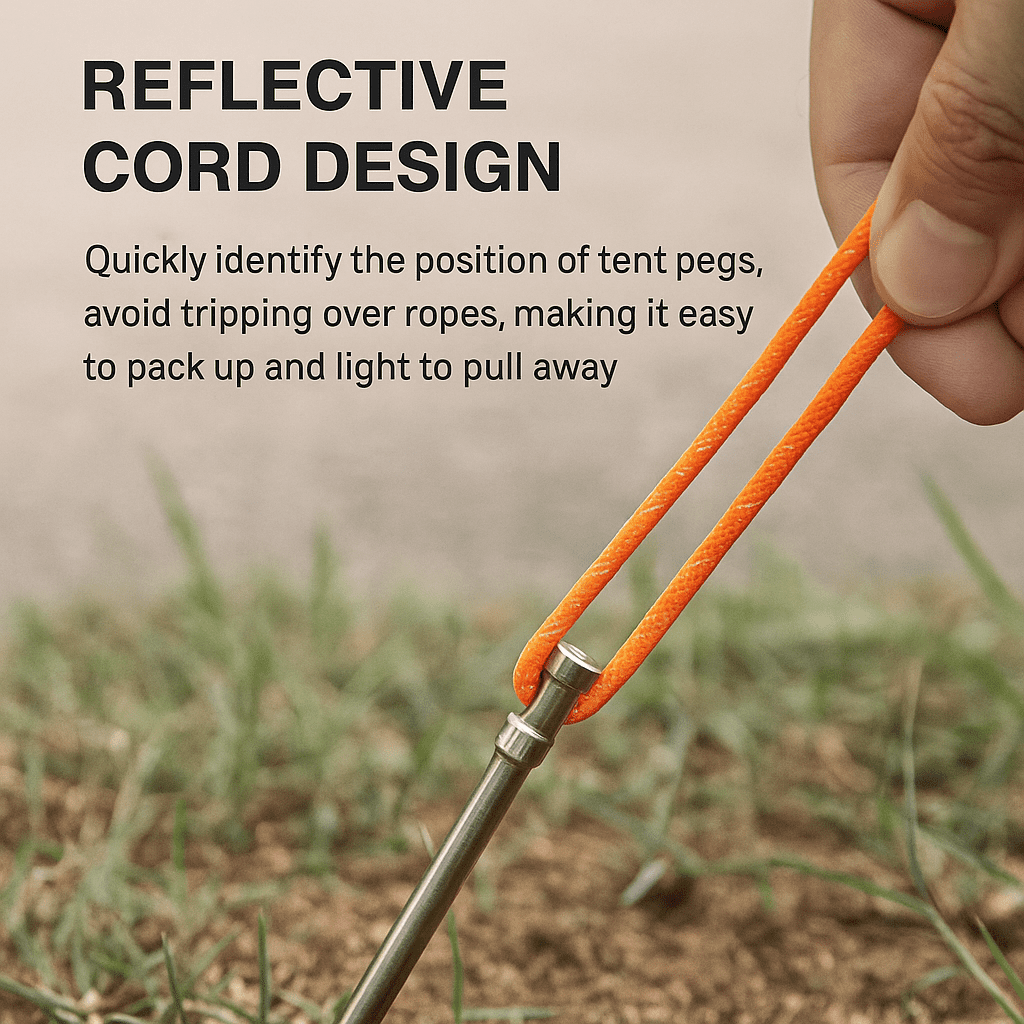
Formé à partir d'un fil ou d'une tige de titane avec un crochet en haut pour un retrait facile. Dimensions typiques : 165 mm de longueur × 3-3,5 mm de diamètre, pesant environ 6 à 8 grammes par piquet. Il s’agit de la conception la plus courante pour les randonnées ultralégères.
2. Piquets en forme de V
Formé à partir d'une feuille de titane ou d'un fil formé dans une section transversale en V. La forme en V augmente la surface pour une meilleure tenue dans les sols mous tout en conservant un faible poids. Dimensions typiques : 160-200 mm de longueur, 13-15 grammes par piquet.
3. Piquets en forme de Y
Semblable aux piquets en V mais avec une section transversale à trois côtés pour une rigidité en torsion accrue. Mieux adapté aux sols rocheux ou durs. Poids généralement 15 à 20 grammes pour des longueurs de 180 à 200 mm.
4. Piquets de clous (goupille droite)
Tige cylindrique simple en titane avec une pointe pointue et une tête plate ou formée. Commun dans les systèmes d’abris minimalistes. Les dimensions varient de 150 à 300 mm de longueur et 3 à 6 mm de diamètre.

Comparaison du poids par matériau
Pour une géométrie de piquet identique (longueur 165 mm, section comparable), la densité du matériau crée ces différences de poids approximatives :
- Aluminium: ~4-5 grammes (le plus léger, mais la résistance inférieure nécessite des sections transversales plus grandes)
- Titane: ~6-8 grammes (équilibre optimal résistance/poids)
- Acier: ~12-14 grammes (le plus lourd, mais la résistance absolue la plus élevée)
Dans la pratique, les piquets en titane offrent une résistance par gramme supérieure à celle de l'aluminium, permettant des profils plus fins qui s'approchent du poids de l'aluminium tout en conservant une puissance de maintien semblable à celle de l'acier.
Spécifications des piquets de tente en titane
Lors de l'évaluation ou de la spécification de piquets de tente en titane pour la production OEM, ces paramètres techniques définissent les performances du produit et les exigences de fabrication.
Qualités et propriétés des matériaux
Titane de grade 2 (commercialement pur)
- Densité : ~4,5 g/cm³
- Résistance à la traction : ~345 MPa
- Applications : crochets et piquets de berger en forme de fil où la formabilité est prioritaire
- Avantages : tolérance de courbure supérieure, plus facile à former en formes complexes, coût des matériaux inférieur à celui du grade 5
- Compromis : résistance inférieure à celle du grade 5 ; peut nécessiter des sections transversales légèrement plus grandes pour une puissance de maintien équivalente
Titane grade 5 (Ti-6Al-4V)
- Densité : ~4,42 g/cm³
- Résistance à la traction : ~900-1 000 MPa
- Applications : Piquets hautes performances nécessitant un rapport résistance/poids maximal
- Avantages : près de 3 fois la résistance à la traction du grade 2 ; permet des profils plus fins et des poids finaux plus légers
- Compromis : plus difficiles à former ; coût des matériaux plus élevé ; nécessite des températures de forgeage/recuit spécifiques
Dimensions et tolérances standard
Piquets en crochet de berger (spécification OEM la plus courante)
- Longueur : 165 mm (tolérance typique de ±2 mm)
- Diamètre du fil : 3,0-3,5 mm (tolérance de ±0,1 mm)
- Poids : 6 à 8 grammes par piquet (Grade 2)
- Rayon du crochet : épaisseur de fil minimale de 4,5 à 6 × pour éviter les fissures pendant le formage
- Géométrie de la pointe : pointe conique ou rectifiée pour la pénétration dans le sol
Piquets en forme de V
- Longueur : 160-200 mm
- Largeur du profil : 8-12 mm (section transversale en V aplatie)
- Poids : 13-15 grammes par piquet
- Épaisseur du matériau : feuille de titane de 1,0 à 1,5 mm ou fil formé
Normes d'approvisionnement en matériaux
Les fils et tiges en titane utilisés pour la fabrication des piquets de tente doivent être conformes :
- ASTMB863: Fil de titane et alliage de titane
- AWS A5.16: Spécification pour les électrodes et les baguettes de soudage en titane et en alliage de titane (référence du fil)
- ISO 5912:2020: Tentes de camping — Exigences et méthodes d'essai (norme au niveau du système pour les composants de tente)
Spécifications de performances
Résistance à la corrosion
Les piquets de tente en titane forment naturellement une couche d'oxyde passive, offrant une résistance supérieure à la corrosion dans l'eau salée, les sols acides et les environnements très humides. Pour la conformité du système de tente, la norme ISO 5912 fait référence aux essais au brouillard salin ISO 9227 pour les composants métalliques.
Tenir la force
Remarque : ISO 5912 : 2020 a explicitement supprimé les tests de performances de stabilité reproductibles en raison du manque de méthodes standardisées. La force d’arrachement varie considérablement en fonction de :
- Type de sol (sable, argileux, limoneux, rocheux)
- Teneur en humidité du sol
- Profondeur d'insertion
- Angle d'insertion (perpendiculaire ou incliné)
- Les fournisseurs OEM de la zone transversale des piquets doivent établir des protocoles de test internes qui reproduisent les conditions du sol cibles et documenter les données de force d'arrachement à des fins de comparaison.
Exigences de poids
Pour les marques commercialisant un « poids minimum utilisable » (terme défini dans la norme ISO 5912), les piquets de tente doivent être inclus dans le poids du système s'ils sont nécessaires au montage de la tente. Cela affecte la façon dont le poids de la mise est communiqué dans les spécifications du produit.

Considérations relatives à la fabrication OEM
Comprendre le processus de production de piquets de tente en titane aide les marques à définir des attentes réalistes en matière de délais de livraison, de coûts et de normes de qualité.
Processus de fabrication
Piquets en forme de fil (crochet de berger, goupille droite)
- Approvisionnement en matériel: Fil de titane source de grade 2 ou grade 5 conforme à la norme ASTM B863. Le fil est disponible en longueurs droites ou en bobines ; diamètres de 0,1 à 6 mm (étiré à froid) et jusqu'à 15 mm (tige laminée à chaud).
- Lissage: Si le fil arrive sous forme enroulée, redressez-le avant de le couper.
- Coupe à longueur: Découpe de précision à la longueur de piquet spécifiée (tolérance de ±2 mm).
- Formation de pointe: Meulez ou effilez une extrémité pour créer un point de pénétration du sol.
- Formation de crochet/tête: Pour les crochets de berger, pliez le fil à l’aide de gabarits de formage. Le rayon de courbure minimum doit être de 4,5 à 6 × l'épaisseur du fil pour éviter les fissures. Le niveau 5 nécessite un contrôle plus minutieux que le niveau 2.
- Finition des surfaces: Les traitements facultatifs incluent le décapage (nettoyage chimique), le sablage ou l'anodisation pour la couleur.
- Contrôle de qualité: Contrôles dimensionnels, vérification du poids, inspection visuelle des fissures ou défauts de formage.
Piquets en V et piquets en Y estampés/formés
- Approvisionnement en matériel: Feuille de titane (épaisseur 1,0-1,5 mm) ou fil de plus grand diamètre pour le formage.
- Estampage/Formage: Les matrices pressent la feuille plate en sections transversales en V ou en Y. Le coût de l'outillage pour les nouvelles géométries varie de 500 à 2 000 USD selon la complexité.
- Coupe à longueur: Cisaillez ou coupez le profil formé à la longueur spécifiée.
- Formage des pointes et des têtes: Aplatir ou former la tête pour la surface de conduite ; pointe aiguisée.
- Traitement de surface et contrôle qualité: Identique aux piquets en forme de fil.
Quantités minimales de commande (MOQ)
Les MOQ typiques des piquets de tente en titane varient selon la complexité de la conception et le niveau de personnalisation :
Conceptions standard (outillage existant)
- Piquets simples en crochet de berger : 50 à 100 pièces
- Piquets en V et piquets en Y : 100-200 pièces
Conceptions personnalisées (nouvel outillage requis)
- Géométries sur mesure nécessitant de nouvelles matrices : 500 à 1 000 pièces pour amortir le coût de l'outillage
MOQ de personnalisation
- Gravure/marquage du logo : Minimum 100 pièces
- Finitions de couleurs personnalisées : minimum 100 à 200 pièces
- Emballage personnalisé : Minimum 1 000 pièces
À titre de comparaison, les MOQ des piquets de tente en aluminium sont généralement inférieurs de 20 à 30 % en raison d'un formage plus simple et d'une plus grande disponibilité des matériaux.
Délais
Délais de production depuis la commande jusqu’à l’expédition :
Petits lots (1 à 100 pièces)
- Conceptions standards avec outillage existant : 7 à 10 jours
- Conceptions ou finitions personnalisées : 10-15 jours
Lots moyens (101-500 pièces)
- Modèles standards : 10-15 jours
- Conceptions personnalisées : 15-20 jours
Grands lots (plus de 500 pièces)
- Modèles standards : 15-20 jours
- Conceptions personnalisées nécessitant un nouvel outillage : 20 à 30 jours (inclut le temps de fabrication de l'outillage)
Ajoutez 3 à 7 jours pour l’expédition internationale et le dédouanement.
Structure des coûts
Coûts des matériaux
La matière première titane est le principal facteur de coûts. Les prix du forgeage et du formage du titane varient de plusieurs dizaines à plusieurs centaines de dollars par kilogramme, variant selon :
- Nuance (CP Grade 2 par rapport à l'alliage Grade 5)
- Facteur de forme (fil, tige, feuille)
- Quantité achetée
- Demande actuelle du marché
Prix de gros par unité (référence)
Pour piquets crochets berger titane 300 mm :
- 100 à 499 pièces : ~ 3,62 USD par mise
- Plus de 500 pièces : ~ 2,86 USD par mise
Les piquets plus courts (165 mm) varient généralement entre 2,00 et 3,00 USD pour des volumes modérés (200 à 500 pièces).
Coûts d'outillage
- Piquets en forme de fil utilisant des gabarits de pliage standard : outillage incrémentiel minimal (~ 0 $ à 200 $)
- Nouvelles matrices d'estampage pour piquets en V ou profils personnalisés : coût unique de 500 $ à 2 000 USD
- Configuration de la gravure du logo : 50 $ à 150 $ USD
Finition et marquage
- Anodisation/traitement de couleur : ajoute 0,30 $ à 0,80 $ par mise
- Gravure laser du logo : ajoute 0,15 $ à 0,40 $ par mise
- Emballage personnalisé par unité : ajoute 0,20 $ à 0,60 $ par mise à partir de 1 000 quantités
Points de contrôle de qualité
Assurez-vous que les fournisseurs OEM mettent en œuvre ces étapes de contrôle qualité :
Vérification du matériel
- Demander des certificats d'essai de matériaux (MTC) conformes à la norme EN 10204 3.1 pour la traçabilité
- Vérifier que la qualité du titane (Grade 2 ou Grade 5) correspond aux spécifications du bon de commande
- Confirmer que les propriétés chimiques et mécaniques sont conformes aux exigences ASTM B863
Contrôle dimensionnel
- Tolérance de longueur : ±2 mm
- Tolérance de diamètre : ±0,1 mm pour les piquets métalliques
- Vérification du poids : Mesurez un échantillon de piquets pour confirmer que la masse correspond aux spécifications de conception (par exemple, 6 à 8 grammes pour des piquets de 165 mm × 3,5 mm de niveau 2).
Qualité de formage
- Inspecter les rayons de courbure pour déceler des fissures ou des défauts de surface
- Vérifier la géométrie du crochet et la netteté de la pointe
- Vérifiez la rectitude et la cohérence de la section transversale
État des surfaces
- Inspecter les rayures, les piqûres ou la contamination
- Vérifier la cohérence de la finition si une anodisation ou un revêtement est appliqué
Tests fonctionnels
- Effectuer des tests d'arrachement dans des conditions de sol représentatives (bien qu'il n'existe aucune méthode normalisée selon la norme ISO 5912).
- Force de maintien du document à des profondeurs et angles d'insertion spécifiés
Évaluation des fournisseurs de piquets de tente en titane
Lors de la sélection de partenaires OEM potentiels pour la fabrication de piquets de tente en titane, utilisez ces critères pour séparer les fournisseurs qualifiés des sources peu fiables.
Certifications essentielles et conformité
Système de gestion de la qualité ISO 9001
Vérifiez que le fournisseur détient la certification ISO 9001 en vigueur pour son usine de fabrication. Cela garantit que des processus de qualité documentés, une traçabilité et des systèmes d'amélioration continue sont en place.
Certifications matérielles
Demandez des certificats d'essai de matériaux (MTC) EN 10204 3.1 pour tous les fils, tiges ou feuilles de titane utilisés dans la production. Les MTC doivent documenter :
- Qualité du matériau (Grade 2 CP ou Grade 5)
- Composition chimique
- Propriétés mécaniques (résistance à la traction, limite d'élasticité, allongement)
- Traçabilité chaleur/lot
Conformité réglementaire (spécifique au marché)
Pour les marchés de l’Union européenne :
- Conformité REACH : Confirmer la compréhension du fournisseur des obligations en vertu du règlement (CE) 1907/2006 pour les articles
- Dépistage des SVHC : vérifiez que les revêtements, les emballages et les matériaux de finition sont examinés pour les substances extrêmement préoccupantes.
- Remarque : les certifications LFGB et FDA s'appliquent uniquement aux matériaux en contact avec les aliments, et non au matériel de camping comme les piquets de tente.
Pour les marchés américains :
- Confirmer la conformité aux exigences des douanes et de la protection des frontières des États-Unis pour les importations de titane
- Vérifier la documentation du pays d'origine pour la classification tarifaire
Évaluation de la capacité de production
Validation de la capacité et des délais
Demandez aux fournisseurs :
- Capacité de production actuelle (pièces par jour pour la conception de votre piquet)
- Tableaux de délais par tranche de quantité
- Données récentes sur les performances de livraison à temps
Demandez des références à 2 ou 3 clients actuels dans des plages de volumes similaires pour vérifier les délais promis.
Outillage et équipement
Lors des audits d'usine ou des appels vidéo, vérifiez :
- Matériel de redressage et de coupe de fils
- Gabarits de formage et presses adaptés au titane
- Équipement de meulage CNC ou de précision pour le formage de pointes
- Capacités de traitement de surface (décapage, sablage, anodisation)
- Équipement de gravure laser ou mécanique pour le marquage de logo
Systèmes de contrôle de qualité
Confirmez que les fournisseurs ont :
- Procédures d'inspection des matières entrantes
- Contrôles dimensionnels en cours de fabrication (pieds à coulisse, micromètres, balances)
- Protocoles d'inspection finaux avec critères d'acceptation documentés
- Procédures d'action corrective documentées pour les défauts
Transparence des coûts et du MOQ
Demander des détails de devis détaillés
Un devis de fournisseur professionnel doit détailler :
- Coût matériel unitaire
- Coût de fabrication unitaire
- Frais d'outillage (ponctuels ou amortis)
- Frais de finition/branding (logo, couleur, packaging)
- Frais d'expédition et de logistique
- Conditions de paiement et conditions de dépôt
Stratégie de négociation MOQ
Pour les premières commandes :
- Demander des MOQ inférieurs pour les prototypes/échantillons (50 à 100 pièces)
- Négocier des remises sur volume avec des prix échelonnés (par exemple, 100 à 499 pièces, 500 à 999 pièces, plus de 1 000 pièces)
- Clarifier les MOQ distincts pour les éléments de marque (logo minimum 100 pièces, emballage minimum 1 000 pièces)

Échantillonnage et validation de pré-production
Demander des échantillons de pré-production
Avant de vous engager dans des séries de production complètes :
- Commandez 10 à 20 échantillons de piquets selon les spécifications indiquées
- Effectuer une vérification du poids (balance précise à 0,1 gramme près)
- Effectuer des contrôles dimensionnels avec des pieds à coulisse
- Échantillons d’essai sur le terrain dans des conditions de sol représentatives
- Évaluer la qualité et la cohérence de la finition de surface
- Vérifier la qualité du logo/de la marque, le cas échéant
Approbation de l'échantillon de document
Créez un exemple de document d'approbation écrit spécifiant :
- Dimensions et tolérances des piquets approuvées
- Plage de poids approuvée
- Normes de finition de surface
- Placement du logo et exigences de qualité
Ce document devient le standard de fabrication pour toutes les commandes ultérieures.
Drapeaux rouges à éviter
Signes avant-coureurs de fournisseurs peu fiables :
- Impossible de fournir des certificats d'essai de matériaux (MTC)
- Pas de certification ISO 9001 ou de qualité équivalente
- Engagements de délais de livraison vagues ou incohérents
- Ne veut pas fournir de références clients
- Cotations nettement inférieures aux taux du marché (suggère des matériaux de qualité inférieure ou des raccourcis de qualité)
- Mauvaise communication en anglais créant une ambiguïté dans les spécifications
- Demandes de paiement intégral d’avance sans relation établie
- Ne peut pas démontrer une expérience de formage spécifique au titane
Erreurs courantes en matière d'approvisionnement et comment les éviter
Même les équipes d’approvisionnement expérimentées commettent ces erreurs lorsqu’elles s’approvisionnent en piquets de tente en titane. Apprenez des erreurs des autres pour éviter des retards coûteux et des problèmes de qualité.
Erreur n°1 : demander la certification LFGB/FDA pour les produits sans contact alimentaire
L'erreur: De nombreuses marques demandent automatiquement des certifications de contact alimentaire LFGB (allemand) ou FDA (États-Unis) pour tous les produits en titane, y compris les piquets de tente.
Pourquoi c'est faux: Les réglementations LFGB et FDA s'appliquent spécifiquement aux matériaux destinés au contact alimentaire. Les piquets de tente sont du matériel de camping et non des articles en contact avec les aliments. Demander des certifications non pertinentes fait perdre du temps et confond les fournisseurs quant à vos exigences réelles.
Le correctif:
- Pour les marchés de l'UE, concentrez-vous sur la conformité REACH (Règlement CE 1907/2006) pour les articles et le dépistage SVHC
- Demander la traçabilité des matériaux via les certificats EN 10204 3.1
- Pour les systèmes de tentes, référencez les normes ISO 5912 : 2020 pour les tentes de camping.
- Réserver les demandes LFGB/FDA pour les produits réels en contact avec les aliments (ustensiles de cuisine, ustensiles, verres)
Erreur n°2 : ignorer les MOQ distincts pour les éléments de marque
L'erreur: Commande de 200 piquets de tente en titane avec logo et emballage personnalisés, puis découverte du logo MOQ est de 100 pièces mais emballage MOQ est de 1 000 pièces.
Pourquoi c'est faux: Cela crée trois mauvais résultats :
- Production retardée en attendant des commandes supplémentaires pour répondre au MOQ d'emballage
- Acceptation forcée d’emballages génériques ne répondant pas aux standards de la marque
- Augmentations inattendues des coûts pour répondre à des MOQ plus élevés que ceux initialement budgétisés
Le correctif:
- Demandez dès le départ des MOQ détaillés pour chaque élément de personnalisation :
- Produit de base MOQ (généralement 50 à 100 pièces pour les piquets en titane standard)
- Gravure/marquage de logo MOQ (généralement 100 pièces)
- Finition couleur personnalisée MOQ (généralement 100-200 pièces)
- Emballage personnalisé MOQ (généralement 1 000 pièces)
- Phasez votre stratégie de marque : commencez par un emballage générique pour les commandes initiales, ajoutez un emballage personnalisé une fois que les volumes justifient le MOQ.
- Négociez des MOQ combinés : certains fournisseurs réduiront le MOQ d’emballage si vous vous engagez à des commandes récurrentes
Erreur n°3 : supposer que les délais de livraison sont cohérents pour toutes les tailles de commande
L'erreur: recevoir un devis dans un délai de 7 jours pour une commande d'échantillon de 50 pièces, puis s'attendre au même délai d'exécution de 7 jours pour une commande de production de 1 000 pièces.
Pourquoi c'est faux: Les délais évoluent en fonction du volume de commande. Les devis pour petits lots (1 à 100 pièces) reflètent une capacité de traitement rapide pour les échantillons ou les commandes urgentes. Des volumes plus importants nécessitent un approvisionnement en matériaux, des cycles de production prolongés et des cycles de contrôle qualité plus longs.
Réalité typique:
- 1-100 pièces : 7-10 jours
- 101-500 pièces : 10-15 jours
- 500 à 1 000 pièces : 15 à 20 jours
- Les outils personnalisés ajoutent 7 à 15 jours
- L'expédition internationale ajoute 3 à 7 jours
Le correctif:
- Demander des tableaux de délais décomposés par tranches de quantités
- Ajoutez un tampon de 20 à 25 % aux délais de livraison indiqués pour la planification de la production
- Alignez les quantités de bons de commande avec les délais qui correspondent à votre calendrier de lancement
- Pour les produits saisonniers, passez les commandes 45 à 60 jours avant la date de livraison requise
Erreur n°4 : Ne pas spécifier la qualité du titane sur les bons de commande
L'erreur: Commander des « piquets de tente en titane » sans préciser de grade 2 (CP) ou de grade 5 (Ti-6Al-4V), puis recevoir des piquets qui ne répondent pas aux exigences de résistance ou pèsent plus que prévu.
Pourquoi c'est faux: Les qualités de titane ont des propriétés radicalement différentes :
- Grade 2 : résistance à la traction d'environ 345 MPa, plus facile à former, coût inférieur
- Grade 5 : résistance à la traction d'environ 900 à 1 000 MPa, coût plus élevé, nécessite des processus de formage spécifiques
Les fournisseurs peuvent choisir par défaut le grade 2 pour minimiser les coûts, ou utiliser des grades incohérents d'un cycle de production à l'autre, créant ainsi une variabilité des produits.
Le correctif:
- Spécifiez explicitement la qualité du titane sur tous les PO : « Titane CP de qualité 2 selon ASTM B863 » ou « Ti-6Al-4V de qualité 5 selon ASTM B863 »
- Demander des certificats d'essai de matériaux (EN 10204 3.1) avec chaque expédition pour vérifier la qualité
- Documentez la sélection de la qualité dans la fiche technique de votre produit
- Adaptez la qualité à l'application : Grade 2 pour les crochets métalliques sensibles au coût ; Grade 5 pour piquets hautes performances nécessitant des profils plus fins
Erreur n°5 : ne pas budgétiser les coûts d'outillage sur les géométries personnalisées
L'erreur: Concevoir un profil unique de piquet en V ou en Y, le soumettre pour un devis et recevoir un devis avec 1 500 USD de coûts d'outillage qui n'étaient pas prévus dans le budget du produit.
Pourquoi c'est faux: Les géométries personnalisées nécessitent des matrices d'estampage dédiées, des gabarits de formage ou des dispositifs de pliage. Les coûts d'outillage sont des investissements ponctuels qui ont un impact significatif sur l'économie de premier ordre, mais qui sont amortis sur des cycles de production répétés.
Coûts d'outillage typiques:
- Pliage en forme de fil standard (gabarits existants) : 0 $ à 200 $
- Matrices d'estampage personnalisées sur piquet en V : 500 $ à 1 500 $ USD
- Enjeux complexes multi-fonctionnalités : 1 500 $ à 3 000 USD
Le correctif:
- Demandez aux fournisseurs : "Cette conception nécessitera-t-elle un nouvel outillage ? Si oui, quel est le coût et à qui appartient l'outillage ?"
- Négocier la propriété de l'outillage : précisez si vous êtes propriétaire des matrices (permettant les changements de fournisseur) ou si le fournisseur en conserve la propriété.
- Amortissez les coûts d'outillage sur plusieurs commandes lors de la modélisation économique des produits
- Pour les premiers tests de marché, envisagez des géométries standards (crochets de berger) qui nécessitent un outillage personnalisé minimal.
Erreur n°6 : trop compter sur des fournisseurs uniques
L'erreur: Établir une relation exclusive avec un fournisseur de piquets de tente en titane sans options de sauvegarde, puis faire face à des arrêts de production lorsque ce fournisseur connaît des contraintes de capacité ou des pénuries de matériaux.
Pourquoi c'est faux: La concentration de la chaîne d’approvisionnement du titane (la Chine produit environ 70 % de l’éponge de titane mondiale) crée une volatilité en amont. Les stratégies de source unique exposent les marques à :
- Problèmes d’allocation de matériaux lors des pics de demande dans le secteur aérospatial
- Contraintes de capacité des usines pendant les hautes saisons
- Problèmes de qualité sans alternative immédiate
- Effet de levier de négociation réduit sur les prix
Le correctif:
- Qualifiez au moins deux fournisseurs pour votre cahier des charges
- Répartir les commandes 70/30 ou 80/20 entre les fournisseurs principaux et secondaires pour maintenir les relations
- Documenter les spécifications et les exigences en matière d'outillage de manière transférable entre les fournisseurs
- Effectuer des examens annuels des fournisseurs en comparant la qualité, les performances de livraison et les prix
- Pour les gammes de produits critiques, maintenez 8 à 12 semaines de stock de sécurité pour amortir les ruptures d'approvisionnement.
Erreur n°7 : ignorer les tests sur le terrain avant les grandes séries de production
L'erreur: Approuver les échantillons sur la base des contrôles dimensionnels et du poids uniquement, puis découvrir les problèmes de résistance de maintien ou les piquets pliés après la livraison et les tests sur le terrain de 500 à 1 000 unités par les clients.
Pourquoi c'est faux: La précision dimensionnelle ne garantit pas les performances sur le terrain. Le retour élastique, les contraintes de formation et la géométrie de la pointe du titane affectent tous la force de maintien réelle. La découverte de problèmes de performances après de grandes séries de production crée :
- Coûts de garantie et insatisfaction des clients
- Inventaire invendable
- Reprise ou mise au rebut coûteuse
Le correctif:
- Commandez 20 à 30 échantillons de pré-production
- Effectuer des tests sur le terrain dans des conditions de sol représentatives :
- Sol sableux (plage, désert)
- Sol argileux (ferme, dense)
- Sol rocheux/dur (alpin, gravier)
- Testez la facilité d’insertion, la force de maintien et la difficulté de retrait
- Évaluez toute flexion, fissuration ou déformation après une utilisation répétée
- Documenter les critères d’approbation avant de passer à la pleine production
- Exiger des fournisseurs qu'ils reproduisent les conditions de test sur le terrain et partagent les données sur la force d'arrachement

Foire aux questions
Quelle est la différence de poids typique entre les piquets de tente en titane et en aluminium ?
Pour une géométrie de piquet identique, le titane pèse environ 1,66 fois plus que l'aluminium en masse. Cependant, la résistance supérieure du titane permet des sections transversales plus fines, réduisant ainsi l’écart de poids réel. Un piquet typique en forme de crochet de berger de 165 mm pèse 6 à 8 grammes en titane contre 4 à 5 grammes en aluminium, mais le piquet en titane offre une résistance et une durabilité de tenue nettement meilleures.
Quelle qualité de titane est la meilleure pour les piquets de tente : Grade 2 ou Grade 5 ?
Le grade 2 (commercialement pur) offre une formabilité plus facile, un coût inférieur et une résistance adéquate pour la plupart des applications ultralégères. Le grade 5 (Ti-6Al-4V) offre une résistance à la traction près de 3 fois supérieure, permettant des profils plus fins et des poids finaux plus légers, mais coûte plus cher et nécessite un formage spécialisé. Pour les crochets métalliques sensibles au coût ciblant les utilisateurs récréatifs, le niveau 2 est suffisant. Pour les enjeux haute performance ciblant les routards ultralégers prêts à payer des prix plus élevés, le Grade 5 justifie le coût.
À quel MOQ dois-je m'attendre pour les commandes OEM de piquets de tente en titane ?
Les MOQ typiques sont :
- Modèles standards (crochets bergers, outillage existant) : 50-100 pièces
- Piquets en V ou en Y personnalisés : 100 à 200 pièces
- Géométries sur mesure nécessitant de nouvelles matrices : 500 à 1 000 pièces
- Gravure du logo : 100 pièces minimum
- Conditionnement sur mesure : 1 000 pièces minimum
Ces MOQ sont environ 20 à 30 % plus élevés que les enjeux en aluminium en raison des exigences de traitement spécialisées du titane.
Combien de temps prend la production de piquets de tente en titane ?
Les délais varient selon la taille de la commande :
- 1 à 100 pièces (modèles standards) : 7 à 10 jours
- 101-500 pièces : 10-15 jours
- 500+ pièces : 15-20 jours
- Les outils personnalisés ajoutent 7 à 15 jours
- L'expédition internationale ajoute 3 à 7 jours
Pour les lancements de produits saisonniers, passez les commandes 45 à 60 jours avant la livraison requise pour tenir compte du temps de production, des contrôles de qualité et de la logistique.
Les piquets de tente en titane valent-ils le prix supérieur à ceux en aluminium ?
Pour les routards ultralégers et les marques outdoor haut de gamme, oui. Les piquets de tente en titane offrent un rapport résistance/poids supérieur, une résistance à la corrosion (critique dans les environnements côtiers/marins) et une durabilité à long terme qui justifie des coûts de gros de 2,86 à 3,62 dollars par piquet, contre 0,80 à 1,50 dollars pour l'aluminium. La proposition de valeur dépend de la volonté du client cible de payer pour les performances et la durabilité par rapport au coût initial.
Ai-je besoin d'une certification LFGB ou FDA pour les piquets de tente en titane ?
Non. Les certifications LFGB et FDA s’appliquent uniquement aux matériaux entrant en contact avec les aliments (ustensiles de cuisine, ustensiles, verres). Les piquets de tente sont du matériel de camping et non des articles en contact avec les aliments. Pour la conformité, concentrez-vous sur :
- EN 10204 3.1 Certificats d'essais de matériaux pour la traçabilité
- Certification ISO 9001 pour la gestion de la qualité des fournisseurs
- Conformité REACH (marchés de l'UE) pour les articles et dépistage SVHC
- ISO 5912 : 2020 pour les normes relatives aux composants des systèmes de tentes
Les piquets de tente en titane peuvent-ils être anodisés ou colorés ?
Oui. Titanium accepte l'anodisation et les traitements de surface pour la personnalisation des couleurs. Le MOQ typique pour les couleurs personnalisées est de 100 à 200 pièces, avec un coût supplémentaire de 0,30 à 0,80 USD par mise. Les couleurs populaires incluent l’or, le bleu, le violet et le noir. L'anodisation améliore également la résistance à la corrosion et la dureté de la surface.
Quelles certifications dois-je demander aux fournisseurs de piquets de tente en titane ?
Certifications essentielles :
- ISO 9001 : Certification du système de management de la qualité
- EN 10204 3.1 : Certificats d'essai de matériaux (MTC) documentant la qualité, la chimie et les propriétés mécaniques du titane
- Documentation de conformité REACH (pour les marchés de l'UE)
Demandez ces documents avant de passer des commandes de production pour garantir la crédibilité des fournisseurs et la traçabilité des matériaux.
Comment puis-je calculer le coût total au débarquement des commandes OEM de piquets de tente en titane ?
Ventilation du coût total :
- Matériau unitaire + coût de fabrication: 2,00 $ à 3,62 $ USD selon le volume et le design
- Outillage (le cas échéant) : 0 $ à 2 000 $ USD, coût unique
- Gravure de logos: 0,15 $ à 0,40 $ par mise
- Finition couleur: 0,30$-0,80$ par mise
- Emballage personnalisé: 0,20 $ à 0,60 $ par mise (à partir de 1 000 quantités)
- Expédition: Varie selon la destination ; budget 0,20 $ à 0,50 $ par participation pour le fret international
- Douanes/droits: Vérifiez la classification du code SH pour le matériel en titane ; taux de droits américains typiques de 2 à 4 %
Pour 500 crochets de berger en titane avec logo, prévoyez environ 3,50 à 4,50 USD de coût total par piquet.
Quelle est la différence entre les piquets en V et les piquets en crochet de berger ?
Les piquets en crochet de berger sont formés de fil de titane rond (diamètre 3-3,5 mm) avec un crochet en haut pour un retrait facile. Ils pèsent 6 à 8 grammes et fonctionnent bien dans les sols fermes. Les piquets en V ont une section transversale en forme de V qui augmente la surface pour une meilleure tenue dans les sols mous comme le sable ou la terre meuble. Ils pèsent 13 à 15 grammes en raison de leur profil plus large. Choisissez les crochets de berger pour les applications critiques en termes de poids et sur un sol ferme ; choisissez les piquets en V pour les sols mous où la puissance de maintien compte plus que le poids minimal.
Travailler avec 7Titanium
Chez 7Titanium, nous sommes spécialisés dans la fabrication OEM d’équipements d’extérieur en titane en mettant l’accent sur la transparence de la chaîne d’approvisionnement et la qualité de l’exécution. Nos capacités en matière de piquets de tente en titane comprennent :
Expertise matérielle
- Approvisionnement direct en fils et feuilles de titane Ti-6Al-4V de grade 2 CP et grade 5 conformes à la norme ASTM B863
- Certificats d'essai de matériaux EN 10204 3.1 fournis avec chaque expédition
- Stock de sécurité de diamètres de fils courants (3 mm, 3,5 mm, 4 mm) pour raccourcir les délais
Capacités de conception et de fabrication
- Piquets à crochet de berger standard (165 mm, diamètre 3-3,5 mm, 6-8 grammes)
- Piquets en V (160-200 mm, profils personnalisables)
- Géométries personnalisées avec conception et fabrication d'outils en interne
- Gravure laser pour marquage de logo (précision 0,1 mm)
- Traitements d'anodisation et de couleur (or, bleu, violet, noir, couleurs personnalisées)
Flexibilité MOQ
- Modèles standards : 50 pièces minimum pour l’échantillonnage et les tests de marché
- Conceptions personnalisées : 200 à 500 pièces selon les besoins en outillage
- Tarification échelonnée transparente avec des remises sur volume clairement documentées
Performance des délais
- 7 à 10 jours pour les commandes de piquets standard (50 à 100 pièces)
- 10 à 15 jours pour les lots moyens (101 à 500 pièces) avec marquage personnalisé
- 15 à 20 jours pour les géométries personnalisées avec de nouveaux outils
- Mises à jour de production en temps réel par e-mail et WhatsApp
Assurance qualité
- Usine de fabrication certifiée ISO 9001 : 2015
- Contrôle dimensionnel à 100 % (longueur ±2 mm, diamètre ±0,1 mm, vérification du poids)
- Effectuer des contrôles de qualité pour la détection des fissures et le respect du rayon de courbure
- Échantillonnage avant expédition disponible pour approbation du client
Pourquoi les marques d'extérieur choisissent 7Titanium
- Transparence de la chaîne d'approvisionnement: Nous entretenons des relations directes avec les fournisseurs d’éponges de titane et assurons une traçabilité complète des matériaux, de la matière première au produit fini.
- Des attentes réalistes: Nous fournissons des délais de livraison honnêtes et des conseils MOQ basés sur la capacité de production réelle, et non sur des promesses optimistes qui créent des retards en aval.
- Assistance technique: Notre équipe d'ingénierie aide à optimiser la conception des piquets en termes de fabricabilité, de coût et de performances avant l'investissement dans l'outillage.
- Documents de conformité: Nous fournissons toutes les certifications nécessaires (ISO 9001, EN 10204 3.1 MTC, conformité REACH) sans que les marques aient besoin de rechercher de la documentation.
Prêt à discuter de votre projet de piquets de tente en titane ?
Que vous lanciez votre première gamme de produits en titane ou que vous recherchiez un partenaire OEM plus fiable, nous examinerons vos spécifications, discuterons de délais et de MOQ réalistes et vous aiderons à déterminer la meilleure qualité de matériau et la meilleure géométrie pour votre marché cible.
Contacter 7Titane
- Site web: 7Titanium.com
- E-mail: [email protected]
- WhatsApp : +86 135 2410 5790
- Catalogue de produits : 7titanium.com/products/titanium-tools-edc/tent-pegs
Construisons des piquets de tente en titane fiables qui correspondent aux normes de performance de votre marque et aux attentes des clients.