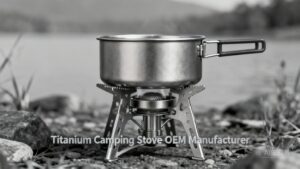
OEM d'ustensiles de cuisine en titane : comment développer votre propre gamme de produits
Developing a successful line of titanium cookware nécessite une approche stratégique OEM, une compréhension approfondie des processus de fabrication et une sélection méticuleuse des fournisseurs. Ce guide guide les marques d'équipements de plein air et d'ustensiles de cuisine à travers chaque décision clé, de la science des matériaux au lancement sur le marché.

Developing a successful line of titanium cookware requires a strategic approach, deep understanding of manufacturing processes, and meticulous supplier selection. This guide provides product managers, purchasing directors, and brand founders in the outdoor gear and cookware industries with a comprehensive framework for navigating the complexities of titanium cookware OEM. From material science to market launch, we’ll equip you with the knowledge to create a high-quality, competitive product line.
Résumé analytique : Maîtriser les fabricants d'ustensiles de cuisine en titane
The demand for lightweight, durable, and corrosion-resistant cookware, particularly in the outdoor and high-performance kitchen segments, continues to surge. Titanium cookware OEM offers brands a unique opportunity to capitalize on this trend without investing in proprietary manufacturing facilities. This article outlines a step-by-step methodology, encompassing material selection, manufacturing process insights, cost analysis, and a robust supplier evaluation framework. Our goal is to empower you to successfully launch your own custom titanium cookware, ensuring product quality, cost efficiency, and market differentiation.
Material Science Overview: Understanding Titanium Grades
Titanium is celebrated for its exceptional strength-to-weight ratio, corrosion resistance, and biocompatibility, making it an ideal material for premium cookware. However, not all titanium is created equal. Understanding the different grades is crucial for selecting the right material for your product.
Qualités de titane pour les ustensiles de cuisine
- Grade 1 (CP1 – Commercially Pure Titanium): This is the softest and most ductile of the commercially pure titanium grades, offering excellent formability. It’s often used for applications requiring extensive deep drawing or bending.
- Grade 2 (CP2 – Commercially Pure Titanium): Slightly stronger than Grade 1, Grade 2 is the most commonly used commercially pure titanium in various industries, including cookware. It offers a good balance of strength, ductility, and weldability, making it suitable for most titanium cookware OEM applications.
- Grade 5 (Ti-6Al-4V – Alpha-Beta Alloy): Known as “aerospace titanium,” Grade 5 is an alloy containing 6% aluminum and 4% vanadium. It possesses significantly higher strength than CP titanium but is less ductile and more challenging to form. While its strength is appealing, its higher cost and manufacturing difficulty often make it less practical for general cookware, though it might be considered for specialized, ultra-high-performance components.
For most titanium cookware OEM projects, Grade 2 titanium strikes the optimal balance between performance, manufacturability, and cost.
Manufacturing Process Deep Dive
The production of titanium cookware involves specialized techniques due to titanium’s unique properties. Key processes include deep drawing and welding.

Deep Drawing
Deep drawing is a metal forming process used to create hollow parts from sheet metal. For titanium, this process requires careful control of parameters such as temperature, lubrication, and drawing speed to prevent tearing and ensure uniform wall thickness. Titanium’s lower ductility compared to stainless steel means that deep drawing often requires multiple stages with intermediate annealing steps to relieve stress and restore ductility. This multi-stage process contributes to the overall manufacturing complexity and cost.
Welding Techniques
Le soudage du titane nécessite un environnement hautement contrôlé pour éviter la contamination par les gaz atmosphériques (oxygène, azote, hydrogène), qui peuvent fragiliser la soudure. Le soudage au gaz inerte au tungstène (TIG) est la méthode la plus courante pour les ustensiles de cuisine en titane en raison de sa précision et de sa capacité à produire des soudures propres et de haute qualité. Les fabricants doivent utiliser des gaz de protection inertes comme l'argon sur les faces avant et arrière de la soudure (gaz de purge) pour protéger le métal en fusion de la contamination. Une conception appropriée des joints de soudure et un nettoyage après soudage sont également essentiels pour maintenir l’intégrité et l’attrait esthétique du matériau.
Analyse des coûts et du MOQ
Comprendre les facteurs de coûts et les quantités minimales de commande (MOQ) est essentiel pour une planification efficace des projets OEM d'ustensiles de cuisine en titane.
Logique de quantité minimale de commande (MOQ)
Pour la coutume titanium cookware, un MOQ typique varie de 300 à 500 unités par article. Ce MOQ apparemment élevé est dû à plusieurs facteurs :
- Coûts d'outillage : Les matrices d'emboutissage profond et les gabarits de soudage spécialisés sont coûteux à produire. La répartition de ces coûts sur une plus grande série de production rend le coût unitaire plus acceptable.
- Approvisionnement en matériaux : Les tôles de titane nécessitent souvent des quantités minimales d'achat auprès des usines.
- Temps d'installation : Chaque cycle de production nécessite un temps de configuration important pour les machines, la programmation et les contrôles qualité. Un volume plus élevé amortit plus efficacement ces coûts fixes.
- Efficacité d'usine : Les fabricants préfèrent les séries plus importantes pour optimiser leurs calendriers de production et réaliser de meilleures économies d'échelle.
La négociation des MOQ peut être possible, en particulier pour les partenariats à long terme ou si votre produit peut partager des outils avec des conceptions existantes, mais attendez-vous à ce que les exécutions initiales respectent ces références.
Composants de répartition des coûts
Une analyse complète des coûts pour les OEM d’ustensiles de cuisine en titane devrait inclure :
- Coût des matières premières : Ceci est principalement dû à la qualité de titane sélectionnée (Grade 1, 2 ou 5) et aux fluctuations du marché.
- Coûts d’outillage/moulage : Coûts d'ingénierie non récurrents (NRE) pour les matrices, gabarits et accessoires personnalisés. Ceux-ci sont généralement payés d’avance ou amortis sur les premières commandes.
- Travail de fabrication : Coûts associés à l'emboutissage profond, au soudage, au polissage, aux traitements de surface (par exemple, anodisation) et à l'assemblage.
- Traitement de surface/finition : Des options telles que le sablage, l’électropolissage ou les revêtements spécialisés augmentent le coût.
- Contrôle de qualité: Coûts de l’inspection en cours et finale.
- Conditionnement: Conception, matériaux et assemblage d'emballages personnalisés.
- Logistique: Expédition, douane et fret.
- Frais généraux et marge bénéficiaire : Les coûts opérationnels et les bénéfices de l’usine.

Cadre de sélection des fournisseurs
Choisir le bon partenaire de fabrication est primordial pour le succès de votre projet OEM d’ustensiles de cuisine en titane. Un processus d’évaluation rigoureux n’est pas négociable.
Liste de contrôle d'évaluation en usine
- Expérience avec Titanium : Does the factory have a proven track record specifically with titanium deep drawing and welding? Ask for case studies and references.
- Quality Certifications: Look for ISO 9001, and ideally, certifications relevant to metal fabrication or cookware safety (e.g., FDA compliance for food contact materials).
- Equipment & Technology: Assess their machinery for deep drawing presses, TIG welding stations, and quality inspection tools (e.g., CMM, material analyzers).
- Engineering Capabilities: Can they assist with DFM (Design for Manufacturability) to optimize your design for production efficiency and cost?
- Communication & Project Management: Evaluate their responsiveness, English proficiency, and dedicated project management team.
- Financial Stability: Ensure the factory is financially sound to avoid disruptions.
- Ethical Practices: Verify their commitment to labor laws and environmental regulations.
OEM Customization Workflow
A clear workflow ensures a smooth development process:
- Initial Concept & Design Brief: Provide detailed specifications, 3D models, and desired features.
- DFM & Prototyping: The factory provides DFM feedback, creates engineering drawings, and produces initial prototypes for approval. This stage often involves several iterations.
- Tooling Development: Once prototypes are approved, tooling fabrication begins.
- Pre-Production Sample (PPS): A small batch of production-intent samples is made for final approval before mass production.
- Mass Production: Full-scale manufacturing commences.
- Quality Control & Inspection: In-line and final inspections are conducted.
- Packaging & Shipping: Products are packed according to specifications and shipped.
Risk Control & Mitigation
Mitigating risks is crucial in any titanium cookware OEM venture.
Common Challenges and Solutions
- Material Defects: Implement stringent raw material inspection protocols and require material certifications from suppliers.
- Manufacturing Flaws: Establish clear quality control checkpoints throughout the production process, including visual inspection, dimensional checks, and leak tests for welded components.
- Communication Gaps: Designate a primary point of contact, use clear communication channels (e.g., project management software), and conduct regular progress meetings. Consider factory visits at critical stages.
- Intellectual Property (IP) Theft: Sign comprehensive Non-Disclosure Agreements (NDAs) and manufacturing agreements with your chosen OEM partner. Register your designs and trademarks where appropriate.
- Lead Time Delays: Build buffer time into your project schedule. Have contingency plans for alternative shipping methods or backup suppliers if feasible.
Practical Roadmap for Launching Your Titanium Cookware Line
- Market Research & Product Definition: Identify your target audience, unique selling propositions (USPs), and desired product features.
- Design & Engineering: Develop detailed 3D CAD models and technical drawings. Consider titanium’s specific properties in your design.
- Supplier Sourcing & Evaluation: Use the checklist provided to identify and vet potential OEM partners. Request quotes and samples.
- Contract Negotiation & Prototyping: Finalize terms, sign agreements, and move into the prototyping phase.
- Quality Assurance & Testing: Rigorously test prototypes for performance, durability, and safety.
- Mass Production & Logistics: Oversee initial production runs, manage quality control, and arrange for shipping.
- Marketing & Launch: Develop your marketing strategy and prepare for product launch.

By meticulously following this guide, outdoor brands and cookware companies can confidently navigate the complexities of titanium cookware OEM, transforming innovative concepts into successful, high-quality product lines that resonate with discerning consumers.
{ "@context": "https://schema.org", "@type": "Article", "mainEntityOfPage": { "@type": "WebPage", "@id": "https://7titanium.com/blog/titanium-cookware-oem-how-to-develop-your-own-product-line/" }, "headline": "Titanium Cookware OEM: How to Develop Your Own Product Line", "description": "A complete OEM sourcing guide for outdoor and cookware brands developing their own titanium cookware line, covering titanium grades, deep drawing and welding, MOQ logic, cost structure, supplier selection, risk control, and launch roadmap.", "author": { "@type": "Organization", "name": "7Titanium Editorial Team" }, "publisher": { "@type": "Organization", "name": "7Titanium", "logo": { "@type": "ImageObject", "url": "https://7titanium.com/wp-content/uploads/2025/01/7titanium-logo-rectangle.png" } }, "datePublished": "2025-02-23", "dateModified": "2025-02-23", "articleSection": "Titanium Cookware OEM", "keywords": [ "titanium cookware OEM", "titanium cookware manufacturer", "titanium deep drawing", "titanium welding", "OEM cookware sourcing", "titanium cookware supplier" ], "image": [ "https://7titanium.com/wp-content/uploads/2025/11/titanium-titanium-cookware-oem-how-to-develop-your-own-product-line-img1.jpg", "https://7titanium.com/wp-content/uploads/2025/11/titanium-titanium-cookware-oem-how-to-develop-your-own-product-line-img2.jpg", "https://7titanium.com/wp-content/uploads/2025/11/titanium-titanium-cookware-oem-how-to-develop-your-own-product-line-img3.jpg", "https://7titanium.com/wp-content/uploads/2025/11/titanium-titanium-cookware-oem-how-to-develop-your-own-product-line-img4.jpg" ] }