
Titanium vs Stainless Steel: How Material Choice Impacts Your Supply Chain, Lead Times, and Total Cost
Why the real risk in “titanium vs stainless” isn’t just material properties—but whether your supply chain can deliver on your launch plan, MOQs, and margins.
Auf dieser Seite
Plan a realistic titanium rollout
Teilen Sie Ihr Ziel-Startfenster, Volumes und Zielkanäle. Wir sagen Ihnen ehrlich, ob Titan passt – oder ob Edelstahl der sicherere erste Schritt für Ihre Marke ist.
Sprechen Sie mit unserem Supply-Chain-Team →Typischer Projektbereich: 500–5.000 Einheiten pro SKU, OEM und Handelsmarke für Outdoor-Marken.

Three weeks before your spring product launch, your supplier sends the email every brand dreads: “Material sourcing delays. Production pushed to Q3.” Your retail partners are locked in, your marketing spend is committed, and your competitor just launched a lighter alternative.
This scenario plays out dozens of times each year in the outdoor gear industry, and it usually starts with the same root cause—misaligned material selection and supply chain planning. The titanium versus stainless steel decision isn’t just about weight specs and corrosion ratings. It’s about lead time windows, minimum order volumes, supplier concentration risk, and whether your production schedule can survive upstream volatility.
Ich habe ein Jahrzehnt bei 7titanium.com damit verbracht, OEM-Beziehungen für Outdoor-Marken zu verwalten, und ich habe miterlebt, wie kluge Teams von beiden Materialien begeistert waren – nicht weil sie sich auf dem Papier für das falsche entschieden hatten, sondern weil sie die Materialeigenschaften nicht an die Realität der Lieferkette angepasst hatten. Eine Gewichtsreduzierung um 45 % bedeutet nichts, wenn Sie Ihr Startfenster verpassen. Ein 3-facher Kostenaufschlag kann sich auszahlen, wenn dadurch eine Leistungsstufe freigeschaltet wird, die Ihr Konkurrent nicht erreichen kann. Die Frage ist nicht: „Welches Material ist besser?“ Die Frage lautet: „Mit welchem Material können Sie Ihre Strategie umsetzen?“
This article breaks down the titanium-stainless steel decision from a supply chain and total cost perspective. You’ll see actual lead time data, MOQ implications, cost structures, and decision frameworks—not just material datasheets. Whether you’re launching your first titanium product line or reconsidering an existing SKU, you’ll finish with a clearer view of when each material makes sense and how to de-risk whichever path you choose.
Material Properties: What the Data Actually Shows
Before we talk lead times and supplier networks, let’s establish the performance baseline. The properties that matter for outdoor gear aren’t academic—they directly affect your product positioning, warranty costs, and whether your customers notice the difference.
Weight and Density: The 45% Advantage
Titanium’s density sits at approximately 4.5 g/cm³, compared to stainless steel’s 8.0 g/cm³. That 45% weight reduction translates differently depending on your product category. For a 600 ml camping pot, you’re looking at roughly 95 grams for titanium versus 175 grams for stainless steel—a difference backpackers feel immediately. For tent stakes, that gap compounds across a set of eight or ten units.
Aber Gewichtsvorteile haben einen Kontext. Wenn Sie ein 3-Liter-Basislager-Kochset entwerfen, bei dem die Stabilität wichtiger ist als das Packgewicht, wird das Gewicht von Edelstahl zu einem Vorteil und nicht zu einer Belastung. Gleiches gilt für fahrzeugbasierte Outdoor-Ausrüstung, bei der das Transportgewicht keine Rolle spielt.
Korrosionsbeständigkeit: Wenn es wirklich darauf ankommt
Titan bildet eine passive Oxidschicht, die ohne zusätzliche Oberflächenbehandlung Salzwasser, säurehaltigen Lebensmitteln und den meisten korrosiven Außenumgebungen widersteht. Titan der Güteklasse 2 (die handelsübliche reine Güteklasse, die die meisten Outdoor-Marken verwenden) hält Meereseinflüssen, Schweißsalzen und säurehaltigen Lebensmitteln ohne Lochfraß oder Flecken stand.
Stainless steel’s corrosion story depends entirely on the grade. 304 stainless works fine for inland camping where chloride exposure is minimal. 316 stainless (the marine grade) handles saltwater and coastal environments reasonably well, though prolonged exposure to concentrated chlorides can still cause pitting over years of use. For brands targeting coastal markets, sailing, or sea kayaking, that performance gap matters. For mountain and desert use cases, 304 stainless holds up without issue.
The practical test: Can your warranty budget absorb corrosion claims from coastal users? If you’re positioning a premium product line and serving customers in Florida, California, or the Pacific Northwest where saltwater exposure is routine, titanium eliminates a failure mode. If your primary market is landlocked trail users, 304 stainless delivers adequate corrosion resistance at a fraction of the cost.
Strength-to-Weight Ratio: The Hidden Complexity
Titanium’s strength-to-weight ratio gets cited often, but the numbers need context. Grade 2 titanium (commercial pure) offers tensile strength around 345 MPa at 4.5 g/cm³. Grade 5 (Ti-6Al-4V, the aerospace alloy) jumps to approximately 900 MPa but costs significantly more and requires more complex processing. 304 stainless delivers roughly 505 MPa at 8.0 g/cm³, while 316 stainless sits around 515 MPa.
For thin-walled cookware where stiffness matters more than raw strength, titanium’s lower modulus of elasticity (about 110 GPa versus stainless steel’s 200 GPa) means titanium walls feel less rigid at the same thickness. Brands often compensate by using thicker titanium gauge or adding structural ribs, which eats into the weight advantage.
For structural components like tent poles, bike frames, or load-bearing hardware, Grade 5 titanium’s strength-to-weight advantage justifies the premium. For cookware, stakes, or utensils where wall thickness and forming complexity dominate, the picture gets muddier.
Temperature Performance: Real-World Limits
Both materials handle typical outdoor temperature ranges (-40 °C to 200 °C) without issues. Titanium maintains strength at higher temperatures, but unless you’re designing exhaust components or industrial equipment, you won’t approach those limits with camping cookware or outdoor accessories.
Ein praktischer Unterschied: Die geringere Wärmeleitfähigkeit von Titan (etwa 21,9 W/m·K gegenüber 16,2 W/m·K von Edelstahl 304, beide deutlich niedriger als die 205 W/m·K von Aluminium) führt dazu, dass Titan-Kochgeschirr über Campingkochern heiße Stellen entwickelt. Einige Benutzer bevorzugen dies wegen der Kocheffizienz; andere empfinden das Anbraten als frustrierend. Kochgeschirr aus Edelstahl weist ein ähnliches Verhalten auf, sodass beide Materialien aus thermischer Sicht für Kochanwendungen im Freien im gleichen Bereich liegen.
Materialqualitäten: Was Outdoor-Marken tatsächlich verwenden
Die meisten Outdoor-Ausrüstungsgegenstände aus Titan verwenden Grad 2 (handelsüblich rein), um ein ausgewogenes Verhältnis von Korrosionsbeständigkeit, Formbarkeit und Kosten zu gewährleisten. Güteklasse 5 kommt bei Hochleistungs-Strukturanwendungen zum Einsatz, bei denen die Kosten und der Bearbeitungsaufwand gerechtfertigt sind. Für die Klassen 1, 3 und 4 ist die Verwendung in Outdoor-Produkten begrenzt.
Bei Edelstahl dominiert 304 für Binnen- und Allzweckanwendungen. 316 kommt in Produkten für den Meeresbereich vor. 430 (eine ferritische Qualität) taucht gelegentlich in preisgünstigen Produktlinien auf, bei denen die Korrosionsbeständigkeit beeinträchtigt sein kann, aber die meisten seriösen Outdoor-Marken meiden es, weil das Rostrisiko den Ruf der Marke schädigt.
Understanding these grade differences matters when you’re qualifying suppliers. If a supplier quotes Grade 1 titanium for cookware or offers 430 stainless for a coastal product line, those are red flags indicating either inexperience or cost-cutting that will hurt you downstream.
Figure 1: Material Properties Comparison Matrix. Titanium offers significant weight and corrosion advantages but requires longer lead times and higher investment. Data reflects typical values for Grade 2 titanium and 304/316 stainless steel in outdoor gear applications.
Supply Chain Reality: Lead Times, MOQ, and Concentration Risk
Materialeigenschaften sorgen dafür, dass Sie in die engere Wahl kommen. Die Umsetzung der Lieferkette bringt Ihr Produkt auf den Markt. Hier wird die Entscheidung zwischen Titan und Edelstahl eher zu einem strategischen Kompromiss als zu einem einfachen Leistungsvergleich.
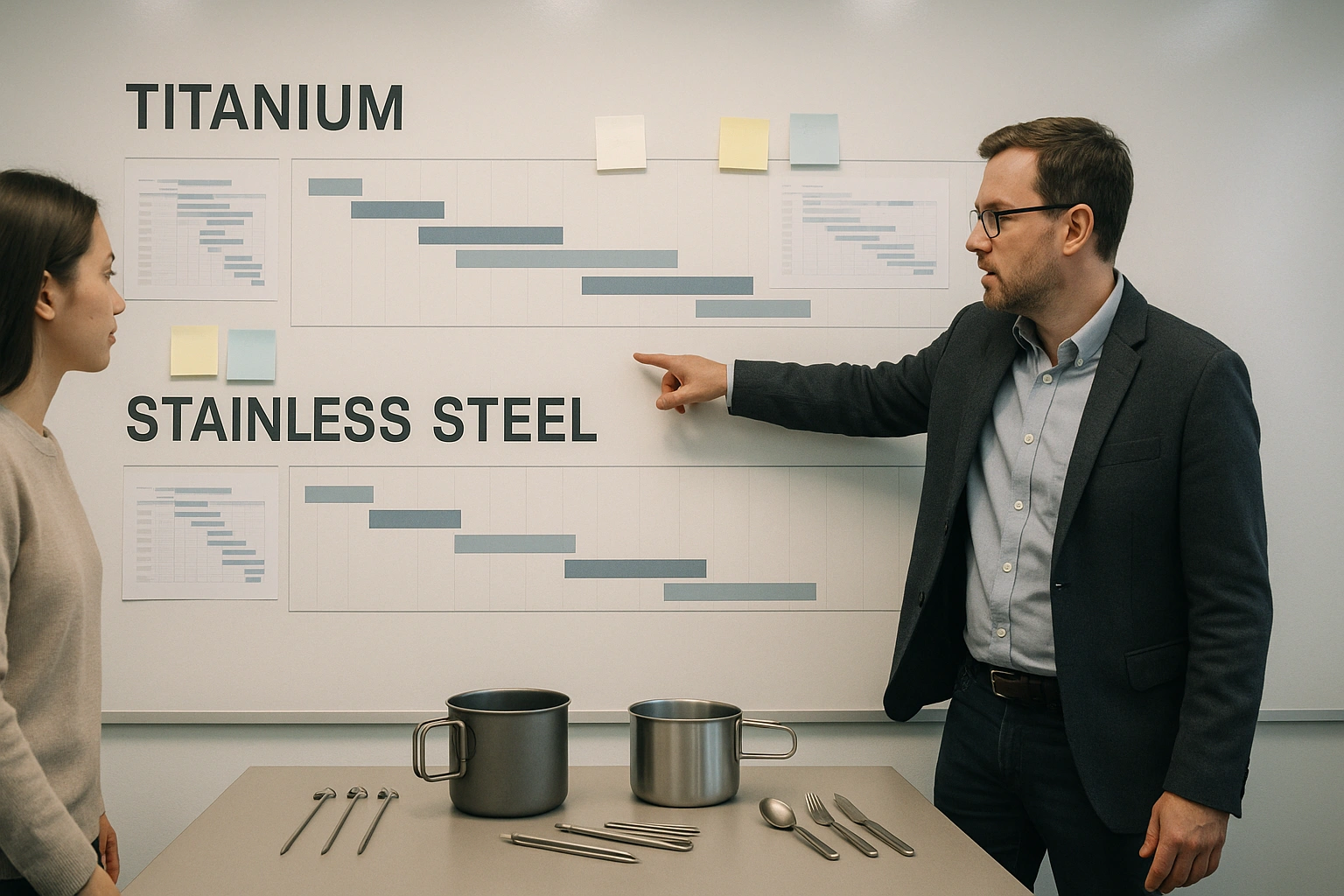
Aufschlüsselung der Durchlaufzeit: Wo sich die Verzögerungen verstecken
Titanium’s lead time challenge starts upstream. U.S. titanium sponge capacity remains severely constrained, with domestic production around 500 tonnes per year and most supply coming from imports—primarily Japan (67%), Saudi Arabia (23%), and Kazakhstan (7%). When aerospace demand tightens or geopolitical friction disrupts these sources, outdoor brands feel it 8–12 weeks later.
For a typical titanium OEM project, expect this timeline:
- Raw material procurement: 6–10 weeks for sponge or scrap sourcing, longer if you’re competing with aerospace orders
- Mill processing: 4–6 weeks to convert sponge to sheet, plate, or tube stock
- Manufacturing: 3–5 weeks for forming, welding, and finishing
- QC and logistics: 2–3 weeks
Total: 15–24 weeks from PO to delivered goods, assuming no upstream disruptions. If your supplier doesn’t maintain safety stock of common titanium gauges, add another 4–8 weeks.
Stainless steel operates on a fundamentally different rhythm. Global production hit 62.6 million tonnes in 2024, distributed across China, Europe, the U.S., and other regions. That scale and geographic diversity translate to:
- Raw material procurement: 1–2 weeks for common grades (304, 316) in standard forms
- Manufacturing: 2–4 weeks depending on complexity
- QC and logistics: 2–3 weeks
Total: 5–9 weeks for most outdoor gear applications, with shorter windows possible if your supplier stocks material.
The lead time gap compounds when you factor in replanning cycles. If you need to adjust order volumes or specifications mid-production, stainless steel suppliers can usually accommodate changes with 2–3 weeks notice. Titanium projects lock in earlier because the upstream material pipeline is longer and less flexible.
Minimum Order Quantities: The Hidden Cost Barrier
Titanium MOQs reflect the economics of a specialty material with concentrated production. For custom titanium components:
- Sheet stock: Minimum 50–100 kg per gauge/width combination
- Formed parts: 500–1,000 units per SKU to justify tooling and setup
- Machined components: 200–500 units depending on complexity
Those minimums create cash flow pressure for emerging brands. A 1,000-unit MOQ on a $35 wholesale titanium pot ties up $35,000 before you’ve validated market demand. For brands testing new product categories or regional markets, that’s a painful threshold.
Stainless steel MOQs run lower across the board:
- Sheet stock: Minimum 20–50 kg, often available from distributor inventory in smaller quantities
- Formed parts: 200–500 units per SKU
- Machined components: 100–300 units
The volume flexibility matters most during product development and market testing phases. You can pilot a stainless steel cookset with 200 units, gather customer feedback, iterate the design, and scale production—all within a 6-month window. The same cycle with titanium forces you to commit heavier upfront or accept unit economics that don’t work until you hit scale.
Supplier Concentration Risk: One Country, Three Suppliers
Titanium’s upstream concentration creates strategic exposure. Global titanium sponge production is dominated by China (~220,000 tonnes), Japan (~55,000 tonnes), Russia (~20,000 tonnes), and Saudi Arabia (~15,000 tonnes). That’s four countries controlling 97% of supply, with China alone accounting for nearly 70%.
For U.S. brands, this matters in two ways. First, import reliance exceeds 95% for titanium sponge, making your production schedule vulnerable to trade policy shifts, tariffs, or export restrictions. Second, aerospace demand takes priority—when Boeing or Airbus ramp up orders, outdoor gear suppliers wait in line.
I’ve seen this play out firsthand. In late 2023, a West Coast outdoor brand committed to a spring 2024 titanium cookware launch. Their supplier’s sponge allocation got diverted to an aerospace contract in February. By the time replacement material arrived, the brand missed their retail window and had to clearance the inventory in Q4 at 40% below planned margins.
Stainless steel’s supply base is fundamentally more diversified. Production spans dozens of countries with deep domestic capacity in the U.S., Europe, and Asia. You can qualify multiple suppliers in different regions, and if one source tightens, alternatives exist without massive lead time penalties. That redundancy carries real value when you’re planning 12–18 months out.
Inventory Strategy: How Much Safety Stock Do You Really Need?
Titanium’s longer and less predictable lead times force you into one of two positions: carry more safety stock (tying up working capital) or accept stockout risk during demand surges.
For a $2 million annual titanium product line, maintaining 12–16 weeks of safety stock to buffer upstream volatility means holding roughly $460K–$615K in inventory. That’s capital you can’t deploy into marketing, new product development, or channel expansion.
Stainless steel’s shorter lead times let you run leaner. 6–8 weeks of safety stock covers most disruption scenarios, cutting your inventory carrying cost by 40–50% compared to titanium for the same revenue base.
The strategic question isn’t whether titanium’s supply chain is “worse” than stainless steel’s. It’s whether your business model and capital structure can absorb the working capital load and lead time variability that come with titanium. High-margin, established product lines can. Early-stage market tests often can’t.
Total Cost of Ownership: Beyond the Sticker Price
Raw material cost gets all the attention, but it’s only one piece of your total cost structure. Tooling, processing, defect rates, and lifecycle costs shift the economic picture in ways that aren’t obvious from a simple material price comparison.
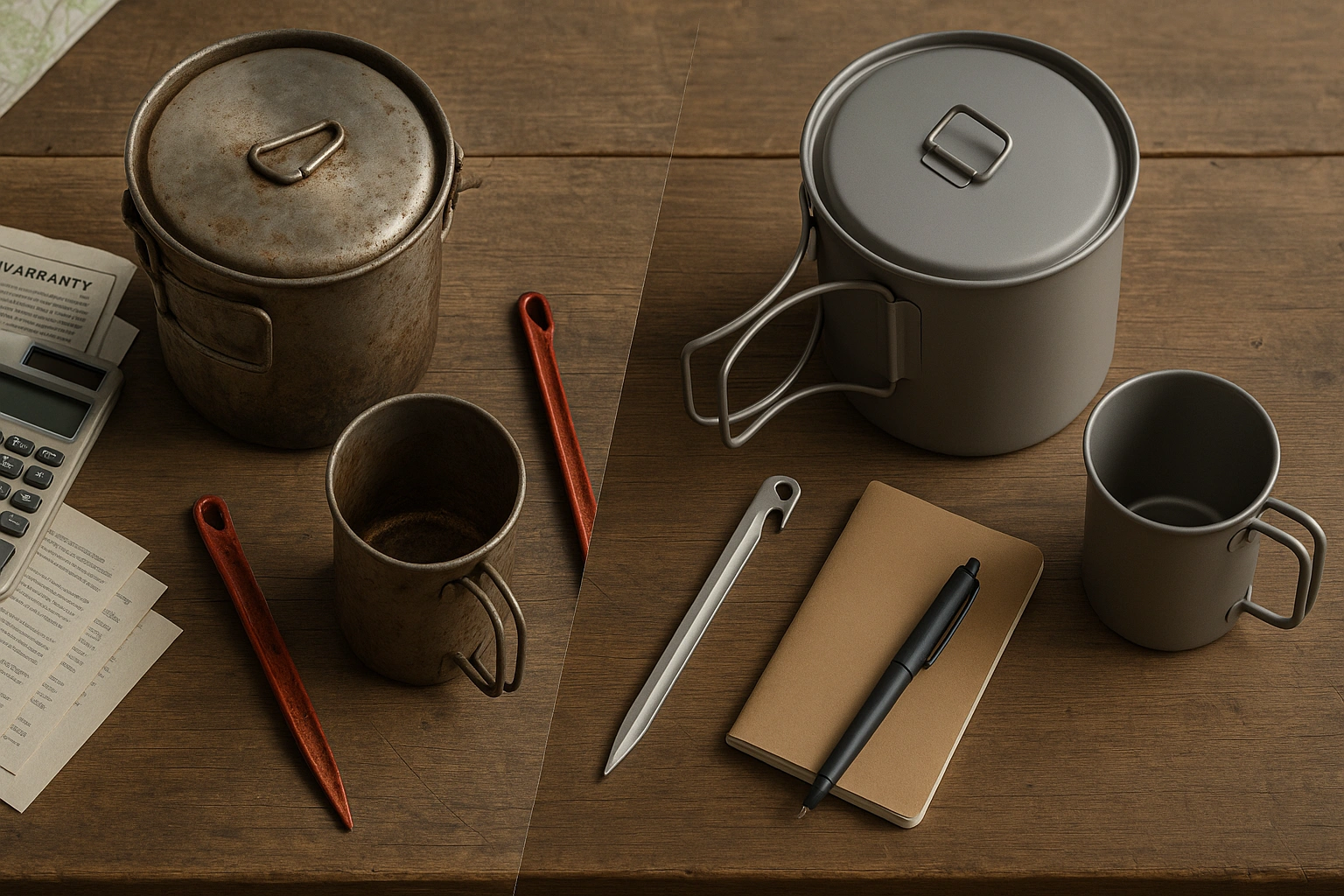
Raw Material Cost: The 3–4× Starting Point
U.S. titanium sponge imports averaged approximately $13 per kilogram in 2024. By the time that sponge becomes Grade 2 sheet or tube stock suitable for outdoor gear manufacturing, you’re looking at $30–45 per kilogram depending on gauge, form, and order volume.
Kaltgewalzte Coils aus Edelstahl 304 werden weltweit für etwa 2,50 bis 3,00 US-Dollar pro Kilogramm gehandelt. 316 (Marinequalität) kostet etwa 4,00–4,30 $. Der Rohstoffmultiplikator liegt also etwa bei 10–15x für Titan gegenüber Edelstahl 304 und bei 7–10x gegenüber Edelstahl 316.
Dieser Abstand verringert sich leicht, wenn man Ertrag und Gewicht berücksichtigt. Der Dichtevorteil von Titan um 45 % bedeutet, dass Sie für die gleiche Teilegeometrie volumenmäßig weniger Material benötigen. Ein Kochtopf, der 120 Gramm Edelstahl benötigt, könnte nur 68 Gramm Titan verbrauchen, wodurch sich die effektive Materialkostenlücke auf das 6- bis 9-fache statt auf das 10- bis 15-fache verringert.
Aber selbst bei 6× beginnen Sie mit einem erheblichen Kostennachteil, der an anderer Stelle in Ihrem Wertversprechen gerechtfertigt werden muss – entweder durch Leistungsdifferenzierung, Zahlungsbereitschaft der Kunden oder Einsparungen bei den Lebenszykluskosten.
Verarbeitung und Werkzeuge: Wo Titan teuer wird
Der Ruf von Titan für seine schwierige Bearbeitung ist wohlverdient. Der Werkzeugverschleiß ist 3- bis 5-mal höher als bei Edelstahl, da die geringe Wärmeleitfähigkeit von Titan die Wärme an der Schneidkante konzentriert. Das bedeutet häufigere Werkzeugwechsel, langsamere Schnittgeschwindigkeiten und höhere Arbeitsstunden pro Teil.
For formed parts (deep-drawn cookware, stamped tent stakes), titanium’s springback and work-hardening behavior require more forming stages and tighter process control than stainless steel. Tooling costs for a titanium cookware project typically run 15–25% higher than the equivalent stainless steel tool set, and tool life is shorter.
Welding adds another layer of complexity. Titanium requires inert gas shielding (argon) on both the weld face and the backside to prevent oxidation and embrittlement. Stainless steel welds can often use simpler shielding or even air in less critical applications. That translates to slower welding speeds, more complex fixturing, and higher scrap rates during production ramp-up for titanium.
All of this processing complexity shows up in your per-unit manufacturing cost. For a moderately complex titanium part (e.g., a cookpot with welded handles and a formed lid), expect manufacturing cost to run 40–60% higher than the stainless steel equivalent, even before you factor in the material cost premium.
Defect Rates and Scrap: The Hidden Margin Killer
Titanium’s sensitivity to contamination and process variation means higher scrap rates, especially during new product introduction. A stainless steel cookware project might stabilize at 2–3% scrap once production is dialed in. Titanium projects often run 5–8% scrap through the first few production runs, and even mature titanium lines hold at 3–5% scrap due to the material’s less forgiving nature.
At $35–45 per kilogram, that scrap rate carries real cost. For a 1,000-unit production run of 100-gram parts, the difference between 3% and 6% scrap is roughly 300 grams of titanium—$10–13 per batch in direct material waste, multiplied across dozens of batches per year.
More painful than the material waste is the risk of late-stage defects. A weld crack discovered after surface finishing on a titanium part means scrapping not just the material but also the labor and processing cost invested up to that point. Stainless steel’s wider process window reduces that risk.
Lifecycle Cost: Where Titanium Claws Back Ground
Titanium’s corrosion resistance and durability extend product life in harsh environments, reducing warranty claims and replacement cycles.
For a coastal sailing brand, the difference between a 5-year service life for 316 stainless hardware and a 15-year service life for titanium changes the total cost of ownership calculation. If your customer values durability and you’re positioning products at the premium end, titanium’s lifecycle advantage justifies the upfront cost premium.
Similarly, weight savings compound over time for ultralight backpacking gear. A backpacker carrying 3 kg less weight over 500 trail miles per year values that reduction far more than the absolute cost difference between a $45 titanium pot and a $22 stainless steel pot. The willingness-to-pay gap widens as you move upmarket.
But lifecycle cost only matters if your customer base values durability over initial price and if your brand positioning supports a premium. For budget-conscious recreational campers or brands competing primarily on price, lifecycle cost arguments don’t move the needle—they buy on sticker price and replace when something breaks.
Volume Economics: When Scale Shifts the Math
At low volumes (under 2,000 units annually per SKU), titanium’s higher tooling and setup costs get amortized over fewer units, making per-unit economics painful. At higher volumes (5,000–10,000+ units), those fixed costs spread out and raw material becomes the dominant cost driver again.
Stainless steel maintains better unit economics at low volumes because tooling is cheaper, setup is faster, and scrap rates are lower out of the gate. This is why you see established outdoor brands launching new product categories in stainless steel first, validating demand, and then introducing a premium titanium variant once volume justifies the investment.
The break-even volume depends on your specific part geometry and target margin, but as a rule of thumb: if you’re not confident you’ll move 3,000+ units annually for at least three years, the titanium economics get hard to defend unless you’re charging a significant premium and targeting a niche willing to pay for it.
When Titanium Justifies the Premium
Titanium isn’t the right choice for every outdoor product, but when the conditions align, it creates differentiation that’s hard for competitors to match. Here are the scenarios where the material premium pays off.
Weight-Critical Applications Where Grams Matter
Ultralight backpacking, bikepacking, and alpine climbing represent markets where customers obsess over weight. A 30-gram tent stake that replaces a 55-gram stainless steel alternative gets noticed. When you’re selling to someone who cuts the handle off their toothbrush to save 8 grams, titanium’s 45% weight advantage isn’t a nice-to-have—it’s the entire value proposition.
These customers will pay 2–3× for titanium without hesitation because the performance benefit is tangible and measurable. Your marketing doesn’t need to convince them; you just need to deliver the product and prove the weight claims.
Marine and Coastal Environments
If your brand serves sailors, sea kayakers, coastal guides, or fishing charter operators, titanium eliminates corrosion as a failure mode. 316 stainless holds up reasonably well in saltwater, but “reasonably well” still means pitting and degradation over 3–5 years of heavy exposure.
Titanium hardware, cookware, and tools in marine environments last 10–15+ years without corrosion. For commercial operators who depend on gear reliability and can’t afford mid-season equipment failures, that durability justifies the upfront cost. For recreational coastal users building a long-term gear collection, titanium becomes a buy-it-for-life investment.
The warranty cost avoidance alone can justify titanium for marine-focused brands. If you’re replacing 8–12% of stainless steel coastal products under warranty each year due to corrosion, switching to titanium for those SKUs cuts your warranty liability and improves customer satisfaction.
Premium Brand Positioning
Einige Outdoor-Marken konkurrieren eher um Leistung und Prestige als um den Preis. Wenn Ihr Kundenstamm Frühanwender, Sammler von Ausrüstungsgegenständen und Enthusiasten umfasst, die die beste verfügbare Option wünschen, signalisiert Titan Premiumqualität auf eine Art und Weise, wie Edelstahl dies nicht kann.
Dabei geht es nicht nur um funktionale Überlegenheit, sondern auch um die Markenwahrnehmung. Ein Titan-Kochset für 150 US-Dollar erzählt eine andere Geschichte als ein Edelstahl-Kochset für 55 US-Dollar, auch wenn beide für die meisten Benutzer eine ausreichende Leistung erbringen. Wenn Ihre Markenpositionierung Premium-Preise unterstützt und Ihre Kunden bereit sind, für Exklusivität und Leistung zu zahlen, verstärkt Titan diese Positionierung.
For brands like Snow Peak, TOAKS, or other premium outdoor companies, titanium isn’t just a material choice—it’s a brand identity anchor that attracts a specific customer segment and supports higher margins across the product line.
Low-Volume, High-Margin Product Lines
If you’re producing limited-edition runs, regional specialty products, or custom projects for guides and outfitters, titanium’s economics work differently. At 500 units per year, stainless steel’s volume advantages disappear, and titanium’s performance benefits become the deciding factor.
For custom knife makers, specialty tool manufacturers, or brands serving niche adventure segments (ultralight paragliding gear, expedition-grade equipment), the customer expects titanium and the volume is too low for mass-production economics to matter. You’re pricing based on value and exclusivity, not cost-plus margins, which means titanium’s material premium gets absorbed into a product price that already sits at the high end of the market.
When Stainless Steel Is the Smarter Choice
Stainless steel doesn’t get the same marketing glamour as titanium, but for many outdoor brands, it’s the more strategic material choice. Here’s when stainless steel wins on both performance and business fundamentals.
High-Volume Product Lines Where Cost Scales
Wenn Sie auf Outdoor-Einzelhändler für den Massenmarkt abzielen, über Amazon verkaufen oder eine Produktlinie aufbauen, die sich an Freizeitcamper und Gelegenheitsnutzer im Freien richtet, erhöht sich der Kostenvorteil von Edelstahl schnell. Bei mehr als 10.000 Einheiten pro Jahr summiert sich der Materialkostenunterschied zwischen Titan und Edelstahl von 15 bis 20 US-Dollar pro Einheit zu einer jährlichen Bruttomarge von 150.000 bis 200.000 US-Dollar – Kapital, das Sie in Marketing, Vertriebskanalerweiterung oder die Entwicklung neuer Produkte reinvestieren können.
Für Marken, die im Einzelhandelspreisbereich von 30 bis 60 US-Dollar konkurrieren und deren Kunden preissensibel sind, funktioniert die Preisgestaltung für Titan einfach nicht. Sie müssten 80–120 US-Dollar verlangen, um entsprechende Margen aufrechtzuerhalten, was Sie aus dem Angebot für Mainstream-Käufer verdrängt. Mit Edelstahl bleiben Sie wettbewerbsfähig und bieten gleichzeitig eine angemessene Leistung für die überwiegende Mehrheit der Outdoor-Anwendungsfälle.
Basislager und Auto-Campingausrüstung
Wenn das Gewicht nicht im Vordergrund steht – Kochgeschirr für das Basislager, Campingausrüstung für das Auto, Zubehör für Wohnmobile oder Picknickausrüstung –, wird das Gewicht von Edelstahl eher zu einem Vorteil als zu einer Belastung. Schwereres Kochgeschirr sitzt stabiler auf Campingkochern, ist kippsicherer und fühlt sich für Kunden, die an Haushaltsküchengeräte gewöhnt sind, stabiler an.
In diesem Marktsegment empfinden Kunden leichte Ausrüstung oft als dürftig oder von minderer Qualität. Ein Titantopf, der 80 Gramm einspart, bietet beim Transport im Fahrzeug und auf einem festen Campingplatz keinen funktionellen Vorteil. Edelstahl bietet ein besseres Preis-Leistungs-Verhältnis zu einem Preis, der für Campingausrüstung für den gelegentlichen Gebrauch sinnvoll ist.
Produkttests und Marktvalidierung
Wenn Sie eine neue Produktkategorie einführen oder in ein neues Marktsegment eintreten, können Sie dank der niedrigeren MOQs und schnelleren Lieferzeiten von Edelstahl die Nachfrage testen, ohne zu viel Kapital zu binden. Sie können 300–500 Einheiten produzieren, ein regionales Pilotprojekt oder einen Online-Soft-Launch durchführen, Kundenfeedback einholen und das Design iterieren – alles innerhalb eines Zyklus von 4–6 Monaten.
Wenn Sie den gleichen Ansatz mit Titan versuchen, müssen Sie sich auf mehr als 1.000 Einheiten mit einer Vorlaufzeit von 20–24 Wochen und einem zwei- bis dreifachen Kapitalaufwand festlegen. Wenn das Produkt keinen Anklang findet oder Sie die Spezifikationen anpassen müssen, stecken Sie mit Überbeständen oder kostspieligen Umrüstungen fest.
Intelligente Outdoor-Marken verwenden Edelstahl als Validierungsmaterial. Sobald sich ein Produkt im großen Maßstab bewährt (mehr als 3.000 verkaufte Einheiten, klare Kundennachfrage, positive Stückzahlen), führen sie eine Premium-Titanvariante ein, um das High-End-Segment zu erobern und die Margenmöglichkeiten zu erweitern. Dadurch wird das Risiko bei der Produktentwicklung verringert, während gleichzeitig die Möglichkeit erhalten bleibt, später in die gehobene Marktsegmentierung vorzudringen.
Binnen- und gemäßigte Klimamärkte
Wenn Ihre Hauptkundenbasis in Wäldern, Bergen oder Wüstengebieten liegt, wo keine Salzwasserbelastung besteht, ist die Korrosionsbeständigkeit von Edelstahl 304 mehr als ausreichend. Die überlegene Korrosionsleistung von Titan bietet unter diesen Bedingungen keinen marginalen Vorteil, sodass der Kostenaufschlag nicht gerechtfertigt ist.
Für Marken, die sich auf regionale Märkte konzentrieren – Colorado-Bergführer, Wanderausrüster im pazifischen Nordwesten, Wüstenwanderer im Südwesten – bietet Edelstahl 304 eine Lebensdauer von 10–15 Jahren ohne Korrosionsausfälle. Ihre Kunden erhalten zuverlässige Ausrüstung, Sie behalten gesunde Margen bei und Sie geben nicht das Sechs- bis Zehnfache an Materialkosten für Leistung aus, die sie nie nutzen werden.
Budgetbewusste Kundensegmente
Not every outdoor enthusiast wants or needs premium gear. Families introducing kids to camping, college students building their first backpacking kit, casual weekend campers—all of these segments prioritize value over performance optimization.
For these customers, a $35 stainless steel cookset that works reliably beats a $95 titanium cookset they can’t afford. By offering stainless steel products at accessible price points, you expand your addressable market and build brand loyalty with customers who may upgrade to premium titanium products later as their involvement in outdoor activities deepens.
De-Risking Your Material Decision
Unabhängig davon, ob Sie sich für Titan oder Edelstahl entscheiden, verschwinden die Risiken in der Lieferkette nicht – sie nehmen nur andere Formen an. Hier erfahren Sie, wie Sie die größten mit jedem Material verbundenen Risiken mindern können.
Für Titan: Bauen Sie Vorlaufzeitpuffer ein und nutzen Sie nach Möglichkeit Dual-Source
Die Upstream-Konzentration von Titanium bedeutet, dass Beziehungen mit nur einem Lieferanten ein erhöhtes Risiko bergen. Wenn es die Mengen rechtfertigen, qualifizieren Sie mindestens zwei Titanlieferanten in verschiedenen Regionen. Wenn bei Ihrem Hauptlieferanten Probleme bei der Schwammzuteilung oder Kapazitätsengpässe auftreten, verhindert ein Backup mit etablierten Werkzeugen und Spezifikationen einen vollständigen Produktionsstopp.
Bezüglich der Vorlaufzeiten sollten Sie Ihre Planungsannahmen um 20–25 % über den angegebenen Zeitplänen aufstocken. Wenn sich Ihr Lieferant zu 18 Wochen verpflichtet, planen Sie in Ihrem Produktionsplan 22–23 Wochen ein. Dieser Puffer absorbiert die meisten Upstream-Verzögerungen, ohne dass es zu verpassten Startfenstern oder Lagerbeständen kommt.
Finally, negotiate safety stock agreements with your supplier. Some titanium OEMs will hold 4–8 weeks of raw material inventory for established customers in exchange for volume commitments or advance deposits. That upstream inventory buffer shortens your effective lead time and reduces exposure to sponge market volatility.
For Stainless Steel: Avoid Complacency on Supplier Quality
Stainless steel’s availability creates a different risk—complacency. With dozens of suppliers quoting competitive prices, it’s tempting to optimize purely on cost. But not all 304 stainless is equivalent. Material certifications, traceability, and consistent chemistry matter, especially for products going into marine environments or food contact applications.
Fordern Sie Werkstestzertifikate und eine Materialüberprüfung durch Dritte für Edelstahllieferanten, insbesondere wenn Sie mit neuen Partnern in Niedriglohnregionen zusammenarbeiten. Wenn Sie zusätzlich 0,30 bis 0,50 US-Dollar pro Kilogramm für zertifiziertes Material aus einer seriösen Mühle ausgeben, vermeiden Sie spätere Garantiekatastrophen, wenn minderwertiger Edelstahl vorzeitig korrodiert oder die mechanischen Tests nicht besteht.
Diversifizieren Sie außerdem die Lieferanten über mindestens zwei Länder oder Regionen. Wenn Sie sich zu sehr auf eine einzelne Region verlassen (selbst wenn diese so groß und leistungsfähig ist wie China), sind Sie regionalen Veränderungen in der Handelspolitik, Zöllen oder Logistikstörungen ausgesetzt, die die Produktion wochenlang lahmlegen können.
Testen Sie, bevor Sie skalieren: Prototyp mit beiden Materialien
Auch wenn Sie zu 80 % sicher sind, welches Material für Ihr Produkt das richtige ist, erstellen Sie einen Prototyp mit beiden. Führen Sie Feldtests mit 20–30 Einheiten jedes Materials in Ihrem Zielkundensegment durch. Sammeln Sie Feedback zur Gewichtswahrnehmung, Haltbarkeit, Wertwahrnehmung und Zahlungsbereitschaft.
Möglicherweise stellen Sie fest, dass Ihre Annahmen über die Kundenprioritäten falsch waren. Ein Produkt, von dem Sie dachten, dass es Titan benötigt, funktioniert in Edelstahl einwandfrei, weil Ihren Kunden Stabilität wichtiger ist als Gewichtseinsparungen. Oder umgekehrt: Ein Produkt, von dem Sie dachten, dass es Edelstahl verwenden könnte, schneidet bei Küstentests schlechter ab, weil sich Korrosion schneller als erwartet zeigt.
Feldtests kosten 5–10 % Ihres ersten Produktionslaufs, können jedoch einen Fehler im sechsstelligen Bereich verhindern, wenn sich herausstellt, dass die Materialauswahl nicht mit den Kundenanforderungen übereinstimmt.
Legen Sie die Preise für Titan frühzeitig fest, bleiben Sie für Edelstahl flexibel
Die Preise für Titan können je nach Schwammverfügbarkeit und Nachfragezyklen in der Luft- und Raumfahrtindustrie im Jahresvergleich um 15–25 % schwanken. Wenn Sie sich für eine mehrjährige Titanproduktlinie entscheiden, verhandeln Sie mit Ihrem Lieferanten Festpreise oder Preisobergrenzen für Laufzeiten von 12 bis 18 Monaten. Das schützt Ihre Margenplanung vor vorgelagerter Rohstoffvolatilität.
Die Preise für Edelstahl sind stabiler, aber der Kompromiss ist weniger ein Grund, langfristige Verträge abzuschließen. Bleiben Sie flexibel, qualifizieren Sie mehrere Lieferanten und verhandeln Sie die Preise alle 6–12 Monate neu, um günstige Marktbedingungen zu nutzen.
Den Anruf tätigen: Ein Rahmen für Ihr nächstes Projekt

Für die Entscheidung zwischen Titan und Edelstahl gibt es keine allgemeingültige Antwort. Es hat Ihre Antwort, basierend auf Ihrer Markenpositionierung, Ihrem Kundensegment, Ihren Volumenerwartungen und Ihren Lieferkettenfähigkeiten. Hier ist ein Entscheidungsrahmen, um zu klären, welches Material mit Ihrer Geschäftsrealität übereinstimmt.
Stellen Sie sich diese fünf Fragen:
- Ist Gewichtsreduktion ein primäres Kundenbedürfnis?
Wenn Ihr Zielkunde Wert auf das Gewicht des Rucksacks legt (Ultraleicht-Rucksacktouristen, Bikepacker, Alpinisten), rechtfertigt der Gewichtsvorteil von Titan von 45 % den Aufpreis. Wenn Ihr Kunde Ausrüstung per Fahrzeug transportiert oder Wert auf Stabilität gegenüber Leichtigkeit legt, gewinnt Edelstahl.
- Wie hoch ist Ihr erwartetes Produktionsvolumen in den nächsten 2–3 Jahren?
Bei weniger als 2.000 Einheiten pro Jahr ist die Wirtschaftlichkeit von Titan schwierig, es sei denn, Sie legen den Preis für Exklusivität fest. Abhängig von Ihren Margenzielen können beide Materialien zwischen 2.000 und 5.000 Einheiten funktionieren. Ab 5.000 Einheiten ist bei strenger Kostenkontrolle Edelstahl in der Regel sinnvoller, es sei denn, Sie sind fest als Premiummarke positioniert.
- Wie viel Prozent Ihrer Kunden sind auf See oder extremer Korrosion ausgesetzt?
Wenn mehr als 40 % Ihres Kundenstamms in Küsten-, Salzwasser- oder chloridreichen Umgebungen tätig sind, macht sich der Korrosionsvorteil von Titan durch geringere Garantiekosten und Kundenzufriedenheit bezahlt. Wenn die meisten Kunden ihre Ausrüstung im Binnenland oder unter gemäßigten Bedingungen verwenden, ist Edelstahl 304 ausreichend.
- Kann Ihr Betriebskapital Lieferzeiten von 15 bis 24 Wochen und höhere Lagerbestände aushalten?
Die vorgelagerte Lieferkette von Titanium erfordert mehr Kapital, längere Planungsfenster und größere Sicherheitsbestände. Wenn Ihre Liquiditätslage oder Finanzierungsstruktur einen Lagerbestand von 12 bis 16 Wochen nicht aufnehmen kann, reduzieren die schnelleren Umschlagszeiten und geringeren Kapitalanforderungen von Edelstahl die finanzielle Belastung.
- Unterstützt Ihre Markenpositionierung einen 2- bis 3-fachen Preisaufschlag?
Titan funktioniert nur, wenn die Kunden dafür bezahlen. Wenn Ihre Marke im Premiumsegment konkurriert (denken Sie an Verkaufspreise zwischen 100 und 200 US-Dollar und mehr), stärkt Titan Ihre Positionierung. Wenn Sie preisbewusste Freizeitnutzer für 30 bis 60 US-Dollar im Einzelhandel ansprechen, verdrängt Sie der Titan-Preis vom Markt.
Gehen Sie diese fünf Fragen mit Ihrem Team durch. Wenn Sie mindestens drei Fragen mit „Ja“ beantwortet haben, ist Titan wahrscheinlich strategisch sinnvoll. Wenn Sie weniger als drei Fragen mit „Ja“ beantwortet haben, ist Edelstahl wahrscheinlich der intelligentere Weg.
Abbildung 4: Entscheidungsrahmen für die Materialauswahl. Nutzen Sie diesen Ablauf, um zu bewerten, ob Titan oder Edelstahl zu Ihrer Markenpositionierung, Ihrem Zielmarkt und Ihren Lieferkettenfähigkeiten passt.
Quick FAQ
Sind Sie bereit, für Ihr nächstes Projekt zwischen Titan und Edelstahl zu wählen? Die Umsetzung hängt davon ab, einen Fertigungspartner zu finden, der Ihren Markt versteht, Ihre Vorlaufzeiten respektiert und über die nötige Lieferkettentiefe verfügt, um konsistent zu liefern.
Bei 7titanium.com haben wir unsere gesamte Tätigkeit darauf ausgerichtet, Outdoor-Marken bei der Umsetzung von Titanprojekten ohne die typischen Probleme in der Lieferkette zu unterstützen. Wir unterhalten einen Sicherheitsbestand an gängigen Titanmessgeräten, arbeiten direkt mit mehreren Schwammquellen und sind auf den Volumenbereich von 500–5.000 Einheiten spezialisiert, in dem die meisten Outdoor-Marken tätig sind.
Ganz gleich, ob Sie sich zum ersten Mal mit Titan befassen oder mit den Vorlaufzeiten Ihres aktuellen Lieferanten frustriert sind: Lassen Sie uns über Ihr Projekt sprechen. Wir überprüfen Ihre Spezifikationen, besprechen realistische Zeitpläne und MOQs und helfen Ihnen herauszufinden, ob Titan zu Ihrem Geschäftsmodell passt – auch wenn die Antwort „noch nicht“ lautet.
Because the right material decision isn’t about what’s “best” in theory. It’s about what works for your customers, your timelines, and your margins.