
Titan-Musterkits für Outdoor-Marken: Spätausfälle verhindern
Warum praktische Titanproben die günstigste Versicherungspolice sind, die Ihre Zeltpfähle und Outdoor-Hardware-Programme abschließen können.
Ihr Produktteam hat gerade acht Wochen damit verbracht, die Entwürfe für Zeltpfähle fertigzustellen. Die Konstruktion hat den CAD abgesegnet. Sourcing fand einen Lieferanten, der Titan der Güteklasse 5 zu einem wettbewerbsfähigen Preis anbot. Jeder ist bereit, die erste Produktionscharge zu bestellen.
Dann kommen die Proben. Das Material formt sich anders als der von Ihnen verwendete Edelstahl. Die Erholung ist schlimmer als erwartet. Die angegebene Oberflächenbeschaffenheit stimmt nicht mit den von Ihrem Designer genehmigten Referenzbildern überein. Bearbeitungsversuche offenbaren Probleme mit dem Werkzeugverschleiß, auf die Ihr Vertragsfertiger nicht vorbereitet war. Jetzt liegen Sie drei Monate hinter dem Zeitplan, verhandeln über geänderte Werkzeugkosten und erklären der Führung, warum die Produkteinführung auf die nächste Saison verschoben wird.
Ich habe dieses Szenario in den letzten fünf Jahren bei mehr als einem Dutzend Outdoor-Marken beobachtet. Der rote Faden? Die Teams gingen auf der Grundlage von Datenblättern und Preisangeboten unumkehrbare Beschaffungszusagen ein, ohne das Material vorher physisch zu testen. Sie behandelten Titan wie eine etwas bessere Version der ihnen bereits bekannten Metalle und nicht wie ein Material mit grundlegend anderem Verhalten.
Ein umfassendes Titan-Musterset kostet ein paar hundert Dollar und wird innerhalb weniger Tage versandt. Damit können Ihre Produkt-, Design- und Engineering-Teams mit dem Material umgehen, Formungsversuche durchführen, Oberflächen testen und Lieferanten vergleichen, bevor jemand eine Bestellung unterzeichnet. Für Marken, die in den Titan-Bereich einsteigen oder neue Lieferanten evaluieren, ist dies die effizienteste Versicherungspolice, die Sie kaufen können.
Die Titan-Lernkurve
Wenn Ihr Team Erfahrung mit Aluminium oder Edelstahl hat, wird Titan Sie auf eine Weise überraschen, die Datenblätter nicht erfassen. Die Unterschiede sind nicht gering – sie wirken sich auf die Formung, Bearbeitung, Endbearbeitung und sogar auf die Art und Weise aus, wie Sie Werkzeuge entwerfen.
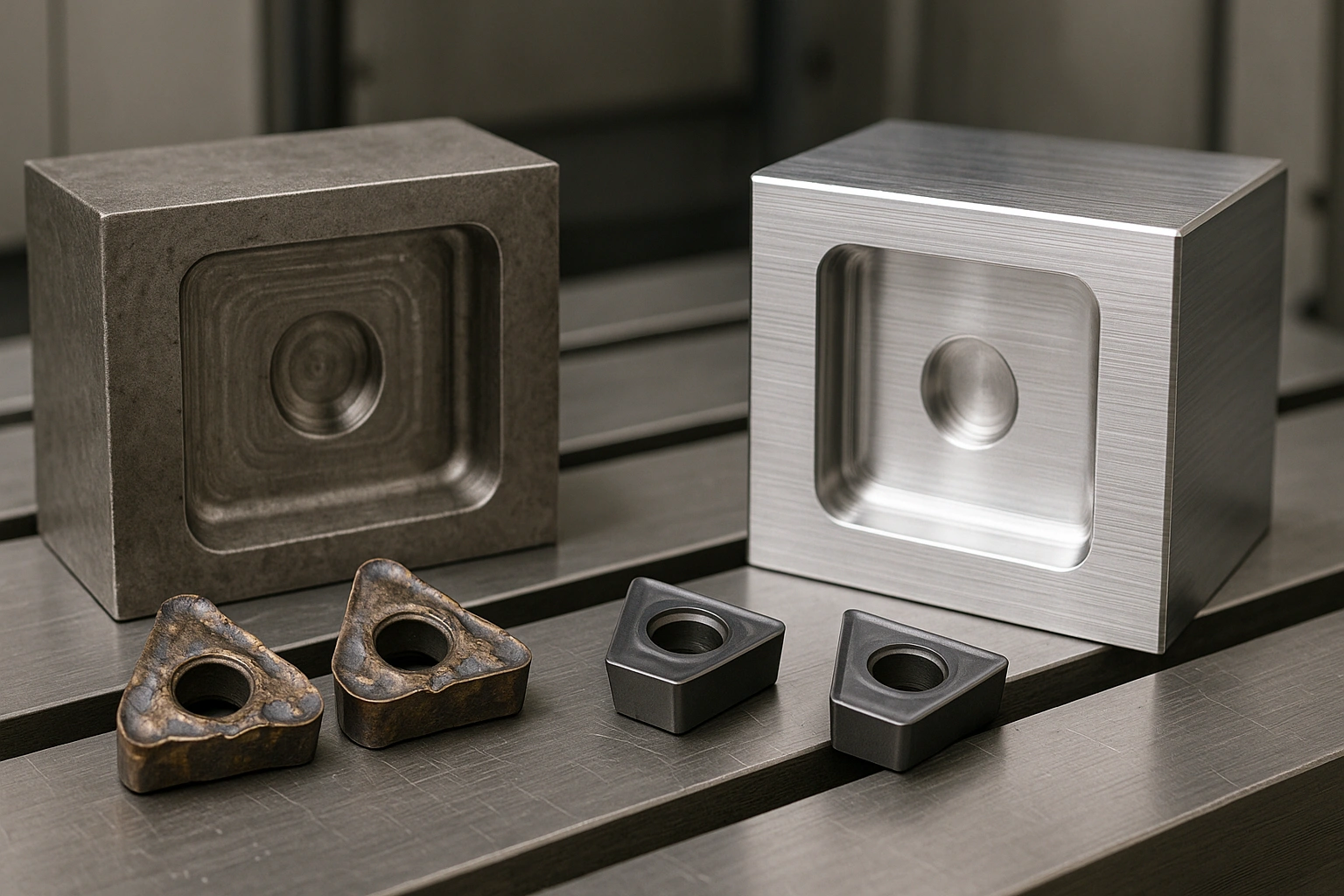
Die Wärmeleitfähigkeit von Titan beträgt etwa ein Zehntel der von Aluminium. Während der Bearbeitung wird keine Wärme aus der Schneidzone abgeleitet; Stattdessen konzentriert es sich auf die Schnittstelle zwischen Werkzeug und Arbeit. Dieses Verhalten erfordert langsamere Schnittgeschwindigkeiten, einen aggressiven Kühlmitteleinsatz und Hartmetallwerkzeuge, die anhaltender Hitze standhalten. Teams, die es gewohnt sind, Aluminium auf ihren CNC-Fräsmaschinen zu bearbeiten, stellen schnell fest, dass die gleichen Vorschübe und Geschwindigkeiten die Werkzeuge zerstören oder Rattern auf Titan erzeugen.
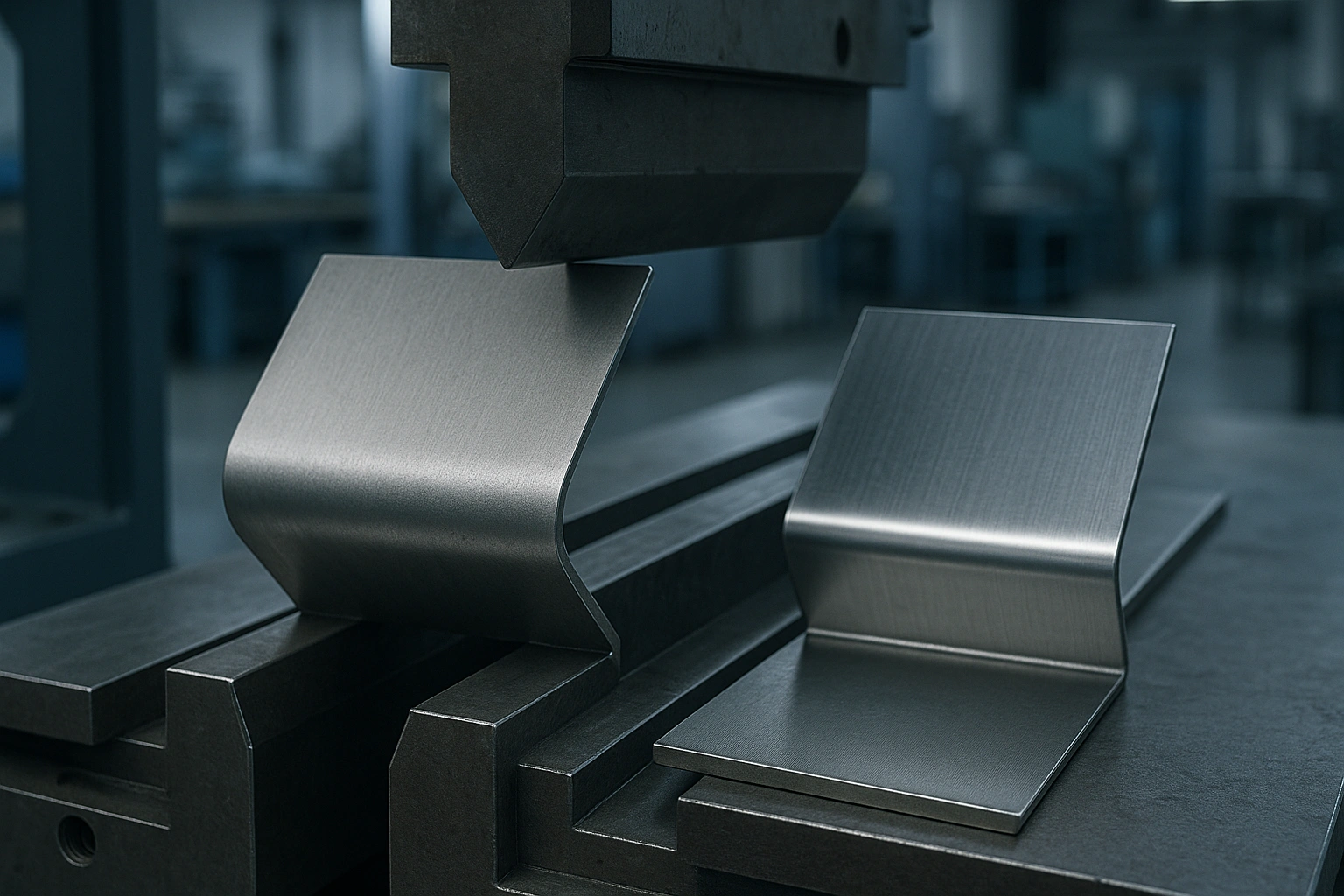
Das Formen stellt eine andere Lernkurve dar. Titan der Güteklasse 5 – die Legierung, die die meisten Outdoor-Marken aufgrund ihres Festigkeits-Gewichts-Verhältnisses verwenden – weist eine begrenzte Dehnformbarkeit und eine erhebliche Rückfederung auf. Während Sie Edelstahl 304 ohne Probleme um einen 2-fachen Dickenradius biegen können, erfordert Güteklasse 5 eine Dicke von mindestens 4,5- bis 5-fach, um Risse zu vermeiden. Verschweißte Bereiche erfordern noch größere Radien. Ihre Werkzeugkonstruktionen müssen die Kompensation der Rückfederung berücksichtigen, was mehr Versuch und Irrtum bedeutet, als Sie es von anderen Metallen gewohnt sind.
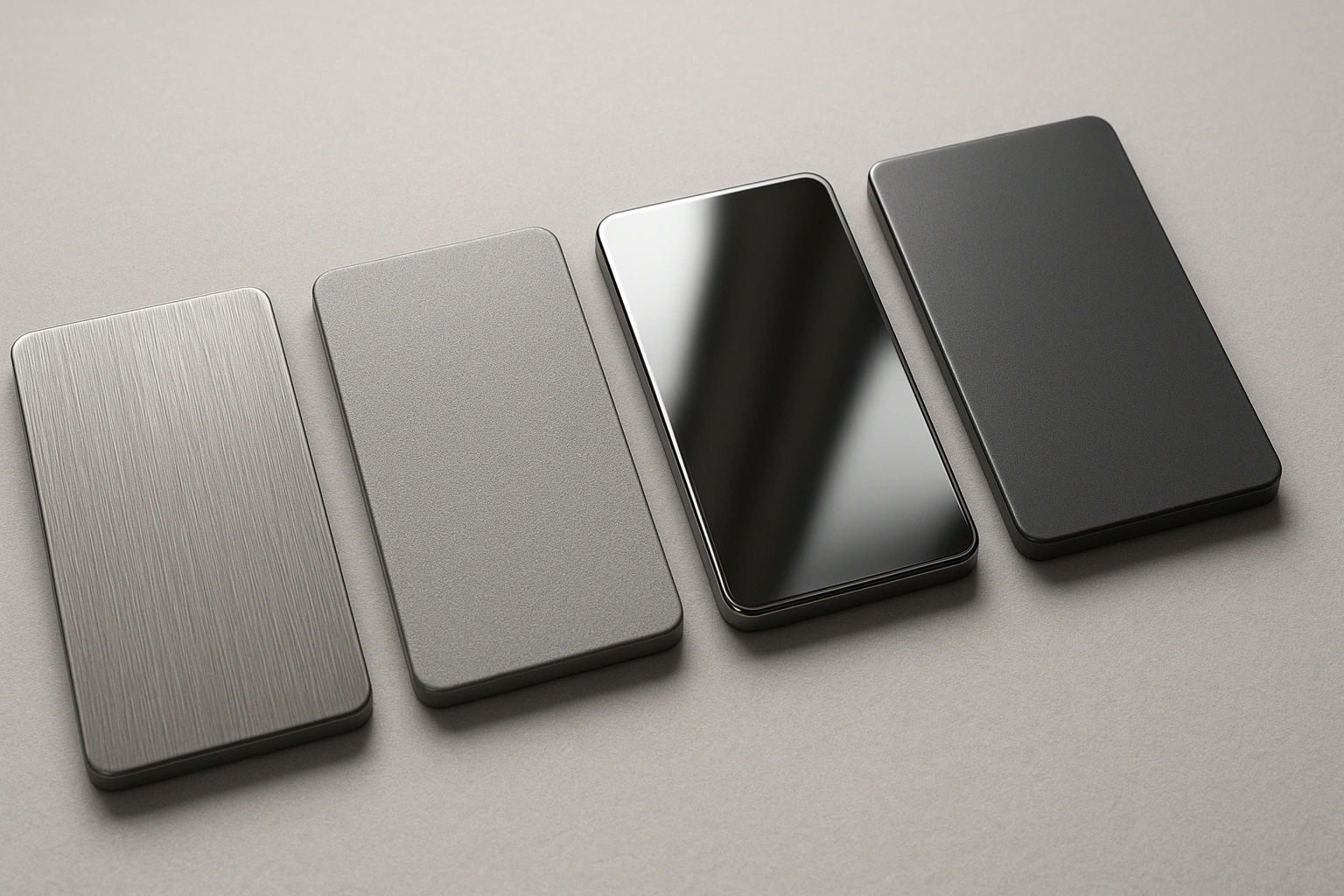
Die Oberflächenveredelung birgt ihre eigenen Überraschungen. Das Kugelstrahlen von Titan mit gleichmäßig mattem Finish erfordert eine strengere Prozesskontrolle als bei Edelstahl – Medientyp, Korngröße, Druck und Strahlzeit wirken sich alle stärker auf das Ergebnis aus. Das Eloxieren zur Farbgebung (eine beliebte ästhetische Wahl bei Titanprodukten für Endverbraucher) hängt von einer präzisen Spannungssteuerung ab, um bestimmte Oxiddicken zu erreichen. Kleine Abweichungen führen zu deutlich unterschiedlichen Farbtönen innerhalb einer Produktionscharge. Marken, die davon ausgehen, dass „gebürstetes Titan“ oder „blau eloxiert“ bei jedem Lieferanten gleich aussehen, sehen sich oft sechs Monate nach Produktionsbeginn mit ästhetischen Konsistenzproblemen konfrontiert.
Die Unterschiede im Materialverhalten sind nicht unüberwindbar, erfordern jedoch praktische Vertrautheit, bevor Sie sich mit der Herstellung befassen. Ein Musterkit gibt Ihren Ingenieuren die Möglichkeit, tatsächliches Material zu biegen, zu bearbeiten und zu bearbeiten, anstatt diese Eigenschaften erst beim ersten Produktionslauf zu entdecken.
Abbildung 2: Variationen der Oberflächenbeschaffenheit von Titan wirken sich dramatisch auf die Ästhetik und die Produktionskonsistenz aus. Von links: gebürstete, glasperlengestrahlte, polierte und eloxierte Oberflächen. Jedes erfordert unterschiedliche Prozessparameter und Lieferantenfähigkeiten – Unterschiede, die durch die praktische Probenbewertung deutlich werden, sich aber anhand von Datenblättern allein nicht beurteilen lassen.
Was ist in einem umfassenden Musterkit enthalten?
A well-structured titanium sample kit for outdoor product development should include physical specimens that let your team evaluate the material properties and processes that matter most to your production. Here’s what to request:
Grade 5 (Ti-6Al-4V) sheet and plate samples in multiple thicknesses. This alloy dominates outdoor hardgoods—tent stakes, cookware, bike components, multi-tools—because it offers the best balance of strength, weight, formability, and cost. Ask for coupons in the thickness range your products will use, typically 0.5mm to 3mm for ultralight gear, heavier gauges for structural components. Sheet samples let your engineers run bend tests at target radii and evaluate spring-back before committing to tooling designs.
Round bar segments if you’re developing turned or machined components. Bar stock behaves differently than sheet during machining, and your contract manufacturer will want to trial feeds, speeds, and tool geometry on actual material before quoting production rates. Even short lengths (50-100mm) are enough for initial trials.
Surface finish coupons showing your target treatments. At minimum, request bead-blasted/satin, polished, and at least two anodized colors if you’re considering color finishes for consumer appeal. Each finish sample should be large enough (roughly 50mm × 50mm minimum) for your design team to evaluate aesthetic and tactile qualities. Critically, ask for boundary samples or high-resolution reference photos that document the exact media, grit, pressure, and blast parameters used. These become your spec reference when ordering production batches, preventing the common problem of finish variation between sample approval and scaled manufacturing.
Material certifications and documentation for every sample. Legitimate suppliers will provide certs referencing the exact ASTM or AMS specification for each product form—typically ASTM B265 or AMS 4911 for sheet/plate, ASTM B348 or AMS 4928 for bar. The cert should note the melt route (double-vacuum melt is standard for aerospace-grade material) and compliance details like DFARS if relevant. This documentation lets you verify material pedigree and gives your quality team the traceability they’ll need for production lots.
Vergleichen Sie Muster von mehreren Lieferanten, wenn Sie Anbieter bewerten. Bestellen Sie identische Spezifikationen bei zwei oder drei Lieferanten und führen Sie parallele Bewertungen durch. Sie werden schnell Unterschiede in der Maßhaltigkeit, der Oberflächengüte, der Vollständigkeit der Dokumentation und der Reaktionszeit bei der Durchlaufzeit erkennen. Diese Unterschiede sind bei Verkaufsgesprächen und Preisangeboten schwerer zu erkennen, werden aber offensichtlich, wenn Sie physische Muster nebeneinander halten.
The total cost for a comprehensive kit from a reputable supplier typically runs $300 to $800 depending on how many finish options and thickness variations you request. Lead time is usually one to three weeks. Given that a single production tooling revision can cost $5,000 to $20,000 and delay your launch by months, the sample kit is a rounding error in your development budget.
Abbildung 1: Ein umfassendes Titan-Musterset umfasst Blechproben in verschiedenen Stärken, Oberflächenbeschaffenheitsgutscheine (perlengestrahlt, poliert, eloxierte Farben), Stangensegmente für Bearbeitungsversuche und vollständige Materialzertifizierungen. Diese organisierte Präsentation ermöglicht es funktionsübergreifenden Teams, Materialeigenschaften, ästhetische Optionen und Lieferantenqualität zu bewerten, bevor sie Produktionsaufträge vergeben.
Wie Teams Beispiele zur Abstimmung und Entscheidung nutzen
One of the sample kit’s underappreciated benefits is how it accelerates internal alignment across functions that typically operate with different priorities and vocabulary. Product wants performance. Design wants aesthetics. Engineering wants manufacturability. Procurement wants cost control. Without a shared physical reference, those conversations stay abstract and create iteration loops late in development.
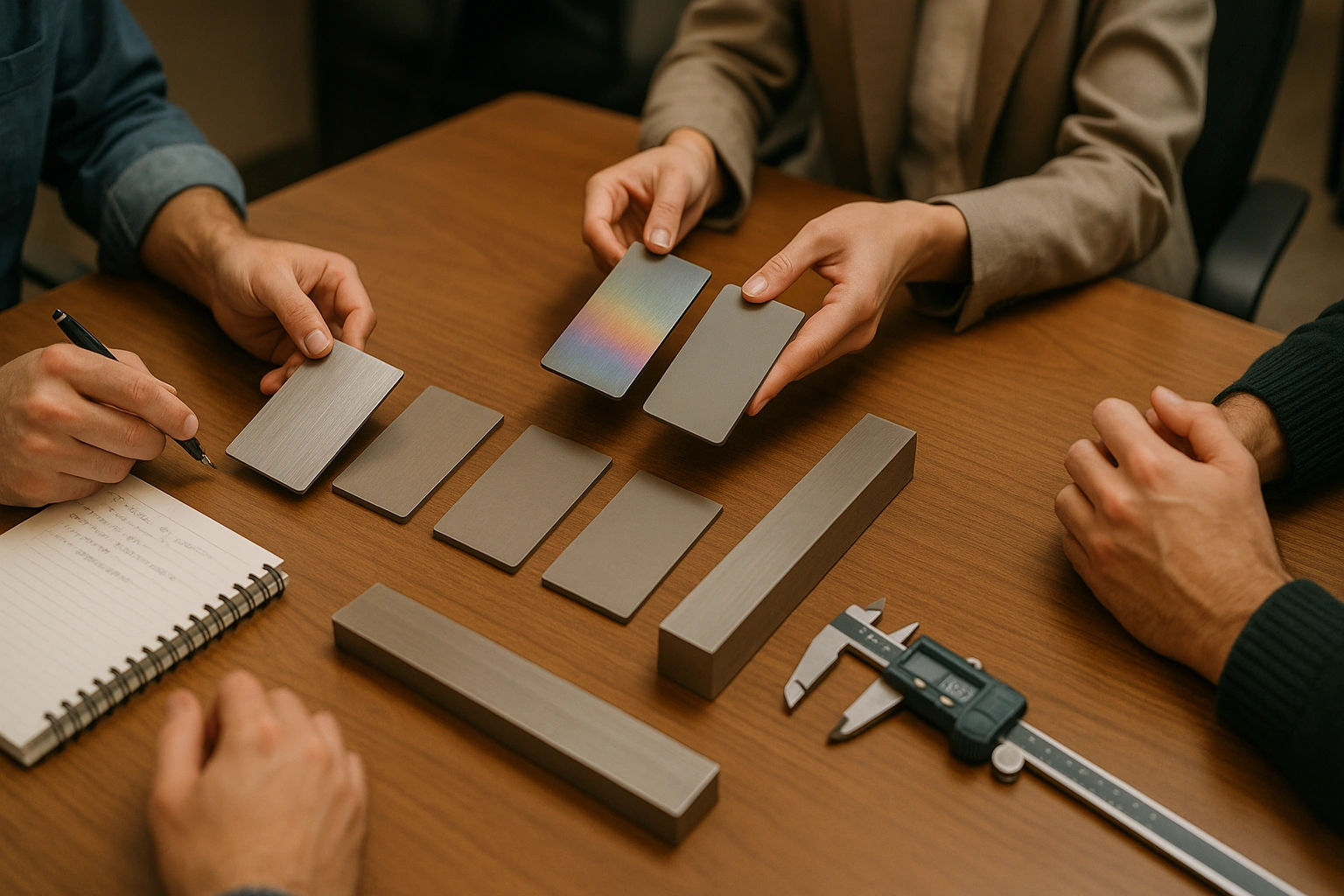
When samples arrive, your product manager can hold a 1.5mm Grade 5 sheet coupon and immediately feel the weight difference versus the steel alternative. Your designer can line up three bead-blast finish samples under different lighting and see which texture aligns with your brand’s premium positioning. Your engineer can run a quick bend test at a 4× radius and confirm whether your tent stake design needs geometry revisions before tooling. Your procurement lead can compare dimensional consistency and documentation quality across three suppliers and narrow the vendor shortlist based on observable differences rather than sales pitches.
These evaluations happen in days, not months. Instead of waiting for a full prototype build to discover that the specified finish doesn’t match your design intent, or that the material gauge creates forming challenges, you resolve those questions during the sample review meeting. Teams that skip this step end up making the same decisions later—but after committing to tooling, placing purchase orders, and setting launch timelines they can’t easily change.
The physical samples also serve as alignment artifacts for external partners. Send finish coupons to your contract manufacturer with clear boundary sample documentation, and they can dial in their blast process before your first production lot. Share material certs with your quality team early, and they can build inspection protocols around the correct specifications rather than scrambling to interpret documentation after parts arrive. Give your marketing team anodized samples to photograph for product launches, and the brand imagery will match what customers actually receive.
I’ve seen cross-functional teams reduce their development cycle by eight to twelve weeks simply by front-loading material evaluation. The time saved isn’t from faster work—it’s from eliminating rework, miscommunication, and late-stage surprises that cascade into schedule delays and budget overruns.
Figure 3: Cross-functional teams use physical samples to align on material selection, finish specifications, and supplier capabilities. Sample kits enable product, design, engineering, and procurement to make informed decisions collaboratively—reducing iteration cycles and preventing costly late-stage revisions during scaled manufacturing.
Was die Probenqualität über die Leistungsfähigkeit des Lieferanten verrät
The samples you receive aren’t just material evaluation tools—they’re also a low-stakes stress test of your potential supplier’s capabilities, processes, and reliability. How a supplier handles a sample request often predicts how they’ll handle your production orders.
Dimensional consistency matters. If you request three sheet coupons at 1.5mm thickness and they arrive measuring 1.48mm, 1.52mm, and 1.50mm, that’s normal mill tolerance. If one measures 1.62mm, that signals weak inventory control or poor lot tracking. The same applies to surface finish. Three bead-blast coupons should look nearly identical under consistent lighting. Noticeable variation in texture or color indicates process inconsistency that will show up in your production batches.
Documentation completeness is an early-warning system. A capable supplier ships samples with material certs that tie each piece to its exact specification (ASTM B265 Grade 5, AMS 4911, etc.), note the melt route, and include compliance markers like DFARS if relevant. Missing, generic, or vague documentation suggests the supplier doesn’t maintain the traceability systems you’ll need for quality audits or regulatory compliance. If they can’t provide proper certs for a $400 sample order, they won’t magically develop those systems when you place a $40,000 production order.
Lead time responsiveness tells you how the supplier manages commitments. If they quote two weeks and deliver in ten days with proactive communication, that’s a positive signal. If samples arrive five weeks late with no explanation, expect the same pattern during production—and remember that production delays cascade into your entire launch timeline.
The supplier’s technical communication during the sample process is equally revealing. Do they ask clarifying questions about your intended application and recommend appropriate thickness ranges or finish options based on your product category? Or do they simply process the order transactionally without offering expertise? Suppliers who understand outdoor gear applications will recognize that tent stakes need different material properties than cookware, and they’ll proactively flag potential issues. That level of applied knowledge reduces your risk during scaled manufacturing.
If you’re evaluating multiple suppliers in parallel, these differences become starkly obvious. One supplier ships samples with complete certs and boundary sample photos in twelve days. Another ships samples three weeks late with incomplete documentation and noticeable finish variation. The pricing might be similar, but the operational risk profiles are entirely different. The sample evaluation process lets you observe those differences before you’re locked into a vendor relationship.
Erste Schritte mit Ihrem Musterkit
If your team is entering titanium or evaluating new suppliers, start with a targeted sample request that covers your immediate development needs without overcomplicating the initial evaluation.
Request Grade 5 (Ti-6Al-4V) sheet samples in the thickness range your products will use—typically 0.5mm to 2.5mm for ultralight outdoor gear, heavier gauges for structural components. Ask for at least three finish options: bead-blasted/satin, polished, and one or two anodized colors if aesthetics matter for your product category. Specify that you need material certifications (ASTM B265 or AMS 4911) and boundary sample documentation for finishes. If you’re developing machined components, add bar stock samples in relevant diameters.
Order from two or three suppliers in parallel if you’re vendor shopping. The comparative evaluation will reveal differences in quality, documentation, responsiveness, and technical support that aren’t obvious from initial sales conversations. Budget $300 to $800 per supplier depending on sample variety.
When samples arrive, organize a cross-functional review session within the first week. Have your product, design, engineering, and procurement leads evaluate the samples together with clear criteria: dimensional accuracy, finish consistency, documentation completeness, and how well the material matches your product requirements. Run quick forming or machining trials if your team has the capability, even crude tests yield useful data about spring-back and tool wear.
Document your findings with photos, measurements, and notes tied to each supplier and sample type. These records become your reference for production specifications and supplier selection decisions. Share finish coupons and certs with your contract manufacturer early so they can plan process parameters and inspection protocols.
The brands that navigate titanium development most efficiently treat the sample kit as a required first step, not an optional nicety. That upfront diligence prevents the expensive, time-consuming surprises that derail product launches and erode team confidence. For a few hundred dollars and a couple of weeks, you gain the hands-on knowledge that spec sheets and supplier presentations can’t provide.