
Inhaltsverzeichnis

/* B2B Engineering Blog Theme - V4.1 (Design Guide Edition) */ :root { --primary-color: #0f172a; /* Slate 900 */ --accent-color: #0071e3; /* Apple Blue */ --text-color: #334155; /* Slate 700 */ --bg-light: #f8fafc; /* Slate 50 */ --border-color: #cbd5e1; /* Slate 300 */ --box-radius: 8px; --warning-bg: #fff1f2; --warning-border: #fda4af; --warning-text: #9f1239; } /* Scoped Container */ .titanium-article-container { font-family: -apple-system, BlinkMacSystemFont, "SF Pro Text", "Segoe UI", Roboto, Arial, sans-serif; line-height: 1.7; color: var(--text-color); max-width: 1100px; margin: 0 auto; padding: 50px 20px; background-color: #ffffff; } /* Typography */ .titanium-article-container h1 { font-size: 2.4rem; line-height: 1.25; color: var(--primary-color); margin-bottom: 1.5rem; font-weight: 800; letter-spacing: -0.02em; } .titanium-article-container h2 { font-size: 1.7rem; color: var(--primary-color); margin-top: 3.5rem; margin-bottom: 1.2rem; font-weight: 700; border-bottom: 1px solid #f1f5f9; padding-bottom: 12px; } .titanium-article-container h3 { font-size: 1.35rem; color: #1e293b; margin-top: 2rem; font-weight: 600; } .titanium-article-container p { margin-bottom: 1.5rem; font-size: 1.05rem; } /* Links */ .titanium-article-container a { color: var(--accent-color); text-decoration: none; font-weight: 500; border-bottom: 1px solid transparent; transition: border-color 0.2s; } .titanium-article-container a:hover { border-bottom-color: var(--accent-color); } /* Images */ .titanium-article-container figure { margin: 40px 0; border: 1px solid var(--border-color); border-radius: var(--box-radius); overflow: hidden; background: #fff; } .titanium-article-container img { width: 100%; height: auto; display: block; } .titanium-article-container figcaption { background: #f1f5f9; padding: 12px 15px; text-align: center; font-size: 0.9rem; color: #64748b; font-style: italic; border-top: 1px solid #e2e8f0; } /* Executive Summary */ .executive-summary { background-color: #eff6ff; padding: 30px; border-radius: var(--box-radius); margin-bottom: 40px; border-left: 4px solid var(--accent-color); } /* Engineering Boundary (Warning) */ .engineering-boundary { background-color: var(--warning-bg); border: 1px solid var(--warning-border); color: var(--warning-text); padding: 20px; margin: 30px 0; border-radius: 6px; font-size: 0.95rem; } .engineering-boundary strong { display: block; margin-bottom: 8px; font-weight: 700; text-transform: uppercase; } /* OEM Takeaway (Grey Box) */ .oem-takeaway { background-color: #f8fafc; border: 1px solid #e2e8f0; padding: 20px; margin: 25px 0; border-radius: 6px; } .oem-takeaway strong { color: #475569; text-transform: uppercase; font-size: 0.85rem; letter-spacing: 0.05em; display: block; margin-bottom: 8px; } /* DFM Checklist Styling */ .checklist-box { background: #fff; border: 2px solid var(--border-color); border-radius: var(--box-radius); padding: 30px; margin-top: 30px; } .checklist-list { list-style: none; padding: 0; margin: 0; } .checklist-list li { padding: 10px 0; border-bottom: 1px dashed #e2e8f0; display: flex; align-items: center; font-size: 1.05rem; } .checklist-list li:before { content: "☐"; font-size: 1.4rem; margin-right: 15px; color: var(--accent-color); font-weight: bold; } /* Meta Info */ .meta-info { font-size: 0.9rem; color: #94a3b8; margin-bottom: 40px; padding-top: 15px; border-top: 1px solid var(--border-color); } @media (max-width: 768px) { .titanium-article-container { padding: 25px 15px; } .titanium-article-container h1 { font-size: 1.9rem; } } { "@context": "https://schema.org", "@type": "TechArticle", "headline": "Titanium Mug Design: Engineering, Ergonomics, and OEM Manufacturing Constraints", "description": "Technical guide for OEM buyers on designing titanium mugs. Covers material constraints (ASTM B265 Grade 1), deep drawing limits, and design for manufacturability (DFM).", "image": "https://7titanium.com/wp-content/uploads/2025/12/20251217_1239_titanium-mug-formation_simple_compose_01kcn9nckhf40a4r71m1381vd1.webp", "articleSection": "Industrial Design & Engineering", "keywords": "Titanium Mug Design, OEM Manufacturing, Deep Drawing Titanium, Titanium Grade 1 vs Grade 2" }

Design von Titanbechern: Konstruktion, Ergonomie und Einschränkungen bei der OEM-Fertigung

Kategorie: Industriedesign und Ingenieurwesen | Zielgruppe: Produktmanager, OEM-Einkäufer | Schnecke: /titanium-mug-design/

Einführung: Warum Design fertigungsorientiert ist

In der Outdoor-Ausrüstungsbranche wird Design oft als ästhetische Übung betrachtet. Bei der Arbeit mit Titan ist das Design jedoch in erster Linie eine Funktion der Materialphysik. Im Gegensatz zu Edelstahl gibt es bei Titan strenge Grenzen.

Für OEM-Käufer führt ein Design, das den niedrigen Elastizitätsmodul oder die begrenzte Dehnung von Titan ignoriert, zu hohen Werkzeugkosten und niedrigen Ausbeuten. In diesem Leitfaden werden die technischen Prinzipien beschrieben, die für die Entwicklung erfolgreicher, optimierter Trinkgefäße aus Titan erforderlich sind OEM-Fertigung.

1. Materialbeschränkungen, die das Design definieren

The first step in any RFQ is defining the material specification. The specific grade determines formability.

Titanium mug deep drawing formation process showing material stress points
Figure 1: Deep drawing titanium requires precise stress relief. Grade 1 allows for the deformation shown without cracking.

ASTM B265 Grade 1 vs Grade 2

  • Grade 1 (CP Ti): The softest and most ductile grade. It is the industry standard for vessel bodies, allowing for deep drawing of tall mugs without intermediate annealing.
  • Grade 2 (CP Ti): Stronger but less ductile. Often used for handles or lids where rigidity is prioritized. Learn more about grades here.

Wall Thickness & Spring-Back

OEM designs typically specify a starting sheet thickness of 0.5mm, which thins to 0.35mm–0.4mm after forming. Titanium’s high “spring-back” (Modulus of Elasticity ~110 GPa) means tooling must be over-bent to achieve precise shapes, limiting complex compound curves.

2. Structural Design Elements

The architecture of a titanium mug determines its functional use case. Design decisions here are binary.

2.1 Single-Wall vs. Double-Wall
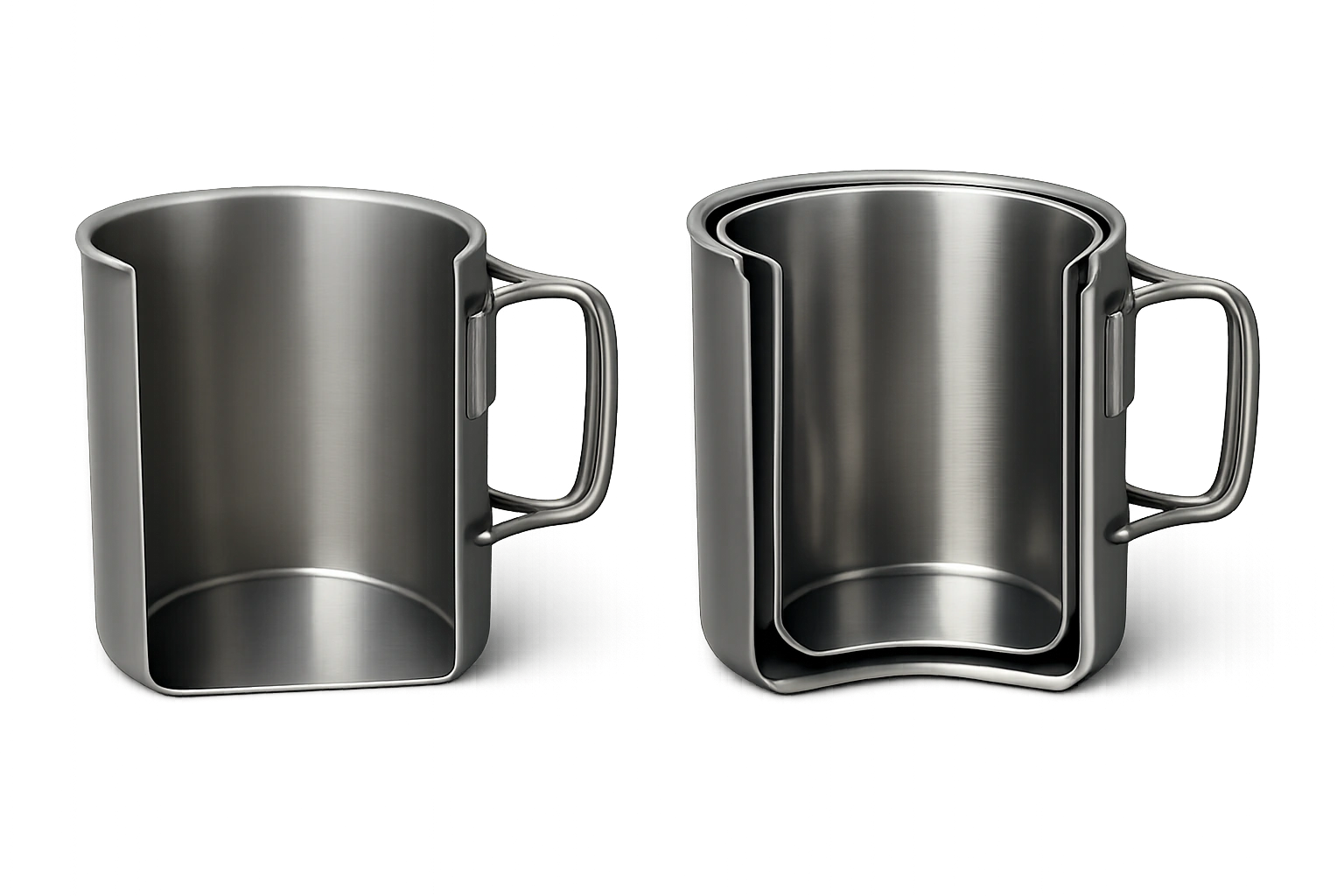
Structural comparison between single wall utility mugs and double wall insulated mugs
Figure 2: Single-wall (left) for utility/cooking vs. Double-wall (right) for insulation. Note the wall thickness difference.
  • Single-Wall: Designed for utility (boiling water). Structural rigidity comes from the rolled rim.
  • Double-Wall: Designed for insulation. Requires a vacuum brazing process.
⚠️ Engineering Boundary: Double-wall vacuum mugs cannot be used for cooking. The trapped gas/vacuum seal may fail explosively under direct heat. This is a critical product liability constraint.

2.2 Handle Design & Attachment

Titanium cannot be soldered; handles are attached via Electrical Resistance Spot Welding.

Titanium D-handle design showing spot welding attachment points
Figure 3: The handle attachment “pad” must be flat to ensure proper electrode contact during spot welding.
OEM-Imbiss: Avoid placing handle weld points on curved surfaces or structural ribs. This leads to weak welds and high defect rates.

2.3 Rim Design

The rim serves two purposes: user interface (lip feel) and structural reinforcement (hoop strength).

Comparison of rolled rim vs cut rim designs in titanium drinkware
Figure 4: Rolled rims (Top) provide structural hoop strength. Cut rims (Bottom) offer a sleek aesthetic but require thicker walls.
  • Rolled Rim: Standard for single-wall. Prevents ovalization.
  • Cut/Polished Rim: Common on double-wall. Sleek aesthetic but higher finishing cost.

3. Surface Finish & Visual Design

Surface finish is a mechanical process affecting cost and durability.

  • Sandblasting (Matte): The OEM standard. Low cost, good grip, hides fingerprints.
  • Crystallization (Ice Flower): A premium high-temperature vacuum treatment unique to titanium.
  • No Coatings: Paints are avoided. Anodizing is preferred for color as it maintains biocompatibility.

4. Ergonomics vs. Manufacturing Reality

The “Nesting” Constraint: For camping gear, volume efficiency is paramount. A 450ml mug is often designed specifically to fit inside a 600ml mug, which fits inside a 900ml pot. This often dictates diameter more than ergonomics.

5. Design for Manufacturability (DFM) Checklist

Before submitting your RFQ to our engineering team, run your design through this checklist to ensure feasibility.

  • Grade Specified: Is Grade 1 specified for the body?
  • Wall Structure: Is it clearly Single or Double wall?
  • Anwendungsfall: Is the cooking/fire requirement defined?
  • Draw Ratio: Is the height-to-diameter ratio < 1.5:1?
  • Handle Interface: Is there a flat surface for spot welding?
  • Nesting: Does the OD fit standard gas canisters (90mm/110mm)?
  • Finish: Is the finish specified (Sandblast/Ice Flower)?

Conclusion: Engineering-Led Design Wins

In titanium drinkware, the most successful products are those where industrial design submits to engineering reality. A mug optimized for the deep drawing process and standard tooling will always offer a better price-to-performance ratio.

Ready to validate your design?
Review our OEM Manufacturing Standards or contact us to review your CAD files.

Bild von Max Jiang

Max Jiang

Marketingdirektor von 7Titanium, spezialisiert auf Titan-OEM/ODM mit über einem Jahrzehnt Erfahrung in Materialtechnik, Produktionsmanagement und globaler Lieferkettenoptimierung für Outdoor-Marken. E-Mail: [email protected]

Aktie:

Weitere Beiträge

Senden Sie uns eine Nachricht


OEM-Partner globaler Outdoor- und Küchenartikelmarken.

Vertrauenswürdiger Titanium-OEM-Partner