
Executive Summary
For procurement managers navigating material selection in aerospace, medical device manufacturing, chemical processing, and marine engineering, titanium represents a strategic engineering material that delivers measurable performance advantages—when specified correctly and sourced from qualified suppliers. This guide addresses the three critical challenges procurement teams face: grade selection accuracy, regulatory compliance verification, and supplier quality assurance.
يعتمد عرض قيمة تيتانيوم على أساسيات هندسية، وليس على ادعاءات تسويقية. بكثافة تبلغ 4.51 جم/سم³، يوفر التيتانيوم النقي تجاريًا (CP) توفيرًا في الوزن بنسبة 45% مقارنةً بالفولاذ المقاوم للصدأ 316 مع الحفاظ على مقاومة تآكل مماثلة أو فائقة من خلال الطبقة السلبية لثاني أكسيد التيتانيوم (TiO₂) ذاتية المعالجة. تحقق سبائك التيتانيوم مثل Ti-6Al-4V (الدرجة 5) قوى محددة تتجاوز 200 ميجاباسكالسم³/جم — مما يتيح تجميعات الفضاء الجوي التي تلبي متطلبات الكلال عند الوزن الهيكلي المنخفض ومعدات المعالجة الكيميائية التي تقضي على فترات التوقف المرتبطة بالتآكل في البيئات الكلوريدية والحمضية.
The regulatory landscape for titanium is well-established. FDA recognizes ASTM F136 (Ti-6Al-4V ELI) and ASTM F67 (CP Grades 1-4) as consensus standards for surgical implants, streamlining biocompatibility demonstrations through ISO 10993-1 endpoint testing. Food-contact applications leverage FDA Food Contact Notifications for titanium nitride coatings on processing equipment. RoHS compliance in electronics manufacturing is straightforward—titanium is not among the ten restricted substances. Occupational safety centers on combustible dust control per NFPA 484 and OSHA guidance for machining operations, not material toxicity concerns.
Grade selection drives both performance and cost outcomes. CP Grade 2—the most widely specified unalloyed grade—offers excellent corrosion resistance and formability at the lowest titanium price point, making it suitable for heat exchangers, chemical process vessels, and marine components where high strength isn’t required. Ti-6Al-4V (Grade 5) dominates aerospace applications due to ~900 MPa tensile strength and fatigue resistance, while Grade 23 ELI (Extra Low Interstitial) variant serves medical implants through improved ductility and fracture toughness. Specifying Grade 5 when Grade 2 suffices inflates material costs by 40-60% without functional benefit; conversely, under-specifying CP titanium for high-stress aerospace assemblies creates failure risk.
Lifecycle cost analysis consistently favors titanium in corrosive environments despite 2-4× higher initial material costs versus stainless steel. A titanium heat exchanger in chemical processing eliminates the 3-5 year replacement cycles common with stainless steel in chloride service, reducing total cost of ownership by 30-45% over ten years when downtime, maintenance labor, and replacement materials are factored. Marine applications see similar payback periods—typically 5-7 years for titanium piping and pressure vessels versus stainless steel alternatives.

ويظل تأهيل الموردين هو قرار الشراء الأكثر تأثيرًا. يعتمد أداء التيتانيوم على التحكم في العناصر الخلالية (الأكسجين والنيتروجين والهيدروجين) والمعالجة الحرارية المناسبة - وهي متغيرات غير مرئية في المكونات النهائية ولكنها مهمة للخواص الميكانيكية ومقاومة التآكل. يتطلب الشراء الفعال شهادات اختبار المطاحن مع إمكانية تتبع كمية الحرارة، والتحقق من التحليل الكيميائي من طرف ثالث، وشهادة المورد وفقًا لمعايير ISO 9001 (خط الأساس)، أو AS9100 (الفضاء الجوي)، أو ISO 13485 (الأجهزة الطبية) اعتمادًا على التطبيق. يوفر اختبار رش الملح وفقًا لمعيار ASTM B117، والتحقق من تحمل الأبعاد من خلال فحص CMM، واختبار سلامة اللحام أدلة جودة موضوعية.
This guide equips procurement teams to specify titanium grades that match application requirements, evaluate supplier capabilities through auditable criteria, and justify titanium’s lifecycle value to internal stakeholders. The framework applies whether you’re sourcing surgical implant stock, aerospace forgings, chemical process equipment, or marine hardware. Technical depth is calibrated for procurement managers with engineering backgrounds—precise enough to support specification decisions, practical enough to accelerate sourcing workflows.
Ready to evaluate titanium for your application? Request an engineering consultation to discuss grade selection and supplier qualification, or download the Titanium Specification Handbook for detailed material property tables and procurement checklists.
Section 1: What Makes Titanium an Engineering-Grade Material?
Titanium’s adoption in regulated industries—aerospace, medical implants, chemical processing, marine engineering—stems from a specific combination of material properties that solve engineering problems conventional alloys cannot address cost-effectively. Understanding these fundamentals enables procurement teams to recognize when titanium specification delivers measurable ROI and when lower-cost alternatives suffice.
1.1 Material Fundamentals: Density, Strength, Microstructure
Crystal Structure and Phase Behavior
Titanium exhibits allotropic transformation between two crystal structures: alpha phase (hexagonal close-packed, HCP) stable at room temperature and beta phase (body-centered cubic, BCC) stable above the beta-transus temperature. For commercially pure Grade 2 titanium, this transformation occurs around 913°C; for Ti-6Al-4V alloy the beta-transus is approximately 999°C (1830°F). This phase behavior matters in procurement because it governs heat treatment responses, weldability, and achievable mechanical properties.
Alloying elements partition into alpha-stabilizing (aluminum, oxygen, nitrogen) or beta-stabilizing (vanadium, molybdenum, iron) categories. Ti-6Al-4V (Grade 5)—the most widely specified titanium alloy—balances 6% aluminum (alpha stabilizer) with 4% vanadium (beta stabilizer) to create a two-phase alpha+beta microstructure. ASTM F136 explicitly requires this fine alpha-beta dispersion in medical-grade Ti-6Al-4V ELI to ensure ductility and fracture toughness; the standard prohibits continuous alpha networks at prior beta grain boundaries because such features degrade fatigue performance and impact resistance.
For procurement, the practical implication is that titanium alloys respond to thermal processing—annealing, solution treating, aging—in ways that directly affect mechanical properties. Mill test certificates should document final heat treatment parameters and resulting microstructure when critical components require specific strength-ductility combinations.
Density and Specific Strength
Titanium’s strategic advantage lies in specific strength—the strength-to-density ratio that determines structural efficiency. At 4.51 g/cm³, CP Grade 2 titanium is 45% lighter than 316 stainless steel (approximately 8.0 g/cm³) and 67% heavier than 6061-T6 aluminum (2.70 g/cm³). This intermediate density would be unremarkable except that titanium’s strength per unit weight exceeds both competing materials in many applications.
Consider specific strength calculations using tensile strength divided by density:
- Ti-6Al-4V Grade 5: ~903 MPa tensile strength ÷ 4.43 g/cm³ = 204 MPa·cm³/g
- 316 Stainless Steel (annealed): ~515 MPa ÷ 8.0 g/cm³ = 64 MPa·cm³/g
- 6061-T6 Aluminum: ~310 MPa ÷ 2.70 g/cm³ = 115 MPa·cm³/g
- CP Grade 2 Titanium: ~344 MPa ÷ 4.51 g/cm³ = 76 MPa·cm³/g
Ti-6Al-4V delivers 3.2× the specific strength of stainless steel and 1.8× that of aluminum alloy, enabling aerospace structures that meet load requirements at lower mass. Even unalloyed CP titanium matches stainless steel’s specific strength while offering superior corrosion resistance—the combination that drives chemical processing applications.
This data justifies titanium in weight-critical applications (aerospace assemblies, rotating equipment) and in corrosive environments where frequent stainless steel replacement negates initial material cost differences.
Thermal Stability and Creep Resistance
Titanium’s melting point of 1,668°C provides substantial thermal margin for most industrial applications, but practical service temperature limits are lower and grade-dependent. Ti-6Al-4V maintains mechanical properties to approximately 427°C (800°F) with acceptable oxidation resistance extending to 538°C (1,000°F) for limited exposure. Above these temperatures, surface oxidation accelerates and creep—time-dependent deformation under stress—becomes the limiting design factor.
CP titanium grades have lower creep resistance than alloys due to lower strength; Grade 2’s ~275 MPa yield strength limits load-bearing applications above 300°C even though the material remains chemically stable. Chemical processing equipment operating at elevated temperatures typically uses Grade 12 (Ti-0.3Mo-0.8Ni) when corrosion resistance must extend into the 250-350°C range under stress.
Thermal expansion coefficients matter for assemblies joining titanium to dissimilar materials. CP Grade 2 exhibits 8.6 µm/m·°C thermal expansion (0-100°C range), roughly half that of 316 stainless steel (~16 µm/m·°C) and one-third that of aluminum (~23.6 µm/m·°C). Bolted joints, brazed assemblies, and welded dissimilar-metal connections require design accommodation for differential expansion to prevent stress concentration and premature failure through thermal cycling.
Titanium’s relatively low thermal conductivity—approximately 16.4 W/m·K for CP Grade 2 compared to 167 W/m·K for aluminum and ~16 W/m·K for stainless steel—affects heat exchanger design. While titanium’s corrosion immunity may justify its use in fouling services where stainless steel fails, the lower conductivity requires larger surface areas to achieve equivalent heat transfer rates. Lifecycle cost analysis must weigh this capital cost increase against eliminated maintenance and replacement costs.

1.2 Industrial Advantages With Quantitative Insights
High Strength-to-Weight Ratio
The specific strength data presented above translates to measurable system-level benefits:
- Aerospace structures: A titanium airframe component weighing 10 kg replaces a 17.8 kg stainless steel equivalent for the same load capacity, reducing structural weight by 7.8 kg. In commercial aircraft where fuel burn scales with weight, this mass reduction drives lifecycle cost savings that exceed titanium’s material premium over 25-30 year service lives.
- Rotating equipment: Titanium compressor blades in gas turbines enable higher tip speeds (lighter blades reduce centrifugal loads) and improved efficiency. The material cost is justified by performance gains that increase turbine output and reduce fuel consumption per megawatt-hour.
- Marine submersibles: Pressure hull components in titanium alloy enable deeper operating depths than aluminum at comparable weight, or equivalent depth capability at substantially lower weight than steel—critical parameters in ROV and submersible design where buoyancy margins determine payload capacity.
Procurement decisions should tie titanium specification to quantifiable performance improvements—fuel savings, increased payload, enhanced operational capability—that translate material costs into measurable ROI.
Corrosion Resistance Mechanisms
Titanium’s corrosion resistance stems from a tenacious, self-healing titanium dioxide (TiO₂) passive film that forms instantaneously upon exposure to oxygen or oxidizing environments. This nanometer-scale film acts as a diffusion barrier preventing substrate attack. The film reforms immediately if damaged through abrasion or scratching, provided sufficient oxygen is present—a characteristic termed “self-healing” passivity.
This passivation mechanism delivers practical advantages:
- Chloride immunity: Titanium resists pitting and crevice corrosion in seawater, brines, and chloride process streams where stainless steels suffer localized attack. The breakdown potential (the voltage above which pitting initiates) for titanium in chloride solutions exceeds that of austenitic stainless steels by 500-1000 mV, indicating far superior resistance.
- Oxidizing acids: Nitric acid, chromic acid, and other oxidizing media maintain the TiO₂ film, enabling titanium service in concentrations and temperatures that would destroy stainless steel. Chemical processing plants use CP Grade 2 titanium heat exchangers and piping in nitric acid service, achieving 20+ year service lives without measurable corrosion.
- Reducing environments require caution: Titanium’s passivity depends on oxidizing conditions. In reducing acids (hydrochloric, sulfuric under certain conditions) and in oxygen-depleted crevices, the film cannot regenerate and corrosion accelerates. Grade 12 (with 0.3% Mo and 0.8% Ni additions) extends titanium’s resistance into mildly reducing environments, but material selection for reducing acid service requires careful evaluation.
- Crevice and pitting resistance: While titanium’s passive film is robust, tight crevices in hot chloride solutions can create localized chemistry (low pH, oxygen depletion) that exceeds the film’s protective capability. Design should minimize crevice geometries—use welded rather than flanged joints where practical, avoid threaded connections in critical service, and specify gasket materials that don’t create tight crevice gaps.
The economic impact: titanium heat exchangers in chemical processing, desalination, and offshore platforms eliminate the 3-5 year replacement intervals typical of 316L stainless steel in chloride service. A titanium unit with 2.5× the capital cost of stainless steel but 20-year service life delivers 30-45% lower total cost of ownership when downtime, replacement materials, and labor are factored.
Fatigue Performance in Aerospace Assemblies
High-cycle fatigue (HCF) resistance—the ability to withstand millions of stress cycles without crack initiation—drives titanium’s dominance in aerospace applications. Ti-6Al-4V exhibits fatigue strength around 500-600 MPa at 10⁷ cycles (R=-1, unnotched specimens), representing roughly 55-65% of its ultimate tensile strength. This fatigue ratio exceeds that of many aluminum alloys and competes favorably with high-strength steels while maintaining the weight advantage.
Aircraft engine components (compressor blades, discs, casings), landing gear, and critical airframe fittings specify titanium alloys for fatigue-critical service. The material’s notch sensitivity requires attention to surface finish and stress concentrations, but proper design and quality control deliver reliable performance through 30,000+ flight cycles.
Material certification for aerospace applications follows AMS (Aerospace Material Specifications) standards: AMS 4928 for Ti-6Al-4V bar stock, AMS 4911 for sheet/plate, AMS 4967 for forgings. These specifications define chemistry, mechanical properties, and processing requirements more stringently than commercial ASTM grades. Procurement for aerospace must verify AMS compliance and supplier AS9100 certification (the aerospace quality standard) to meet OEM traceability requirements and FAA documentation standards.
Non-Magnetic and EMI-Safe Applications
Titanium’s non-ferromagnetic nature—confirmed for both CP grades and Ti-6Al-4V—makes it the material of choice in applications where magnetic interference must be eliminated:
- MRI-compatible surgical instruments and implants: Ferromagnetic materials create image artifacts and experience forces in magnetic fields; titanium implants and tools operate safely in MRI environments.
- Electromagnetic interference (EMI) sensitive equipment: Aerospace and defense electronics housings, shipboard equipment near compass systems, and scientific instrumentation specify titanium to avoid magnetic signature and interference.
- Mine countermeasures: Naval mine-hunting equipment uses titanium to minimize magnetic signature that could trigger magnetic-influence mines.
While these applications represent niche markets compared to corrosion-driven uses, they demonstrate titanium’s unique property combination: strength, corrosion resistance, biocompatibility, and electromagnetic transparency converge in no other structural metal.

Section 2: Safety & Compliance — Is Titanium Toxic?
Is Titanium Safe? (B2B Interpretation)
In B2B procurement contexts, “Is titanium toxic?” is the wrong question. The relevant questions are: Does titanium meet regulatory standards for my industry? What biocompatibility testing does my application require? What occupational safety protocols must suppliers follow during processing?
The evidence-based answer: Titanium metal and common implant alloys exhibit physiological inertness and high corrosion resistance when properly passivated, delivering long clinical survival in load-bearing medical devices and decades of service in food contact and chemical processing applications. Procurement decisions should focus on regulatory compliance pathways, required documentation, and supplier quality systems—not abstract “toxicity” concerns that don’t reflect how titanium behaves in industrial use.
2.1 Regulatory Frameworks That Govern Titanium Use
FDA Biocompatibility Standards (Class II/III Medical Devices)
FDA’s biocompatibility assessment framework aligns with ISO 10993-1, directing device sponsors to evaluation endpoint tables that map required testing to device tissue contact type and exposure duration. Cytotoxicity, sensitization, irritation, systemic toxicity, and implantation testing apply based on these parameters. The FDA explicitly recognizes titanium material standards that streamline premarket submissions:
- ASTM F136-13: “Wrought Titanium-6Aluminum-4Vanadium ELI (Extra Low Interstitial) Alloy for Surgical Implant Applications” is a recognized consensus standard covering chemical, mechanical, and metallurgical requirements for Ti-6Al-4V ELI (UNS R56401) surgical implants. Recognition as a “Complete” standard means FDA accepts declarations of conformity to F136 in 510(k) premarket notifications for Class II devices and PMA (premarket approval) applications for Class III devices, provided the material use falls within the standard’s scope.
- ASTM F67: “Standard Specification for Unalloyed Titanium, for Surgical Implant Applications” covers CP titanium Grades 1-4 (UNS R50250, R50400, R50550, R50700) in various product forms with defined mechanical properties and finish options. This standard is similarly recognized by FDA for surgical implant applications.
Procurement implications: When sourcing titanium for implantable medical devices, require supplier certificates documenting ASTM F136 or F67 conformance with full heat-lot traceability. Mill test certificates should include chemical composition (verifying interstitial element limits), mechanical test results (UTS, yield, elongation, reduction of area), and final heat treatment parameters. Biocompatibility testing follows the ISO 10993-1 endpoint matrix appropriate to the device’s contact category and duration; the recognized material standard addresses material conformance, not device-level biocompatibility.
ISO 10993 for Implantable Materials
ISO 10993-1 establishes a risk-based biocompatibility evaluation process rather than prescribing fixed test batteries. The standard provides endpoint tables that categorize devices by contact type (surface contact, external communicating, implant) and contact duration (limited ≤24h, prolonged >24h to 30 days, permanent >30 days). Relevant endpoints for titanium implant components typically include:
- Cytotoxicity: In vitro cell culture testing to detect acute cellular toxicity from material extracts
- Sensitization: Guinea pig maximization or local lymph node assay to identify delayed-type hypersensitivity potential
- Irritation: Intracutaneous or intramuscular injection studies evaluating local tissue response
- Systemic toxicity: Acute, subacute, or subchronic studies based on exposure scenario
- Implantation: Histopathological evaluation of tissue response to materials implanted in rabbits or other models (typically 12-26 weeks)
- Hemocompatibility: Thrombosis, coagulation, platelet, and complement activation studies for blood-contacting devices
Titanium and Ti-6Al-4V alloys have decades of biocompatibility data demonstrating favorable performance across these endpoints. The material’s adoption in orthopedic implants (hip/knee replacements), dental implants, and cardiovascular devices reflects consistent passage of these regulatory requirements. Systematic reviews report mean implant survival rates of 97.4% at ≥5 years for immediately loaded dental implants, evidencing reliable osseointegration under clinical protocols.
Procurement note: Biocompatibility testing is device-specific, not material-specific. Recognized material standards like ASTM F136 address the starting material’s conformance; device manufacturers must conduct biocompatibility evaluation on the finished device considering manufacturing processes (surface treatments, sterilization, contaminants). Suppliers claiming “biocompatible titanium” without reference to specific testing and standards are using the term loosely; demand documentation of F136/F67 conformance and verification that your device’s final biocompatibility matrix is complete.
ISO 22000 & NSF Standards for Food-Contact Applications
Titanium’s use in food processing equipment, pharmaceutical production, and beverage handling is governed by food-contact safety standards rather than medical device frameworks. FDA Food Contact Notifications (FCN) provide a regulatory pathway for new food-contact substances:
- FCN 1240 approves titanium nitride thin-film ceramic coatings (0.1-25 μm thickness) on repeated-use metal component parts in food processing and packaging machinery for contact with all food types under standard conditions of use. This approval demonstrates titanium-based surface engineering’s regulatory acceptance in food equipment applications.
توفر معايير NSF/ANSI (خاصة NSF/ANSI 51 لمواد المعدات الغذائية) شهادة طرف ثالث بأن المواد تلبي متطلبات سلامة الأغذية من حيث التركيب ومقاومة التآكل والتوافق مع التنظيف/التعقيم. عادةً ما تحمل المبادلات الحرارية المصنوعة من التيتانيوم وأوعية الخلط والأنابيب المستخدمة في معالجة الألبان والمشروبات والأدوية شهادة NSF.
ISO 22000 (Food Safety Management Systems) doesn’t certify materials directly but requires food equipment manufacturers to validate that materials contacting food don’t introduce contamination. Titanium’s chemical inertness, absence of leachable toxic elements, and resistance to corrosion products makes it a preferred material in sanitary process systems where stainless steel may release iron, chromium, or nickel ions under aggressive cleaning regimes (caustic washes, acid sanitizers).
Procurement guidance: For food-contact titanium components, verify that material conforms to relevant FDA FCNs or holds NSF certification. Request corrosion testing documentation showing absence of metal ion release under your specific process conditions (product pH, temperature, cleaning chemicals, contact duration). Surface finish specifications matter—electropolished or mechanically polished titanium (typically Ra <0.8 μm) minimizes bacterial harboring and supports effective CIP (clean-in-place) protocols.
RoHS / REACH Compliance for Electronics and Manufacturing
European Union RoHS (Restriction of Hazardous Substances) Directive currently restricts ten substances in electrical and electronic equipment: lead, cadmium, mercury, hexavalent chromium, polybrominated biphenyls (PBB), polybrominated diphenyl ethers (PBDE), and four phthalates (DEHP, BBP, DBP, DIBP). Titanium metal is not among the restricted substances, simplifying RoHS compliance for titanium components and housings in electronics assemblies. Normal exemption analysis for complete assemblies still applies, but titanium itself presents no RoHS substance restriction concern.
REACH (Registration, Evaluation, Authorization, and Restriction of Chemicals) requires chemical substance registration in the EU market. Metallic titanium and titanium dioxide are registered substances; procurement teams should review supplier Safety Data Sheets (SDS) and ensure that downstream use requirements are communicated per REACH Article 31/32 obligations. Of particular note: titanium dioxide powder (TiO₂) used in sandblasting, surface treatments, and coatings has undergone classification review for carcinogenic potential via inhalation. While conclusions remain debated, occupational exposure controls for TiO₂ dust (respiratory protection, dust collection, exposure monitoring) are prudent. Finished titanium components with adherent oxide layers or TiN coatings don’t present the same exposure scenario as powder handling.
Procurement implications: For EU market shipments, verify that titanium suppliers provide REACH-compliant SDS and registration documentation. Confirm that any surface treatment processes (anodizing, blasting, coating) using TiO₂ powders follow occupational exposure limits and that final components don’t retain loose powder that could create downstream exposure during customer handling or machining.
2.2 Occupational & Process Safety
Titanium’s Inertness Under Normal Processing Conditions
Titanium metal in solid form (bar, sheet, forgings, finished components) presents no significant toxicity or chemical hazard during normal handling, machining, forming, or welding. The material doesn’t off-gas toxic compounds at room temperature, doesn’t cause skin sensitization from contact with solid metal, and doesn’t leach hazardous elements into aqueous or organic solvents under ambient conditions. Standard metalworking PPE (safety glasses, gloves, hearing protection) suffices for routine titanium fabrication.
The exception: titanium’s affinity for oxygen makes it reactive in finely divided forms (powder, turnings, swarf, grinding dust) where high surface-area-to-volume ratios enable rapid oxidation. This reactivity creates combustible metal hazards that require specific process controls.
Safe Temperature Ranges for Chemical Processing
Titanium maintains its corrosion resistance and mechanical stability across a wide temperature range relevant to chemical processing:
- Room temperature to 300°C: Excellent stability for most chemical process applications; corrosion resistance and mechanical properties are stable. CP grades suitable for lower-stress applications; Grade 12 or alloys for loaded components.
- 300-538°C (1,000°F): Ti-6Al-4V maintains mechanical properties to ~427°C (800°F) with acceptable surface oxidation to 538°C for limited exposure. CP grades see reduced strength at elevated temperature. Oxidation accelerates; consider protective atmospheres or coatings for prolonged exposure.
- Above 538°C: Significant oxidation; mechanical properties degrade. Not recommended for structural applications except in inert atmospheres or with surface protection.
In chemical reactors, heat exchangers, and process piping, normal operating temperatures (typically <250°C) are well within titanium’s safe range. Designers must account for upset conditions, thermal excursions, and pressure relief scenarios to ensure temperatures remain compatible with material limits.
Avoiding Contamination in Pharmaceutical / Food Production Lines
Titanium’s corrosion resistance eliminates common contamination pathways:
- No metal ion leaching: Unlike stainless steel, which can release iron, chromium, and nickel under aggressive conditions, titanium’s passive TiO₂ film prevents ion transfer into process streams. This matters in pharmaceutical APIs (active pharmaceutical ingredients) where trace metal contamination can catalyze degradation or affect bioavailability.
- No corrosion products: Stainless steel rust, pitting, and crevice corrosion introduce particulate contamination and discoloration in product. Titanium eliminates these failure modes in chloride-containing formulations, acidic products, and oxidizing cleaning regimes.
- Surface finish retention: Electropolished titanium maintains its low-roughness finish through years of caustic cleaning, acid sanitizing, and thermal cycling—sustaining CIP/SIP (sterilize-in-place) effectiveness and minimizing biofilm formation risk.
Procurement specification for pharmaceutical/food contact titanium should include surface roughness requirements (typically Ra ≤0.8 μm for product contact surfaces, Ra ≤0.4 μm for critical biofilm-sensitive areas), passivation treatment documentation, and weld procedure qualifications ensuring full-penetration sanitary welds with smooth internal profiles.
2.3 Why “Is Titanium Toxic?” Is the Wrong Question in B2B
Titanium Is Physiologically Inert and Corrosion-Resistant
The clinical and industrial evidence is clear: titanium metal and common alloys (Ti-6Al-4V) are physiologically inert under conditions relevant to biomedical implants, food contact, and pharmaceutical processing. This inertness stems from the TiO₂ passive film that prevents substrate dissolution and ion release. Decades of implant use—hip replacements, dental implants, pacemaker housings, surgical instruments—demonstrate biocompatibility without systemic toxicity or carcinogenicity concerns.
Systematic reviews covering thousands of implant patients show that titanium’s biocompatibility is not theoretical; it’s validated through long-term clinical outcomes. The 97.4% mean survival rate for dental implants at ≥5 years reflects the material’s ability to osseointegrate (bond directly to bone) without inflammatory responses or rejection common with less-inert materials.
Contrast With Stainless Steel Ion Release, Nickel Sensitivity, and Corrosion By-Products
The procurement question should not be “Is titanium safe?” but rather “Does titanium eliminate safety and compliance risks inherent in alternative materials?” The comparison with stainless steel is instructive:
- Nickel sensitization: Austenitic stainless steels (304, 316) contain 8-14% nickel. While most users tolerate stainless steel, nickel sensitivity affects 10-20% of the population, causing contact dermatitis and, in implants, potential inflammatory responses. Titanium’s nickel-free composition eliminates this concern, making it mandatory for nickel-sensitive patients and preferable in applications (jewelry, wearables, EDC tools) where skin contact is prolonged.
- Corrosion product toxicity: When stainless steel corrodes—in marine environments, chemical processing, or biofluids under mechanical wear—it releases iron, chromium (including hexavalent chromium under certain conditions), and nickel ions. These ions can stain products, catalyze chemical reactions, and in biomedical contexts, accumulate in tissues with unclear long-term consequences. Titanium’s corrosion resistance fundamentally prevents these pathways.
- Pitting and crevice contamination: Stainless steel’s localized corrosion creates pits and crevices that harbor bacteria, complicate cleaning, and introduce particulate contamination. Food and pharmaceutical processors replacing stainless equipment with titanium in critical services see reduced microbial contamination, easier validation of cleaning protocols, and longer maintenance intervals.
Table: Comparative Material Safety/Compliance Considerations
| عامل | Titanium (CP, Ti-6Al-4V) | 316L Stainless Steel | 6061 Aluminum |
| Nickel content | 0% (nickel-free) | 10-14% | 0% |
| Corrosion ion release | Negligible (stable TiO₂ film) | Moderate (Fe, Cr, Ni in aggressive environments) | Moderate (Al ions; oxide growth) |
| التوافق الحيوي | Excellent (FDA recognized standards) | Good (but nickel sensitivity concern) | Limited (not used for implants) |
| Food contact approval | Approved (FCN 1240 for TiN coatings; intrinsic suitability) | Approved (common food-grade material) | Approved (certain alloys/finishes) |
| Chloride resistance | Excellent (immune to pitting/crevice) | Moderate (pitting in chlorides >200 ppm) | Poor (rapid pitting in seawater) |
| Occupational hazard | Combustible dust (machining chips/powder) | Low (standard metalworking) | Combustible dust (powder form) |
Request Compliance Certificates: Ready to verify titanium material compliance for your application? Request RoHS, REACH, and ISO certificates for your project, or speak with a materials compliance specialist to review regulatory requirements for your industry.
Section 3: Understanding Titanium Grades
What Is a Titanium Grade?
Titanium “grades” classify commercially available titanium materials by chemical composition, particularly interstitial element (oxygen, nitrogen, carbon, hydrogen) content and intentional alloying additions. This classification system—primarily defined by ASTM standards—enables procurement teams to specify materials that balance mechanical properties, formability, corrosion resistance, and cost for specific applications.
The grade designation communicates essential material characteristics in shorthand: CP (commercially pure) Grade 2 immediately signals unalloyed titanium with moderate strength and excellent formability, while Grade 5 (Ti-6Al-4V) indicates an alpha-beta alloy with high strength suitable for aerospace structures. Misspecifying grades creates either over-engineering (paying for performance you don’t need) or under-engineering (risking field failures). This section provides the decision framework to avoid both pitfalls.
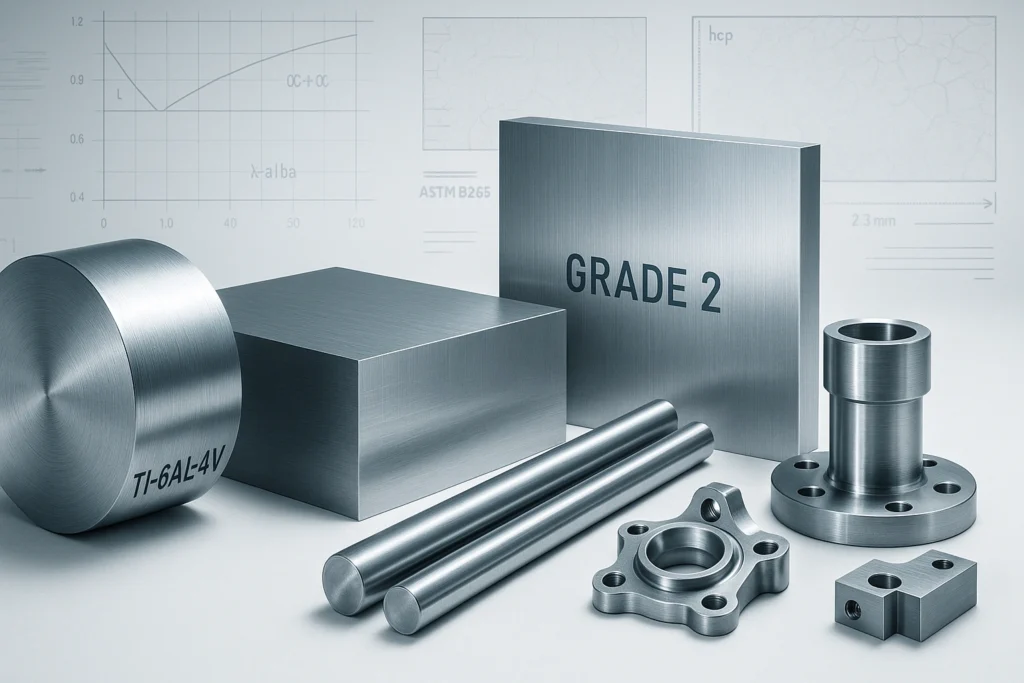
3.1 The Metallurgical Basis of Titanium Grades
CP (Commercially Pure) Titanium Grades 1–4: Oxygen Content & Mechanical Properties
The four commercially pure grades differ primarily in oxygen content, with each 0.05-0.10% increase in oxygen raising strength while reducing ductility. This interstitial strengthening mechanism—oxygen atoms occupy spaces in the titanium crystal lattice, impeding dislocation movement—enables tailoring properties without expensive alloying elements.
Grade 1 (UNS R50250): Lowest oxygen content (~0.18% max O₂), highest formability
- Tensile Strength: 240 MPa minimum
- Yield Strength: 170 MPa minimum
- Elongation: 24% minimum
- التطبيقات: Deep-drawn components, complex forming operations, maximum ductility requirements (bellows, expansion joints)
- Cost positioning: Lowest among titanium grades due to less stringent chemistry control
Grade 2 (UNS R50400): The “workhorse” unalloyed grade—most widely specified
- Tensile Strength: 345 MPa minimum (typical ~344-380 MPa)
- Yield Strength: 275 MPa minimum
- Elongation: 20% minimum
- التطبيقات: Chemical process equipment, heat exchangers, marine piping, desalination, general corrosion-resistant structures
- Cost positioning: Best balance of properties and cost for corrosion-driven applications
- Why it dominates: Provides sufficient strength for pressure vessels and piping while maintaining good formability and weldability; corrosion resistance matches higher grades in oxidizing environments
Grade 3 (UNS R50550): Intermediate strength, less commonly specified
- Tensile Strength: 450 MPa minimum
- Yield Strength: 380 MPa minimum
- Elongation: 18% minimum
- التطبيقات: Aerospace airframe components requiring higher strength than Grade 2, pressure vessels, cryogenic equipment
- Cost positioning: Premium over Grade 2 (~10-15%) due to tighter oxygen control and lower production volumes
Grade 4 (UNS R50700): Highest strength unalloyed grade
- Tensile Strength: 550 MPa minimum
- Yield Strength: 480 MPa minimum
- Elongation: 15% minimum
- التطبيقات: High-strength fasteners, aerospace structures, cryogenic vessels, surgical implants requiring strength without alloying
- Cost positioning: Highest CP grade cost; often competes with Grade 5 alloy on cost-performance basis
- Specification note: Grade 4’s reduced ductility vs. lower grades affects formability; consider this in manufacturing process planning
Procurement guidance: Specify Grade 2 unless your application specifically requires higher strength (Grade 3/4) or maximum formability (Grade 1). Approximately 80% of CP titanium procurement is Grade 2 because it offers optimal cost-performance for corrosion-resistant structures.
Titanium Alloys: Grade 5 Ti-6Al-4V, Grade 23 ELI, Grade 9, Grade 12
Alloying titanium with elements like aluminum, vanadium, molybdenum, and nickel creates two-phase microstructures (alpha+beta) and property combinations impossible with CP grades. These alloys command 30-60% premiums over CP titanium but deliver strength, fatigue resistance, or corrosion performance that justify the cost in demanding applications.
Grade 5 (Ti-6Al-4V) (UNS R56400): The dominant titanium alloy—accounts for ~50% of all titanium consumption
- Composition: 6% aluminum (alpha stabilizer), 4% vanadium (beta stabilizer), balance titanium
- Tensile Strength: 900 MPa typical (annealed condition); up to 1,100 MPa (solution treated and aged)
- Yield Strength: 830 MPa typical (annealed)
- Elongation: 10-15% (varies with heat treatment)
- Density: 4.43 g/cm³
- التطبيقات: Aerospace structures (fuselage fittings, landing gear, engine components), biomedical implants (hip/knee prostheses), high-performance automotive (connecting rods, valves), marine submersibles, sporting equipment
- Heat treatment response: Can be solution treated (heat to beta phase field, rapid cool to retain metastable beta, then age at intermediate temperature) to increase strength 15-20% over annealed condition
- Weldability: Good with appropriate filler (ERTi-5 filler wire matches composition); requires inert gas shielding (argon purge) to prevent embrittlement
- Cost positioning: ~1.5-2× Grade 2 CP titanium; justified in applications where strength-to-weight ratio drives system performance
Grade 23 (Ti-6Al-4V ELI – Extra Low Interstitial) (UNS R56401): Medical/aerospace variant with controlled interstitials
- Composition: 6% Al, 4% V, with reduced oxygen (0.13% max vs 0.20% for Grade 5), nitrogen (0.03% max vs 0.05%), and carbon (0.08% max vs 0.10%)
- Key difference from Grade 5: Lower interstitial content improves ductility and fracture toughness—critical for implants and fracture-critical aerospace parts
- Tensile/Yield: Similar to Grade 5 (~900/830 MPa) but with improved notch toughness and fatigue crack growth resistance
- التطبيقات: Surgical implants (FDA-recognized ASTM F136 standard), aerospace components with fracture-critical designations, cryogenic vessels
- Procurement note: Specify Grade 23 (not Grade 5) for medical implants to meet FDA expectations; the extra cost (~10-20% over Grade 5) is mandatory for regulatory compliance
- Manufacturing consideration: ELI designation requires tight process control (vacuum arc remelting, controlled atmosphere heat treatment) to achieve interstitial limits; verify supplier capability
Grade 9 (Ti-3Al-2.5V) (UNS R56320): Lower alloy content for enhanced formability
- Composition: 3% aluminum, 2.5% vanadium—half the alloy loading of Grade 5
- Tensile Strength: ~620 MPa (between CP Grade 4 and Grade 5)
- Yield Strength: ~520 MPa
- التطبيقات: Hydraulic tubing (aerospace), bicycle frames, pressure vessels requiring forming operations, golf club faces
- Key advantage: Better formability and weldability than Grade 5 while delivering strength 75% higher than CP Grade 2; tubing can be bent, flared, and welded more easily
- Cost positioning: ~1.3-1.6× Grade 2; fills the gap between CP titanium and full-strength Grade 5
Grade 12 (Ti-0.3Mo-0.8Ni) (UNS R53400): Enhanced corrosion resistance in reducing environments
- Composition: 0.3% molybdenum, 0.8% nickel—alloying specifically targets corrosion performance, not mechanical strength
- Tensile/Yield: Similar to CP Grade 2 (~345/275 MPa)—this is a corrosion-enhanced CP grade, not a strength alloy
- Corrosion advantage: Molybdenum and nickel additions enable passivity in reducing acids (dilute sulfuric, hydrochloric under certain conditions) and improve crevice corrosion resistance in hot chloride brines
- التطبيقات: Chemical processing equipment handling reducing acids, sour gas (H₂S) service in oil/gas production, geothermal power plant heat exchangers, chlor-alkali electrolysis cells
- Cost positioning: ~1.4-1.7× Grade 2; justified when Grade 2’s corrosion resistance is insufficient but stainless/Hastelloy alternatives are unsuitable
- Specification decision: Use Grade 12 when corrosion testing shows CP titanium attacks in your specific environment; common in hot (>60°C) concentrated chlorides or reducing acid services
3.2 ASTM & AMS Standards Buyers Must Know
ASTM B348 – Titanium and Titanium Alloy Bars and Billets
ASTM B348 is the primary specification for titanium bar stock and billets in annealed condition. This standard covers Grades 1-5, 6, 7/7H, 9, 11, 12, and numerous other grades including palladium-, ruthenium-, and nickel-modified variants. Key procurement elements:
- Scope: Applies to annealed bars and billets up to 600mm diameter; does not cover heat-treated conditions beyond annealing
- Ordering information requirements: Buyers must specify grade, size (diameter/width, length), quantity, finish (hot finished, machined, ground), certification requirements
- Chemical composition tables: Defines maximum/minimum limits for each alloying element and interstitial by grade; suppliers must certify conformance
- Mechanical property tables: Tensile strength, yield strength, elongation, and reduction of area minima vary by grade and product size
- Test methods referenced: ASTM E8 (tensile testing), ASTM E1409 (oxygen/nitrogen by inert gas fusion), ASTM E1447 (hydrogen by inert gas fusion), ASTM E1941 (carbon by combustion)
Procurement teams should reference B348 when specifying bar stock for machined components, ensuring mill test certificates document conformance to the ordered grade’s chemical and mechanical requirements.
ASTM F67 – Unalloyed Titanium for Surgical Implant Applications
ASTM F67 specifically addresses CP titanium Grades 1-4 (UNS R50250, R50400, R50550, R50700) for surgical implants in various product forms:
- Scope: Covers bars, wire, sheet, strip, plate; intended for fabrication of surgical implants
- Grade selection in F67: Same four CP grades as general commercial specs but with additional surface finish, cleanliness, and inspection requirements appropriate to medical use
- Mechanical properties: Defined by product size and form; typically stricter tolerances than commercial specs
- FDA recognition: F67 is an FDA-recognized consensus standard; declaring conformity to F67 in device submissions demonstrates material suitability for implant use
Procurement for medical implant manufacturing requires F67-conformant material with certifications documenting the medical-grade designation and full traceability to enable device submission documentation.
ASTM F136 – Ti-6Al-4V ELI for Surgical Implant Applications
ASTM F136 is the medical device industry’s standard for Grade 23 (Ti-6Al-4V ELI) surgical implant material:
- Scope: Wrought product forms (bar, billet, wire, sheet, strip, plate) in annealed or solution treated plus aged condition; intended for surgical implant fabrication
- Chemistry: Defines maximum interstitial limits (O: 0.13%, N: 0.03%, C: 0.08%, H: 0.012%, Fe: 0.25%) that distinguish ELI from standard Grade 5
- Mechanical properties: Minimum tensile, yield, elongation, and reduction of area vary by product size; typical bars ≥75mm diameter require 860 MPa UTS, 795 MPa YS, 10% elongation minimum
- Microstructure requirements: Prohibits continuous alpha networks at prior beta grain boundaries; requires fine, uniform alpha-beta dispersion to ensure toughness
- Referenced test methods: ASTM E8, E1409, E1447, E1941 for composition verification; also cites AMS 2249 (fluorescent penetrant inspection) and aerospace specs (AMS 4930) showing medical-aerospace crossover
- FDA recognition: F136 is fully recognized by FDA for Class II (510(k)) and Class III (PMA) device submissions
Implant manufacturers must procure F136-certified Grade 23 (not commercial Grade 5) to meet regulatory expectations and ensure material properties support biocompatibility testing and clinical performance.
AMS (Aerospace Material Specifications) for Procurement
Aerospace procurement typically references AMS specifications that impose stricter controls than commercial ASTM grades:
- AMS 4928: Ti-6Al-4V annealed bar, billet, and forging stock—aerospace baseline for Grade 5
- AMS 4911: Ti-6Al-4V annealed sheet and plate
- AMS 4967/4965: Ti-6Al-4V bar and forgings with specific processing controls
- AMS 4930: Ti-6Al-4V ELI (equivalent to ASTM F136 for medical) but with aerospace traceability requirements
Aerospace OEMs and Tier 1 suppliers typically mandate AMS conformance, AS9100 supplier certification (aerospace quality standard), and NADCAP accreditation for special processes (welding, heat treatment, NDT). Procurement teams sourcing for aerospace must verify supplier holds these certifications and that material certs reference AMS specifications, not just ASTM equivalents.
3.3 Grade Selection Framework for Engineering Teams
The correct grade depends on four interacting factors: strength requirements, formability/manufacturing constraints, corrosion environment, and cost targets. This framework guides selection:
Decision Matrix: Strength vs. Formability vs. Corrosion vs. Cost
- Start with corrosion environment:
- Oxidizing acids, seawater, marine atmosphere, most industrial environments → CP grades sufficient (start with Grade 2)
- Reducing acids, hot chloride brines, crevice-prone geometries → Grade 12 or higher
- Biomedical/pharmaceutical contact → CP Grade 1-4 (F67) or Grade 23 (F136) depending on strength needs
- Evaluate strength requirements:
- Low stress (<200 MPa operating stress) → CP Grade 2 adequate
- Moderate stress (200-350 MPa) → CP Grade 3/4 or Grade 9
- High stress (>400 MPa), fatigue-critical → Grade 5 or Grade 23
- Cryogenic, fracture-critical → Grade 23 ELI (improved notch toughness)
- Consider manufacturing operations:
- Deep drawing, complex forming, hydroforming → CP Grade 1 or 2 (maximum ductility)
- Tube bending, moderate forming → Grade 2, 9, or lower-strength CP grades
- Machining only (no forming) → Strength/corrosion drive choice; formability irrelevant
- Welding required → All grades weld with appropriate filler; ELI grades preferred for fracture-critical welds
- Apply cost discipline:
- If CP Grade 2 meets strength and corrosion requirements, specifying Grade 5 adds 50-80% material cost without functional benefit
- If commercial Grade 5 would work but you’re in medical devices, Grade 23 is mandatory for FDA recognition—the 10-20% premium is non-negotiable
- For chemical processing in oxidizing environments, Grade 2 delivers 20-year service life at 40-50% the cost of Grade 12 or Hastelloy; reserve premium alloys for environments where Grade 2 fails testing
Application-Fit Recommendations
Aerospace Applications:
- Structural components (wings, fuselage fittings, frames): Grade 5 or Grade 9 depending on stress levels and forming requirements
- Landing gear, high-load components: Grade 5, often heat-treated to increase strength
- Hydraulic lines, tubing: Grade 9 (superior formability vs Grade 5)
- Fasteners: Grade 5 or CP Grade 4
- Fracture-critical parts: Grade 23 ELI for improved damage tolerance
- Specifications: AMS 4928, AMS 4911, AMS 4967; require AS9100-certified suppliers
Medical Implant Applications:
- Orthopedic implants (hip/knee): Grade 23 ELI per ASTM F136 (high strength + toughness + FDA recognition)
- Dental implants: Grade 23 (F136) for fixtures; CP Grade 4 (F67) for abutments
- Surgical instruments: CP Grade 1-2 (F67) for non-load-bearing; Grade 23 for load-bearing
- Cardiovascular implants: Grade 23 ELI (F136) mandatory for blood-contacting devices
- Specifications: ASTM F136 (Grade 23), ASTM F67 (CP grades); ISO 13485 supplier certification required
Chemical Processing & Desalination:
- Heat exchanger tubes, shells: CP Grade 2 (oxidizing environments); Grade 12 (reducing acids, hot brines)
- Reactor vessels: CP Grade 2 (most services); Grade 12 (crevice-prone, reducing)
- Piping systems: CP Grade 2 (general corrosion resistance)
- Pump components: Grade 2 (low-stress); Grade 5 (high-pressure, erosion-corrosion)
- Specifications: ASTM B338 (tubing), ASTM B861 (pipe), ASTM B265 (plate)
Marine & Offshore Engineering:
- Seawater piping, heat exchangers: CP Grade 2 (excellent seawater resistance at lowest cost)
- Pressure hulls (submersibles): Grade 5 or Grade 23 (high strength-to-weight; depth capability)
- Propeller shafts, fasteners: Grade 5 (strength + corrosion)
- Risers, subsea structures: Grade 2 (general); Grade 12 (crevice-prone geometries, H₂S service)
- Specifications: ASTM B338, ASTM B861, ASTM B381 (forgings); ABS/DNV material approvals
Next Step: Request a grade recommendation for your specific application with operating conditions, or explore our titanium product specifications to see grade options across drinkware, cookware, and OEM applications.

Section 4: Industrial Applications With Engineering Depth
Titanium’s commercial deployment spans sectors where conventional materials fail on corrosion resistance, weight, or lifecycle economics. This section translates material properties into application-specific value propositions, showing procurement teams where titanium delivers measurable ROI.
4.1 Aerospace & Defense
The aerospace industry consumes ~30-40% of global titanium production, driven by titanium’s unmatched specific strength and fatigue resistance. Key applications:
Airframe Structures: Ti-6Al-4V (Grade 5) dominates wing attachment fittings, fuselage frames, landing gear components, and door mechanisms. A commercial aircraft like the Boeing 787 uses ~15% titanium by structural weight (~15-20 metric tons), replacing aluminum and steel in critical load paths. The weight savings (compared to steel) enable increased fuel efficiency—each kilogram of weight reduction saves ~$3,000 in fuel costs over a 25-year aircraft life.
Gas Turbine Engines: تشكل سبائك التيتانيوم (الصف الخامس بشكل أساسي، مع سبائك بيتا في بعض التطبيقات) شفرات وأقراص وأغلفة الضاغط. درجات حرارة التشغيل تحد من استخدام التيتانيوم في أقسام الضاغط (~400-600 درجة مئوية كحد أقصى)؛ تستخدم أقسام التوربينات الأكثر سخونة سبائك النيكل الفائقة. الميزة: يتيح التيتانيوم سرعات أعلى لطرف الضاغط (يؤدي الوزن المنخفض إلى تقليل أحمال الطرد المركزي على الأقراص) وتحسين كفاءة استهلاك الوقود. تستخدم المحركات مثل Pratt & Whitney PW1000G التيتانيوم على نطاق واسع، مما يحقق التوازن بين الأداء والوزن.
اعتبارات الشراء: يجب أن يفي التيتانيوم الفضائي بمواصفات AMS (AMS 4928، 4911، 4967)، وإدارة الجودة AS9100، وغالبًا ما يكون معتمدًا من NADCAP للمعالجة الحرارية واللحام والاختبار اللاتدميري. تعد إمكانية التتبع بدءًا من كمية حرارة المطحنة وحتى التصنيع وحتى التجميع النهائي أمرًا إلزاميًا. توقع مهلة زمنية تتراوح من 12 إلى 20 أسبوعًا لقضبان ومطروقات التيتانيوم المستخدمة في مجال الطيران والفضاء نظرًا للاختبارات الصارمة ومتطلبات الاعتماد.
4.2 الأجهزة الطبية والأدوية
إن توافق التيتانيوم الحيوي ومقاومته للتآكل يجعله المادة المفضلة للأجهزة القابلة للزرع ومعدات العمليات الصيدلانية.
زراعة العظام: تستخدم بدائل الورك والركبة الدرجة 23 (Ti-6Al-4V ELI) وفقًا لمعيار ASTM F136 للسيقان ورؤوس الفخذ والأدراج الظنبوبية. تتيح قدرة المادة على الاندماج العظمي - الارتباط المباشر للعظام بسطح أكسيد التيتانيوم - إمكانية زراعة الغرسات غير الأسمنتية بمعدلات بقاء على قيد الحياة لمدة تتراوح بين 15 و20 عامًا تتجاوز 95%. يزن الجذع البديل لمفصل الورك حوالي 200-400 جرام من التيتانيوم مقابل 600-800 جرام من الكوبالت والكروم، مما يقلل من الحماية من الضغط (ارتشاف العظم من تجاوز الحمل).
زراعة الأسنان: تستخدم تركيبات الغرسة الداخلية الدرجة 23 أو CP الصف 4 (ASTM F67) لتثبيت التيجان الاصطناعية. تتيح خصائص التيتانيوم غير المغناطيسية التوافق مع التصوير بالرنين المغناطيسي، وهو أمر بالغ الأهمية للمرضى المسنين الذين يحتاجون إلى تصوير متكرر. يعكس معدل البقاء على قيد الحياة لمدة 5 سنوات بنسبة 97.4% والموثق في المراجعات المنهجية التحقق السريري من تكامل وثبات عظام التيتانيوم.
المعالجة الصيدلانية: المفاعلات والمبادلات الحرارية والأنابيب في تركيب API (العنصر الصيدلاني النشط) تستخدم التيتانيوم من الدرجة 2 أو الدرجة 12. المحرك: يمكن للتلوث الأيوني المعدني الناتج عن تآكل الفولاذ المقاوم للصدأ أن يحفز تدهور API أو يؤدي إلى عمليات تعليق تنظيمية. تعمل أوعية التيتانيوم في التركيبات المحتوية على الكلوريد أو الحمضية على التخلص من ترشيح الحديد/الكروم/النيكل، مما يضمن نقاء المنتج وإطالة عمر المعدات إلى أكثر من 20 عامًا مقابل 5-7 سنوات للفولاذ المقاوم للصدأ 316L في الخدمة المكافئة.
4.3 المعالجة الكيميائية وتحلية المياه
وتكلف الأعطال الناجمة عن التآكل في المصانع الكيماوية ما بين 5 إلى 7 مليار دولار سنويا في فترات التوقف عن العمل، والإصلاحات، واستبدال المواد. توفر مناعة التيتانيوم ضد التآكل وفورات في تكلفة دورة الحياة تعوض تكاليف رأس المال الأعلى بمقدار 2-4 مرات.
المبادلات الحرارية: تحقق المبادلات الحرارية المصنوعة من التيتانيوم ذات الغلاف والأنبوب في مصانع الكلور والقلويات وإنتاج الأسمدة ومرافق تحلية المياه فترة خدمة تتراوح بين 20 إلى 30 عامًا في البيئات التي يدوم فيها الفولاذ المقاوم للصدأ لمدة 3 إلى 5 سنوات. تبلغ تكلفة المبادل الحراري المصنوع من التيتانيوم بمساحة 100 متر مربع حوالي 200000 دولار أمريكي مقابل 80000 دولار أمريكي للفولاذ المقاوم للصدأ 316L، ولكنه يلغي ثلاثة بدائل غير قابلة للصدأ على مدار 20 عامًا (240000 دولار + تكاليف التوقف)، مما يوفر تكلفة ملكية أقل بنسبة 30-45%.
أوعية المفاعل والأنابيب: مكثفات حمض النيتريك، ومولدات ثاني أكسيد الكلور، ومبخرات حمض الفوسفوريك تحدد درجة CP 2 للأوعية والأنابيب. تتعامل المادة مع 50-70% من حمض النيتريك عند درجة حرارة 80-100 درجة مئوية إلى أجل غير مسمى، حيث يعاني الفولاذ المقاوم للصدأ من التآكل الحبيبي خلال أشهر. تستخدم أنظمة الأنابيب في حلقات تبريد مياه البحر (تحلية المياه ومحطات الطاقة) الدرجة 2 أو الدرجة 12، مما يؤدي إلى عدم حدوث أي تآكل أو تآكل على مدى عقود.
تبرير عائد الاستثمار: تُظهر نماذج تكلفة دورة الحياة باستمرار فترات استرداد تتراوح من 10 إلى 15 عامًا للتيتانيوم في الخدمة الكيميائية القوية عند أخذ تكاليف التوقف في الاعتبار. يتكلف إغلاق مصنع كيميائي لاستبدال المبادل الحراري ما بين 50.000 إلى 500.000 دولار في اليوم حسب السعة؛ إن القضاء على عمليات الإغلاق هذه يبرر علاوة التيتانيوم.
4.4 الهندسة البحرية والبحرية
إن محتوى كلوريد مياه البحر (حوالي 19000 جزء في المليون Cl⁻) والكائنات الحشفة الحيوية تخلق بيئات تآكل/تآكل قاسية. يقاوم التيتانيوم كلتا الآليتين، مما يتيح عمر خدمة يتراوح بين 30 إلى 50 عامًا في التطبيقات البحرية.
أنظمة تبريد مياه البحر: تستخدم المكثفات في المنصات البحرية ومحطات الطاقة الساحلية أنابيب التيتانيوم (الدرجة 2) بدلاً من سبائك النحاس والنيكل. لا يتلوث التيتانيوم بسهولة مثل سبائك النحاس (المبيدات الحيوية ليست مطلوبة)، ويحافظ على كفاءة نقل الحرارة على مدى عقود، ويتحمل تآكل الرمال/الجزيئات في المآخذ الساحلية. التكلفة الأولية هي 3-4× نحاس ونيكل ولكن تكاليف دورة الحياة أقل بنسبة 40% بسبب التخلص من إعادة الأنابيب وتحسين الكفاءة الحرارية.
الهياكل تحت سطح البحر: تستخدم مركبات ROVs (المركبات التي يتم تشغيلها عن بعد)، وهياكل الضغط الغاطسة، ومساكن الأجهزة في أعماق البحار، التيتانيوم من الدرجة 5 أو الدرجة 23 لتحسين القوة مقابل الوزن. تتطلب غواصة الغوص العميق (> عمق 3000 متر) مواد عالية القوة لتحمل الضغط الهيدروستاتيكي؛ يتيح التيتانيوم قدرة أكبر على العمق بوزن أقل من الفولاذ، مما يترجم مباشرة إلى زيادة سعة الحمولة.
السحابات والأجهزة: تستخدم التطبيقات البحرية تاريخيًا 316 مثبتًا مقاومًا للصدأ، والتي تؤدي إلى الحفر والتآكل في مناطق الرش. تعمل البراغي والصواميل والدبابيس المصنوعة من التيتانيوم من الدرجة 5 على القضاء على مخاوف التآكل الجلفاني، ومقاومة تآكل الشقوق تحت الحشيات، وتدوم عمر المعدات (20-40 عامًا) مقابل 5-10 سنوات للبدائل المصنوعة من الفولاذ المقاوم للصدأ.
4.5 عندما لا يكون التيتانيوم هو الاختيار الصحيح
تتطلب السلامة الهندسية الاعتراف بقيود التيتانيوم:
تكلفة باهظة في الخدمة غير المسببة للتآكل: إذا كان تطبيقك يتضمن بيئات معتدلة (هواء جاف، وأجواء غير عدوانية) حيث يؤدي الفولاذ الكربوني أو الألومنيوم أداءً مناسبًا، فإن علاوة التيتانيوم غير مبررة. استخدم التيتانيوم حيث يؤدي التآكل أو الوزن أو التوافق الحيوي إلى اختيار المواد - وليس كمادة "ممتازة" افتراضية.
حدود درجة الحرارة فوق 538 درجة مئوية: يتأكسد التيتانيوم بسرعة فوق 538 درجة مئوية (1000 درجة فهرنهايت) ويفقد خصائصه الميكانيكية. تتطلب التطبيقات ذات درجات الحرارة العالية (> 600 درجة مئوية) سبائك النيكل الفائقة أو المعادن المقاومة للحرارة أو السيراميك. لا تحدد التيتانيوم لمكونات الفرن، أو أنظمة العادم (باستثناء أقسام التبريد)، أو المفاعلات الكيميائية ذات درجة الحرارة العالية.
قيود الصلابة: تصل سبائك التيتانيوم إلى الحد الأقصى حول HRC 40-42 في الظروف المعالجة بالحرارة، وهي غير كافية للاستخدام في الأدوات أو الأسطح المتآكلة أو المكونات المقاومة للتآكل. يعد فولاذ الأدوات أو الفولاذ المقاوم للصدأ أو السبائك الصلبة مناسبًا لهذه التطبيقات. إن ميل التيتانيوم المزعج في التلامس المنزلق يحد أيضًا من تطبيقات المحمل والجلبة ما لم يتم تطبيق المعالجات السطحية (النيترة وطلاءات PVD).
خطر التقصف الهيدروجيني: يمتص التيتانيوم الهيدروجين عند درجات حرارة مرتفعة (> 300 درجة مئوية) في البيئات الغنية بالهيدروجين، مما يسبب التقصف. تتطلب التطبيقات التي تتضمن خدمة الهيدروجين (مفاعلات الهدرجة البتروكيميائية، تخزين الهيدروجين) تقييمًا دقيقًا أو مواد بديلة مثل الفولاذ الأوستنيتي أو Hastelloy.

القسم 5: عمليات التصنيع ومراقبة الجودة
يعتمد أداء التيتانيوم على سلامة التصنيع. يجب على فرق المشتريات التحقق من قدرات الموردين عبر التشكيل والتصنيع واللحام وضمان الجودة لضمان وصول الخصائص المحددة إلى المكونات النهائية.
5.1 التصنيع الأولي: من الخام إلى منتجات المطاحن
يبدأ إنتاج التيتانيوم بخام ثاني أكسيد التيتانيوم (TiO₂)، ويتقدم من خلال عملية كرول (اختزال المغنيسيوم في رابع كلوريد التيتانيوم إلى إسفنجة تيتانيوم)، ويتوج بإعادة صهر القوس الفراغي (VAR) لإنتاج سبائك ذات كيمياء ونظافة معدنية خاضعة للرقابة.
لماذا هذا مهم للمشتريات: يؤثر عدد عمليات إعادة صهر VAR على المحتوى الخلالي ونظافة التضمين. تتطلب درجات ELI (الدرجة 23) والتطبيقات الحيوية في مجال الطيران والفضاء تقنية VAR ثلاثية لتحقيق حدود الأكسجين/النيتروجين وبنية مجهرية موحدة. يجب أن توثق شهادات اختبار مطحنة المورد تاريخ VAR؛ قد لا تلبي المواد أحادية الذوبان متطلبات ELI أو الفضاء الجوي.
نماذج منتجات المطحنة: يتم تشكيل السبائك على الساخن (مزورة، ملفوفة، مقذوفة) إلى قضبان، وقضبان، وصفائح، وألواح، وأسلاك، وأنابيب. يؤثر شكل المنتج على الخواص الميكانيكية بسبب اتجاه العمل وتدفق الحبوب. يجب أن تحدد مواصفات المشتريات الشكل: قضيب للتصنيع، لوحة للأوعية المصنعة، أنابيب لأنظمة الأنابيب. تضمن معايير المنتج ASTM المرجعية (B348 للقضبان، B265 للصفائح، B338 للأنابيب) أن النموذج المطلوب يتوافق مع متطلبات التطبيق.
5.2 اعتبارات التصنيع والتشكيل
تجهيز التيتانيوم: تعمل الموصلية الحرارية المنخفضة للتيتانيوم (16.4 وات/م · كلفن مقابل 167 وات/م · كلفن للألمنيوم) على تركيز الحرارة عند حافة القطع، مما يؤدي إلى تسريع تآكل الأداة. أفضل الممارسات:
- سرعات قطع منخفضة ومعدلات تغذية عالية: عادة 50-70% من سرعات قطع الألومنيوم؛ الأعلاف العالية تمنع تصلب العمل
- أدوات حادة وصلبة: إدراجات كربيد (غير مطلية أو مطلية بـ TiAlN) أو كوبالت HSS؛ الأدوات الباهتة تسبب تصلب العمل والفشل السريع
- المبرد السخي: التبريد بالغمر (القابل للذوبان في الماء أو الاصطناعي) يزيل الحرارة ويمنع خطر حريق التيتانيوم من اشتعال الخراطة
- التحكم في الشريحة: الرقائق الطويلة والخيطية تشكل خطر الحريق؛ تمنع هندسة تكسير الرقائق والأعلاف المناسبة تراكم الخراطة بشكل خطير
يجب على الموردين الذين يقومون بتصنيع التيتانيوم إظهار ممارسات آمنة من الحرائق: احتواء الرقائق، وطفايات الحريق من الفئة D (مسحوق جاف لحرائق المعادن)، وعدم استخدام الماء لحرق سوار التيتانيوم، والامتثال لمعايير NFPA 484.
عمليات التشكيل: توفر درجات CP (خاصة الدرجة 1 و 2) قابلية تشكيل ممتازة للسحب العميق والغزل والتشكيل المائي. تتطلب السبائك (الصف 5، 9) درجات حرارة تشكيل أعلى (650-900 درجة مئوية للصف 5) لمنع التشقق. يجب أن يتم التحقق من شراء مكونات التيتانيوم المشكلة من أن الموردين لديهم مكابس وأفران وقوالب تشكيل مناسبة، بالإضافة إلى الخبرة في خصائص التيتانيوم الخلفي.
5.3 إجراءات اللحام والانضمام
يتم لحام التيتانيوم بسهولة باستخدام عمليات TIG (GTAW) أو MIG (GMAW)، ولكنه يتطلب حماية من الغاز الخامل لمنع التقاط الأكسجين/النيتروجين الذي يؤدي إلى هشاشة مناطق اللحام.
- التدريع الغاز: الأرجون أو الهيليوم على وجه اللحام؛ التطهير الخلفي بالأرجون على الجانب الجذري (لحام الأنابيب/الأنابيب)
- درجة حرارة البينية: يحفظ في درجة حرارة أقل من 150 درجة مئوية لمنع نمو الحبوب والتقصف
- اختيار الحشو: مطابقة التركيب المعدني الأساسي (ERTi-2 للصف 2، ERTi-5 للصف 5، ERTi-23 للصف 23)
- النظافة المشتركة: إزالة الزيوت والأكاسيد والملوثات. يشير تغير اللون إلى التقاط الأكسجين (الذهبي مقبول، الأزرق/الرمادي الهامشي، الأبيض/الطباشيري غير مقبول)
- التأهيل لإجراءات AWS D1.9 (كود اللحام الإنشائي - التيتانيوم) أو AWS D17.1 (لحام الانصهار الفضائي)
- لحامون معتمدون حاصلون على تدريب خاص بالتيتانيوم
- مواصفات إجراءات اللحام (WPS) التي توثق المعلمات والحشو والتدريع ومعايير القبول
- NDE (التقييم غير المدمر): RT (الاختبار الشعاعي)، أو UT (اختبار الموجات فوق الصوتية)، أو PT (اختبار الاختراق) لكل متطلبات الكود
5.4 المعالجات السطحية والتخميل
يشكل التيتانيوم طبقة طبيعية من أكسيد التيتانيوم، لكن معالجات التخميل الخاضعة للرقابة تعمل على تحسين مقاومة التآكل ونظافة السطح:
تخليل: المعالجة الحمضية (مخاليط HF/HNO₃) تزيل قشور الطحن والتلوث، مما ينتج عنه سطح نظيف وسلبي. معيار لمعظم التطبيقات الصناعية.
أنودة: تعمل الأكسدة الكهروكيميائية على زيادة سماكة طبقة TiO₂ (عادةً 0.1-25 ميكرومتر)، مما يؤدي إلى إنشاء ألوان زخرفية (الذهبي والأزرق والأرجواني بناءً على تأثيرات التداخل) وتعزيز مقاومة التآكل. الأنودة من النوع الثاني شائعة في المنتجات الاستهلاكية؛ النوع الثالث (الأكسدة الصلبة) يزيد من صلابة السطح لتطبيقات التآكل.
التلميع الكهربائي: يعمل الذوبان الأنوديك على تنعيم الأسطح إلى Ra <0.4 ميكرومتر، وهو مثالي للتطبيقات الصيدلانية وتطبيقات ملامسة الأغذية التي تتطلب مقاومة الأغشية الحيوية وقابلية التنظيف.
طلاءات النيترة / PVD: تصلب السطح عن طريق نشر النيتروجين (النيترة) أو ترسيب البخار الفيزيائي لطلاءات TiN/TiCN يزيد من صلابة السطح إلى HV 700-1200، مما يتيح استخدام التيتانيوم في تطبيقات التحمل والتآكل.
يجب على فرق المشتريات التي تحدد المعالجات السطحية الرجوع إلى ASTM B600 (التخليل والتخميل) والتحقق من قدرة المورد على التشطيب المطلوب والفحص اللاحق (قياس مواصفات الخشونة، وقياس سمك الطلاءات).
5.5 متطلبات ضمان الجودة وإصدار الشهادات
يعتمد أداء تيتانيوم على الكيمياء والبنية المجهرية وإمكانية التتبع، وهي متغيرات تتطلب ضمانًا قويًا لضمان الجودة:
شهادات اختبار المطحنة (MTC): توثيق رقم الدفعة الحرارية، والتحليل الكيميائي، ونتائج الاختبار الميكانيكي (UTS، YS، الاستطالة)، وتاريخ المعالجة الحرارية، والمطابقة للمواصفات (ASTM B348، F136، AMS 4928). يجب أن تشتمل كل عملية شراء للتيتانيوم على MTCs مع إمكانية التتبع الكامل.
التحقق من طرف ثالث: بالنسبة للتطبيقات الحرجة (الفضائية والطبية والنووية)، تتطلب إجراء اختبارات معملية مستقلة (التحليل الكيميائي بواسطة OES أو ICP، والاختبار الميكانيكي وفقًا لمعيار ASTM E8، وتحليل البنية المجهرية عبر دراسة المعادن) للتحقق من صحة MTCs للموردين. تشير التناقضات بين شهادات الموردين ونتائج الجهات الخارجية إلى مشكلات تتعلق بمراقبة الجودة.
التفتيش الأبعاد: CMM (coordinate measuring machine) inspection verifies dimensions, perpendicularity, flatness, and tolerances. Titanium’s thermal expansion and machining spring-back affect dimensional accuracy; verify inspection procedures account for these factors.
Non-Destructive Testing (NDT): PT (dye penetrant) detects surface cracks, UT (ultrasonic) finds internal voids/inclusions, RT (radiography) verifies weld integrity. Critical components (pressure vessels, aerospace structures) should specify NDT methods, acceptance criteria, and technician certification per ASNT (American Society for Nondestructive Testing) or equivalent.

Figure 2: Titanium manufacturing and quality assurance process flow from raw material to certified product. This flowchart maps critical decision points that procurement teams should audit when evaluating supplier capabilities: (1) VAR remelting history affects interstitial content and ELI grade conformance; (2) chemistry verification via OES/ICP-MS catches grade substitutions; (3) dimensional inspection after machining/forming ensures tolerances; (4) NDE testing (PT/UT/RT) detects internal and surface defects; (5) documentation package (mill test certificates, compliance certs, inspection reports) enables traceability. Suppliers unable to document these checkpoints present elevated risk. Request process flow documentation and audit records during supplier qualification to verify quality system maturity.
Section 6: Procurement Strategy—Reducing Risk in Titanium Sourcing
Supplier qualification and procurement discipline determine whether titanium delivers its theoretical performance in your application. This section provides auditable frameworks for supplier evaluation and specification management.
6.1 Supplier Qualification Checklist
- ISO 9001 (minimum baseline): Demonstrates documented quality management system
- AS9100 (aerospace): Mandatory for aerospace suppliers; adds traceability, FOD prevention, configuration control
- ISO 13485 (medical devices): Required for medical implant material suppliers; addresses risk management and design controls
- NADCAP (special processes): For heat treatment, welding, NDT, chemical processing in aerospace/defense supply chains
- Heat lot traceability from mill ingot through finished product
- Serialization or batch marking enabling field traceability (critical for aerospace, medical)
- Documented chain of custody through processing operations
- In-house or third-party chemical analysis (OES, ICP-MS for composition verification)
- Mechanical testing per ASTM E8 (tensile) with calibrated equipment and certified operators
- Metallography lab for microstructure verification (grain size, phase distribution, inclusion rating)
- NDE facilities (PT, UT, RT) with ASNT-certified technicians
- Heat treatment furnaces with calibrated temperature control and atmosphere monitoring
- Welding procedures qualified to AWS D1.9 or D17.1 with certified welders
- Machining facilities equipped for titanium (chip containment, coolant flood, fire safety per NFPA 484)
- Surface treatment capabilities (pickling, anodizing, electropolishing) with documented parameters
- Prior titanium projects in your industry (aerospace, medical, chemical processing)
- Customer references you can contact for performance history
- Case studies or technical papers demonstrating material knowledge
6.2 Writing Effective Procurement Specifications
Ambiguous specs invite misinterpretation and non-conformance. Effective titanium specifications address:
- ASTM/AMS standard and specific grade: “ASTM B348 Grade 2” or “AMS 4928 (Ti-6Al-4V)”
- UNS number when applicable: “UNS R50400” eliminates grade confusion
- Product form: bar, plate, sheet, tube, forgings, castings
- Condition: annealed, solution treated and aged, as-forged
- Nominal dimensions with tolerances (diameter, thickness, length)
- Surface finish (Ra values, grinding requirements)
- Straightness, flatness, perpendicularity tolerances
- Heat treatment cycle documentation (if non-standard)
- Surface treatment: pickled, anodized, electropolished, coated
- Testing beyond standard requirements: additional tensile tests, impact tests, corrosion testing
- NDE requirements: methods (PT, UT, RT), acceptance criteria, inspection frequency
- Mill test certificates with full chemistry and mechanical properties
- Compliance certificates for regulatory standards (FDA, RoHS, REACH)
- Inspection reports (dimensional, NDE)
- Traceability records linking material to heat lot and production records
Example Specification:
“Material: Titanium bar per ASTM B348 Grade 5 (UNS R56400), annealed condition. Dimensions: 50mm diameter ±0.5mm, 3000mm length +50/-0mm. Surface: Centerless ground to Ra ≤3.2 μm. Testing: Mill test certificate with full chemistry, tensile test per ASTM E8, ultrasonic inspection per ASTM E2375 (acceptance per AMS 2631). Certifications: ISO 9001, AS9100. Traceability: Heat lot number marked on each bar.”
6.3 Total Cost of Ownership (TCO) Analysis Framework
Justifying titanium’s 2-4× material premium requires lifecycle cost modeling that captures operational and maintenance savings:
TCO Components:
- Initial Capital Cost: Material, fabrication, installation
- Operating Costs: Energy (pumping losses, heat transfer efficiency), consumables (cleaning chemicals)
- Maintenance Costs: Inspection frequency, repair labor, spare parts inventory
- Replacement Costs: Material and labor for component replacement, plus downtime costs
- Downtime Costs: Lost production value during maintenance/replacement outages
Example: Heat Exchanger TCO (10-Year Horizon)
- Capital cost: $80,000
- Service life: 3 years (chloride corrosion)
- Replacement frequency: 3 replacements over 10 years
- Downtime per replacement: 5 days @ $100,000/day = $500,000
- Total replacement material: 3 × $80,000 = $240,000
- Total downtime cost: 3 × $500,000 = $1,500,000
- 10-year TCO: $1,820,000
- Capital cost: $200,000
- Service life: 20+ years (no corrosion)
- Replacement frequency: 0 over 10 years
- Downtime: 0
- 10-year TCO: $200,000
ROI: Titanium saves $1,620,000 over 10 years—an 89% TCO reduction despite 2.5× capital cost. Payback period: <1 year.
This framework applies across applications: marine piping, pharmaceutical reactors, aerospace structures (where weight savings translate to fuel cost reductions), and medical implants (where revision surgery costs dwarf material cost differences).
Figure 3: Lifecycle cost comparison quantifying titanium’s ROI in corrosive service. The waterfall chart contrasts two 10-year scenarios: (Left) 316L stainless steel heat exchanger with $80K initial cost requires three replacements over 10 years ($240K material) plus three shutdown cycles at 5 days each ($1.5M downtime @ $100K/day), totaling $1.82M. (Right) CP Grade 2 titanium heat exchanger at $200K capital cost lasts 20+ years with zero replacements and zero downtime, delivering $1.62M savings (89% TCO reduction) despite 2.5× higher upfront cost. Payback: <1 year when downtime costs are factored. This model applies broadly: marine piping eliminates corrosion failures; pharmaceutical reactors avoid contamination shutdowns; aerospace structures save $3,000/kg in fuel costs. Adapt the framework to your application by quantifying replacement frequency, downtime cost, and service life delta between materials.

Begin Your TCO Analysis: Request a custom TCO model for your application, including operational parameters, maintenance history, and downtime costs, or download the TCO Calculator Template to run preliminary scenarios.
Section 7: FAQ—Expert Answers for Procurement Teams
Q1: What’s the real-world cost difference between titanium and stainless steel?
Raw material costs: CP Grade 2 titanium bar stock runs $15-25/lb versus $3-5/lb for 316L stainless steel bar—approximately 4-6× higher. Ti-6Al-4V (Grade 5) is $25-40/lb, or 6-10× stainless. However, finished component costs narrow this gap due to similar machining/fabrication labor. More importantly, lifecycle costs often favor titanium in corrosive environments where stainless requires frequent replacement.
Q2: Can I substitute Grade 5 (Ti-6Al-4V) for Grade 2 to get better performance?
Not necessarily. Grade 5 offers higher strength (~900 MPa vs ~345 MPa) but costs 50-80% more and has lower formability. If your application is corrosion-driven (heat exchangers, chemical piping) rather than strength-limited, Grade 2 delivers equivalent corrosion resistance at lower cost. Grade 5 is justified when high strength or fatigue resistance drives the design—aerospace structures, high-pressure vessels, load-bearing implants. Avoid over-specifying Grade 5 for applications where Grade 2 suffices.
Q3: How do I verify my supplier is actually delivering the titanium grade I ordered?
- XRF (X-ray fluorescence) analysis provides rapid alloy verification (confirms titanium vs steel/aluminum and major alloy elements)
- OES (optical emission spectroscopy) or ICP-MS (inductively coupled plasma mass spectrometry) quantifies chemistry to verify grade conformance
- Hardness testing (Rockwell C or Vickers) flags grade substitutions (Grade 2 typically HRB 80-90; Grade 5 typically HRC 35-40)
- Metallography (microstructure examination) identifies alloy grades (CP titanium shows alpha grains; Grade 5 shows alpha+beta phases)
Reputable suppliers welcome third-party testing; resistance to verification is a red flag.
Q4: Is titanium weldable, and what special precautions are required?
- Argon shielding on both sides: Weld face and back-purge (for full-penetration welds) to exclude oxygen/nitrogen
- Color acceptance: Gold or light straw indicates proper shielding; blue/gray suggests oxygen pickup (marginal); white/chalky indicates contamination (rejectable)
- Filler matching: Use ERTi-2 for Grade 2, ERTi-5 for Grade 5, ERTi-23 for Grade 23
- Procedure qualification: Critical welds (pressure vessels, aerospace) require WPS per AWS D1.9 or D17.1 with tested specimens confirming strength and ductility
Experienced titanium welders and proper shielding equipment are essential—don’t assume general steel welders can transition without training.
Q5: What lead times should I expect for titanium material and components?
- Commercial bar/sheet (Grade 2, 5): 4-8 weeks for common sizes from distributors; 12-16 weeks from mills for custom sizes
- Aerospace-grade material (AMS specs): 12-20 weeks due to additional testing, certification, and AS9100 documentation
- Medical-grade material (F136, F67): 10-16 weeks with full traceability and biocompatibility documentation packages
- Custom forgings/castings: 16-24 weeks including tooling, production, and QA
Lead times extend during high-demand periods (aerospace production ramps, military programs). Maintain strategic inventory for long-lead items to buffer supply chain variability.
Q6: Can titanium be recycled, and does recycled material meet specifications?
Yes, titanium is highly recyclable. Scrap (turnings, rejected parts, end-of-life components) is remelted and blended with virgin material to produce mill products meeting full ASTM/AMS specifications. Recycled content doesn’t compromise properties—chemistry and mechanical performance are verified via standard testing. Many suppliers incorporate 20-40% recycled content in new production, reducing environmental impact and material costs without affecting quality.
Q7: What’s the difference between commercial and aerospace titanium grades?
- إمكانية التتبع: AMS requires individual heat lot tracking through all processing steps
- Testing frequency: More frequent testing per lot/batch
- Certification: AS9100 quality systems, often NADCAP for special processes
- الوثائق: Complete material pedigree for FAA compliance and configuration control
- Cleanliness: Stricter inclusion limits and NDE requirements
Aerospace material costs 15-30% more due to these additional controls, justified by safety-critical applications and regulatory requirements.
Section 8: Conclusion—Establishing Confidence in Titanium Sourcing
Titanium procurement reduces to three imperatives: specify the right grade for your application, verify supplier capability to deliver conforming material, and justify lifecycle value to internal stakeholders.
The technical foundation is clear. Titanium’s combination of corrosion resistance, specific strength, biocompatibility, and non-magnetic properties addresses engineering challenges that defeat conventional materials. CP Grade 2 eliminates corrosion failures in chemical processing and marine environments. Grade 5 (Ti-6Al-4V) enables aerospace structures that meet fatigue requirements at 40-50% lower weight than steel. Grade 23 ELI delivers the fracture toughness and FDA recognition mandatory for medical implants. Grade 12 extends corrosion resistance into reducing acid services where unalloyed titanium fails.
But material properties matter only if procurement disciplines ensure you receive what you specify. Supplier qualification—ISO 9001, AS9100, or ISO 13485 depending on industry; heat lot traceability; third-party verification of chemistry and mechanical properties; demonstrated welding and NDE capabilities—separates reliable suppliers from those trading on titanium’s reputation without delivering its performance. Every specification should reference ASTM or AMS standards explicitly, define required certifications, and stipulate documentation (MTCs, compliance certificates, inspection reports) that enable verification.
Lifecycle economics justify titanium’s capital premium in applications where corrosion, weight, or contamination drive operating costs. A titanium heat exchanger lasting 20 years eliminates three stainless steel replacements and associated downtime, typically delivering 30-45% TCO savings over a decade. Aerospace structures save $3,000 per kilogram of weight reduction over aircraft service lives. Medical implants avoid $30,000-80,000 revision surgeries when initial material selection ensures long-term biocompatibility and mechanical stability. The procurement decision isn’t “Can we afford titanium?” but rather “Can we afford not to use titanium when lifecycle analysis favors it?”
The path forward: use the grade selection framework in Section 3 to map application requirements to appropriate material grades, apply the supplier qualification checklist in Section 6 to evaluate potential vendors, and build TCO models that quantify titanium’s value proposition for your CFO and internal stakeholders. Engage suppliers early in design phases—experienced titanium processors provide manufacturability feedback that prevents costly redesigns and optimize material utilization.
Next Steps:
- For immediate projects: Request a quote with your application parameters (operating environment, mechanical loads, required certifications) to receive grade recommendations and supplier-certified material options.
- For strategic evaluation: Schedule an engineering consultation to review your material portfolio, identify titanium opportunities, and develop procurement strategies aligned with operational goals.
- For detailed reference: Download the complete Titanium Specification Handbook—a 50-page technical reference covering ASTM/AMS standards, property tables, corrosion data, and procurement checklists.
Titanium sourcing confidence comes from engineering knowledge, supplier relationships built on verified performance, and lifecycle cost discipline that connects material decisions to business outcomes. This guide provides the framework. The application is yours.
الأسئلة المتداولة
Is titanium safe for food and pharmaceutical processing?
Yes. Titanium is inert, corrosion-resistant, and compliant with FDA Food-Contact pathways, making it suitable for CIP/SIP environments.
Which titanium grade should we specify for chloride-rich environments?
Grade 2 is sufficient for most oxidizing environments. Grade 12 is recommended for hot, concentrated chlorides or reducing acids.
What documentation should titanium suppliers provide?
MTC with chemistry & mechanical results, heat-lot traceability, NDT reports, surface finish records, and conformity to ASTM/AMS standards.
How does titanium compare to stainless steel in lifecycle cost?
Titanium reduces replacement cycles and downtime, delivering 30–45% lower total cost of ownership over 10 years.
What alloy should we use for structural aerospace components?
Ti-6Al-4V (Grade 5) or Ti-6Al-4V ELI for higher toughness and fracture performance.